Bleeding hearts revealed with new scan
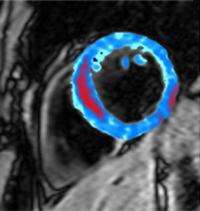
Images that for the first time show bleeding inside the heart after people have suffered a heart attack have been captured by scientists, in a new study published today in the journal Radiology.
The research shows that the amount of bleeding can indicate how damaged a person's heart is after a heart attack. The researchers, from the MRC Clinical Sciences Centre at Imperial College London, hope that this kind of imaging will be used alongside other tests to create a fuller picture of a patient's condition and their chances of recovery.
The research was funded by the Medical Research Council, the British Heart Foundation and the Department of Health, UK.
People suffer heart attacks when an artery that feeds blood to the heart becomes blocked, stopping the heart's blood supply and depriving the heart muscle of oxygen. Currently, most people treated for a heart attack are fitted with a metal tube called a stent to keep the blocked artery clear.
Recent research has shown that some people experience bleeding inside the heart muscle once blood starts to pump into it again. However, the significance of this bleeding is currently not understood.
For the new small study, the researchers captured images of bleeding inside the heart in 15 patients from Imperial College Healthcare NHS Trust who had recently suffered a heart attack, using Magnetic Resonance Imaging (MRI). Analysis of the MRI scans revealed that the amount of bleeding correlated with how much damage the heart muscle had sustained.
Patients who had suffered a large heart attack, where a lot of the heart muscle was damaged, had a lot of bleeding into the heart muscle compared with those whose heart attack was relatively small.
The researchers were able to detect the area of bleeding because of the magnetic effects of iron, which is present in the blood.
Dr Declan O'Regan, the first and corresponding author of the study from the MRC Clinical Sciences Centre at Imperial College London, said: "Our study gives us a new insight into the damage that heart attacks can cause. Using this new scanning technique shows us that patients who develop bleeding inside their damaged heart muscle have a much poorer chance of recovery. We hope that this will help us to identify which patients are at most risk of complications following their heart attack"
Dr Stuart Cook, the study's senior author from the MRC Clinical Sciences Centre at Imperial College London, added: "We still have a lot of unanswered questions about whether the bleeding itself may cause further damage to the heart muscle and this is an area that needs further research. The more we understand about what happens during and after a heart attack, the greater the chances are of scientists finding new ways to combat the damage that heart attacks cause."
Source: Imperial College London


