Satellites help locate water in Niger
January 19, 2009 Satellites help locate water in Niger

Enlarge

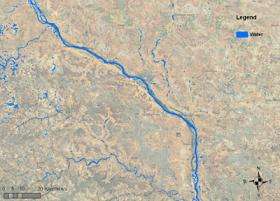
Water body map around the Niger River, near Niamey, Niger, in 2007. Credits: Advanced Computer Systems S.p.A.

(PhysOrg.com) -- Like most sub-Saharan African countries, Niger faces problems meeting its water needs. As part of ESA’s TIGER initiative, satellite data are being used to identify surface and underground water resources in the drought-prone country.

Due to the rainfall variability in time and in space, during recent years the rain-fed agriculture struggles to meet the requirements of food security in the Sahel area.

ESA’s WADE (Water resources Assessment using SAR in Desert and arid lands in West African Ecosystems) project, funded by the Data User Element (DUE), uses ERS and Envisat Synthetic Aperture Radar (SAR) imagery to map and monitor the location and extent of surface water bodies and to identify potential areas for water infiltration.

Having access to these maps will help local water authorities to better manage their water resources, lead livestock to water and improve their water storage capacity.

The Advanced Computer Systems (ACS spa) in Rome, Italy, developed the WADE processing system in conjunction with local users, represented by AGRHYMET (the Regional Centre of the Permanent Interstate Committee for Drought Control in the Sahel).

To demonstrate the technology, ERS and Envisat SAR data from 1993 to 2007 were integrated with in-situ data over an area of about 100 000 km² in the west part of Niger. Based on these data, a water body classification map was generated for each year. Results have been validated against 90 sampling points collected in the field by AGRHYMET during summer 2007 and showed an overall accuracy of 100% for permanent water bodies and above 75% for semi-permanent water bodies.

"Permanent and semi-permanent water body monitoring is an essential resource for rangeland activities and irrigated agriculture areas in the semi-arid zone," said Issifou Alfari, AGRHYMET’s Head of Water Resources Management and Desertification Division. "We are very happy with the project’s scope and outcome, as we believe this source of information will be fundamental for water management activities."

In November 2008, WADE software and data were installed in AGRHYMET’s facilities in Niamey, Niger’s capital city. Following extensive training sessions, AGRHYMET employees are now using the system to carry out their monitoring.

"The WADE system fits well into AGRHYMET general activities, particularly providing accurate water resource management information at regional and national levels," Alfari said.

ESA launched the TIGER initiative in 2002 to exploit Earth Observation (EO) technologies in order to respond to the urgent need for reliable water information in Africa.

WADE is one of five TIGER Innovator projects, which use the latest EO technology to develop innovative, low-cost solutions to support African water authorities in the conservation and monitoring of scarce water resources.

Provided by ESA


print this article email this article download pdf blog this article bookmark this article     Stumble it Digg this share on Facebook retweet share on Reddit add to delicious
Rate this story - 4.5 /5 (2 votes)


January 19, 2009 all stories

Comments: 0

4.5 /5 (2 votes)
  • Stumble this up

  • Digg this

  • share this

  • hide
  • Related Stories

  • Beer Here
    created Nov 25, 2009 | popularity not rated yet | comments 0
  • Asian carp may have breached barrier protecting Lake Michigan
    created Nov 24, 2009 | popularity not rated yet | comments 0
  • Dead Sea needs world help to stay alive
    created Nov 24, 2009 | popularity not rated yet | comments 0
  • Beyond sunlight: Explorers census 17,650 ocean species between edge of darkness and black abyss (w/ Video)
    created Nov 22, 2009 | popularity not rated yet | comments 0
  • China harnesses mountain wind power
    created Nov 22, 2009 | popularity not rated yet | comments 0


  • hide
  • Relevant PhysicsForums posts

  • The IPCC and the term "most"
    created Nov 23, 2009
  • Is global warming a fact?
    created Nov 23, 2009
  • Random variability of wind patterns
    created Nov 23, 2009
  • Record precipitation in the UK
    created Nov 22, 2009
  • More from Physics Forums - Earth

Other News

Space shuttle Atlantis aims for morning landing

Space & Earth / Space Exploration

created 58 minutes ago | popularity not rated yet | comments 0

(AP) -- Space shuttle Atlantis looks to be headed for an on-time landing.


In Greenland, warming fuels dream of hidden wealth (AP)

In Greenland, warming fuels dream of hidden wealth

Space & Earth / Environment

created 8 minutes ago | popularity not rated yet | comments 0

(AP) -- Gert Ignatiussen returns to this fjord-front Inuit town with the spoils of his hunting trip. Six seals, all killed with a single shot to the head.


New climate targets may not change daily life much (AP)

New climate targets may not change daily life much

Space & Earth / Environment

created 46 minutes ago | popularity not rated yet | comments 0

(AP) -- Americans' day-to-day lives won't change noticeably if President Barack Obama achieves his newly announced goal of slashing carbon dioxide pollution by one-sixth in the next decade, experts say.


Marine ecosystems get a climate form guide

Marine ecosystems get a climate form guide

Space & Earth / Environment

created 48 minutes ago | popularity not rated yet | comments 0

(PhysOrg.com) -- The first-ever Australian benchmark of climate change impacts on marine ecosystems and options for adaptation is being released in Brisbane today.


China is set to launch its second moon orbiter next October, state media have reported

China to launch second lunar probe: state media

Space & Earth / Space Exploration

created 1hour ago | popularity 5 / 5 (2) | comments 0

China will launch its second moon orbiter next October, state media reported Friday, as it powers ahead with a space programme that has sparked concerns abroad.