Chemists engineer plants to produce new compounds
January 19, 2009 Chemists engineer plants to produce new compounds

Enlarge

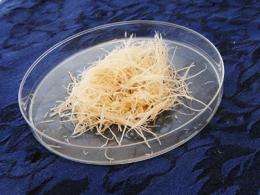
Tissue of a periwinkle plant Photo: Donna Coveney

(PhysOrg.com) -- In work that could expand the frontiers of genetic engineering, MIT chemists have, for the first time, genetically altered a plant to produce entirely new compounds, some of which could be used as drugs against cancer and other diseases.

The researchers, led by Sarah O'Connor of the Department of Chemistry, produced the new compounds by manipulating the complex biosynthetic pathways of the periwinkle plant. This sort of manipulation, which O'Connor and her graduate student, Weerawat Runguphan, report in the Jan. 18 issue of Nature Chemical Biology, offers a new way to tweak potential drugs to make them less toxic (and/or more effective).

Genetic engineering is not new: Scientists have known for years how to get plants to resist pests and herbicides or to produce substances such as insecticides by inserting genes from other plants or animals. What is new, however, is the ability to induce plants to create new products by tinkering with the plants' own synthetic pathways.

O'Connor's laboratory has studied periwinkle for several years because it produces a variety of alkaloid compounds of pharmacological interest, including vinblastine, a drug commonly used to treat cancers such as Hodgkin's lymphoma.

Periwinkle also produces serpentines, which have shown promise as anti-cancer agents, and ajmalicine, which is used to treat hypertension. Other plant-produced compounds have shown pharmacological activity but are too toxic for use in humans.

The current work builds on research O'Connor and grad student Elizabeth McCoy reported two years ago. They found that periwinkle cell cultures could produce novel compounds if fed starting materials slightly different from their normal substrates.

"That inspired us to think about metabolic engineering in a much more sophisticated way," said O'Connor, the Latham Family Career Development Associate Professor of Chemistry. "We can virtually re-engineer the pathway."

O'Connor and Runguphan focused on an enzyme involved in an early step of the alkaloid synthesis pathway. The enzyme normally accepts a terpenoid called secologanin and tryptamine, an alkaloid, as substrates.

Another graduate student, Peter Bernhardt, engineered a mutant form of the enzyme that can accept tryptamine with a halogen (such as chlorine or bromine) attached. Runguphan grew genetically engineered plant cell cultures that produce the mutant enzyme and got them to synthesize several compounds that periwinkle plants would normally never produce.

The halogens could serve as points of attachment to add other novel chemical groups to the compounds, modifying their effectiveness and/or toxicity as drugs, said O'Connor.

So far all of the genetic engineering has been done in plant cell cultures, but Runguphan has started growing a tiny whole periwinkle plant with the mutant enzyme.

In the future, the researchers plan to use the same approach to produce additional compounds, in hopes of creating new and more effective drug candidates.

The research was funded by the National Science Foundation, the National Institutes of Health and the American Cancer Society.

Provided by MIT


print this article email this article download pdf blog this article bookmark this article     Stumble it Digg this share on Facebook retweet share on Reddit add to delicious
Rate this story - 4.6 /5 (10 votes)

Rank Filter

Move the slider to adjust rank threshold, so that you can hide some of the comments.


Display comments: newest first

  • E_L_Earnhardt - Jan 19, 2009
    • Rank: not rated yet
    Danger, DANGER! We have almost learned what to touch and what to eat, (and not eat or touch!)

January 19, 2009 all stories

Comments: 1

4.6 /5 (10 votes)
  • Stumble this up

  • Digg this

  • share this

  • hide
  • Related Stories

  • Promising antimicrobial attacks virus, stimulates immune system
    created Jun 04, 2009 | popularity not rated yet | comments 0
  • Compounds have potential for diagnosis, treatment of Alzheimer's disease
    created Aug 21, 2008 | popularity not rated yet | comments 0
  • Olympic Games: Have we reached a plateau in terms of speed?
    created Jul 31, 2008 | popularity not rated yet | comments 0
  • Novel enzyme inhibitor paves way for new cancer drug
    created May 16, 2008 | popularity not rated yet | comments 0
  • Researchers genetically engineer micro-organisms into tiny factories
    created Sep 18, 2007 | popularity not rated yet | comments 0


Other News

Sandia CR5

Machine Converts CO2 into Gasoline, Diesel, and Jet Fuel

Chemistry / Biochemistry

created Nov 23, 2009 | popularity 4.6 / 5 (31) | comments 20

(PhysOrg.com) -- Researchers at Sandia National Laboratories have built a machine that uses the sun's energy to convert carbon dioxide waste from power plants into transportation fuels such as gasoline, diesel, ...


New hydrogen-storage method discovered

New hydrogen-storage method discovered

Chemistry / Materials Science

created Nov 22, 2009 | popularity 4.3 / 5 (42) | comments 15

Scientists at the Carnegie Institution have found for the first time that high pressure can be used to make a unique hydrogen-storage material. The discovery paves the way for an entirely new way to approach ...


New chemical reaction offers opportunities for drug development

Chemistry / Biochemistry

created Nov 26, 2009 | popularity not rated yet | comments 2

Researchers led by Conway Fellow, Professor Pat Guiry have solved a chemistry problem that has stumped researchers worldwide for more than a decade. The results have earned the group the cover story of the leading scientific ...


Research sheds light on workings of anti-cancer drug

Chemistry / Analytical Chemistry

created Nov 26, 2009 | popularity not rated yet | comments 0

(PhysOrg.com) -- The copper sequestering drug tetrathiomolybdate (TM) has been shown in studies to be effective in the treatment of Wilson disease, a disease caused by an overload of copper, and certain metastatic cancers. ...


Chemists get custom-designed microscopic particles to self-assemble in liquid crystal

Chemists get custom-designed microscopic particles to self-assemble in liquid crystal

Chemistry / Materials Science

created Nov 25, 2009 | popularity 5 / 5 (5) | comments 0

(PhysOrg.com) -- The scientists anticipate their "LithoParticles" will have significant applications in photonics, optical communications and other areas.