New Ice Age maps point to climate change patterns
January 19, 2009 New Ice Age maps point to climate change patterns

Enlarge

Image courtesy Dr Timothy Barrows/Elsevier

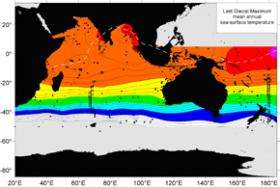
(PhysOrg.com) -- New climate maps of the Earth’s surface during the height of the last Ice Age support predictions that northern Australia will become wetter and southern Australia drier due to climate change.

An international consortium of scientists from 11 countries has produced the maps, which appear in this week’s issue of Nature Geoscience.

Dr Timothy Barrows of the Research School of Earth Sciences at The Australian National University was responsible for the Australian sector of the reconstruction.

“During the last Ice Age - around 20,000 years ago - sea surface temperature was as much as 10 degrees colder than present and icebergs would have been regular visitors to the southern coastline of Australia,” Dr Barrows said.

The temperature was estimated by measuring changes in abundance of tiny plankton fossils preserved on the sea floor, together with chemical analyses of the sediment itself.

“One of our major findings was that the continent’s mid latitudes (Canberra, Perth, Adelaide, Melbourne and Sydney) are very sensitive and experience the greatest climate change in and out of Ice Ages. This is where we should focus monitoring and look at past impacts of climate change.

“In contrast, the tropical areas (north of Brisbane) change very little, mostly less than 2 degrees.”

The global warming at the end of the last Ice Age was the greatest in recent geological history. Temperatures warmed by as much as 6-10 degrees across Australia.

‘We expect that the same pattern of change will hold for future global warming, with the temperate latitudes changing the most and the tropics changing the least,” Dr Barrows said. “It should be wetter in the tropics and drier in the south as climate belts shift.”

“Recently we have found that right at the end of the last Ice Age, temperatures were actually warmer than they are now in the southwest Pacific Ocean. We still do not know the reason for this.

“The study highlights how important researching past climate change is to understanding patterns of modern climate change. It’s crucial that Australia commit more resources so we can continue this vital work.”

Provided by Australian National University


print this article email this article download pdf blog this article bookmark this article     Stumble it Digg this share on Facebook retweet share on Reddit add to delicious
Rate this story - 3.7 /5 (9 votes)

Rank Filter

Move the slider to adjust rank threshold, so that you can hide some of the comments.


Display comments: newest first

  • MikeB - Jan 19, 2009
    • Rank: 4.5 / 5 (8)
    "It's crucial that Australia commit more resources so we can continue this vital work."

    Translation... Send more money... We need lots and lots of it.
  • jonnyboy - Jan 19, 2009
    • Rank: 4.1 / 5 (9)
    These guys are so smart that they are surprised that the middle of the continent changes temperature more than the coasts?

    What school did they graduate from again?

    Sesame Street?
  • dachpyarvile - Jan 20, 2009
    • Rank: 4.5 / 5 (8)
    This is my favorite part:

    "Recently we have found that right at the end of the last Ice Age, temperatures were actually warmer than they are now in the southwest Pacific Ocean. We still do not know the reason for this."

    There were no manmade emissions then. It was warmer then than now. Therefore, IPCC's AGW theory is a crock full of crap!

January 19, 2009 all stories

Comments: 3

3.7 /5 (9 votes)
  • Stumble this up

  • Digg this

  • share this

  • hide
  • Related Stories

  • Life's Ancient Island in the Ice
    created Oct 29, 2009 | popularity not rated yet | comments 0
  • Arctic sea ice recovers slightly in 2009, remains on downward trend (w/ Video)
    created Oct 06, 2009 | popularity not rated yet | comments 0
  • In tiny 'Tuk,' they man climate's front line
    created Sep 07, 2009 | popularity not rated yet | comments 0
  • New discovery suggests mammoths survived in Britain until 14,000 years ago
    created Jun 18, 2009 | popularity not rated yet | comments 0
  • When palm trees gave way to spruce trees
    created Jun 17, 2009 | popularity not rated yet | comments 0


  • hide
  • Relevant PhysicsForums posts

  • cycles
    created 17 hours ago
  • The Origin of the term 'fossil' fuels
    created Nov 05, 2009
  • co2
    created Nov 03, 2009
  • Early Earths Sulfidic Ocean Conditions
    created Oct 30, 2009
  • More from Physics Forums - Earth

Other News

Deep creep means milder, more frequent earthquakes along Southern California's San Jacinto fault

Deep creep means milder, more frequent earthquakes along Southern California's San Jacinto fault

Space & Earth / Earth Sciences

created 16 hours ago | popularity 4.5 / 5 (4) | comments 0

With an average of four mini-earthquakes per day, Southern California's San Jacinto fault constantly adjusts to make it a less likely candidate for a major earthquake than its quiet neighbor to the east, the ...


Success in 'space elevator' competition (AP)

Success in 'space elevator' competition (Update 3)

Space & Earth / Space Exploration

created Nov 05, 2009 | popularity 4.3 / 5 (33) | comments 50

(AP) -- A robot powered by a ground-based laser beam climbed a long cable dangling from a helicopter on Wednesday to qualify for prize money in a $2 million competition to test the potential reality of the ...


In a Galaxy Far, Far Away...

In a Galaxy Far, Far Away...

Space & Earth / Astronomy

created Nov 06, 2009 | popularity 4.8 / 5 (5) | comments 17

(PhysOrg.com) -- Astronomers have published the discovery of the farthest known object in the cosmos: a star that exploded when the universe was only 630 million years old -- only 4.6% of its current age. ...


'Dropouts' pinpoint earliest galaxies

'Dropouts' pinpoint earliest galaxies

Space & Earth / Astronomy

created Nov 06, 2009 | popularity 4.2 / 5 (10) | comments 13

Astronomers, conducting the broadest survey to date of galaxies from about 800 million years after the Big Bang, have found 22 early galaxies and confirmed the age of one by its characteristic hydrogen signature ...


Space hotel taking bookings for 2012 opening

Space hotel taking bookings for 2012 opening

Space & Earth / Space Exploration

created Nov 05, 2009 | popularity 4.4 / 5 (21) | comments 11

(PhysOrg.com) -- The first orbiting space hotel is on track to open for its first customers in 2012, but hurry, as bookings are filling fast.