Microbot motors fit to swim human arteries (Video)
January 20, 2009
Microbot
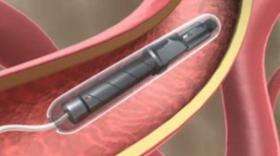
(PhysOrg.com) -- A range of complex surgical operations necessary to treat stroke victims, confront hardened arteries or address blockages in the bloodstream are about to be made safer as researchers from the Micro/Nanophysics Research Laboratory at Australia's Monash University put the final touches to the design of micro-motors small enough to be injected into the human bloodstream.
A research paper, published today, Tuesday, 20 January, in IOP Publishing's Journal of Micromechanics and Microengineering details how researchers are harnessing piezoelectricity, the energy force most commonly used to trigger-start a gas stove, to produce microbot motors just 250 micrometres, a quarter of a millimetre, wide.
Methods of minimally invasive surgery, such as keyhole surgery and a range of operations that utilise catheters, tubes inserted into body cavities to allow surgical manoeuvrability, are preferred by surgeons and patients because of the damage avoided when contrasted against cut and sew operations. Serious damage during minimally invasive surgery is however not always avoidable and surgeons are often limited by, for example, the width of a catheter tube which, in serious cases, can fatally puncture narrow arteries.
This video is not supported by your browser at this time.
Remote controlled miniature robots small enough to swim up arteries could save lives by reaching parts of the body, like a stroke-damaged cranial artery, that catheters have previously been unable to reach (because of the labyrinthine structure of the brain that catheters are too immobile to safely reach). With the right sensor equipment attached to the microbot motor, the surgeon's view of, for example, a patient's troubled artery can be enhanced and the ability to work remotely also increases the surgeon's dexterity.
As Professor James Friend, leader of the research team at Monash University, explained, motors have lagged behind in the age of technological miniaturisation and provide the key to making robots small enough for injection into the bloodstream. "If you pick up an electronics catalogue, you'll find all sorts of sensors, LEDs, memory chips, etc that represent the latest in technology and miniaturisation. Take a look however at the motors and there are few changes from the motors available in the 1950s."
Professor Friend and his team began their research over two years ago in the belief that piezoelectricity was the most suitable energy force for micro-motors because the engines can be scaled down while remaining forceful enough, even at the sizes necessary to enter the bloodstream, for motors to swim against the blood's current and reach spots difficult to operate upon.
Piezoelectricity is most commonly found in quartz watches and gas stoves. It is based on the ability of some materials to generate electric potential in response to mechanical stress. In the case of a gas stove, the ignition switch on a stove triggers a spring to release a ball that smashes against a piece of piezoelectric material, often kinds of crystal, which translates the force of the ball into more than 10,000 volts of electricity which then travels down wires, reaches the gas, and starts the stove fire.
As Professor Friend explains, "Opportunities for micro-motors abound in fields as diverse as biomedicine, electronics, aeronautics and the automotive industry. Responses to this need have been just as diverse, with designs developed using electromagnetic, electrostatic, thermal and osmotic driving forces. Piezoelectric designs however have favourable scaling characteristics and, in general, are simple designs, which have provided an excellent platform for the development of micro-motors."
The team has produced prototypes of the motors and is now working on ways to improve the assembly method and the mechanical device which moves and controls the micro-motors.
Paper: "Piezoelectric ultrasonic resonant motor with stator diameter less than 250 µm: the Proteus motor", B Watson et al 2009 J. Micromech. Microeng. 19 022001
http://stacks.iop. … MM/19/022001
Provided by Institute of Physics
-
Medical robotics to improve heart surgery
Dec 16, 2010 |
5 / 5 (2) |
0
-
Avatars in Space
Mar 17, 2010 |
4 / 5 (5) |
2
-
The next medical frontier: nano-surgery
Dec 21, 2009 |
5 / 5 (6) |
3
-
Ship noise boosts stress in whales, 9/11 reveals: study
Feb 08, 2012 |
not rated yet |
1
-
Facebook valuation will be high, but justified, expert says
19 hours ago |
1 / 5 (1) |
0
-
Engineers build first sub-10-nm carbon nanotube transistor
Feb 01, 2012 |
4.9 / 5 (31) |
30
-
Something old, something new: Evolution and the structural divergence of duplicate genes
Jan 31, 2012 |
4.6 / 5 (7) |
1
-
The hidden nanoworld of ice crystals: Revealing the dynamic behavior of quasi-liquid layers
Jan 30, 2012 |
5 / 5 (3) |
1
-
Stock market network reveals investor clustering
Jan 27, 2012 |
3.9 / 5 (23) |
8
-
Of microchemistry and molecules: Electronic microfluidic device synthesizes biocompatible probes
Jan 26, 2012 |
5 / 5 (1) |
0
-
Calling function with no input argument
7 hours ago
-
Force free body diagram problem on gym equipment
8 hours ago
-
Empirical data regarding shower heads and water
16 hours ago
-
feed hold button on CNC lathe
Feb 09, 2012
-
RFAC in Fortran
Feb 09, 2012
-
dynamics 2/32
Feb 08, 2012
- More from Physics Forums - General Engineering
More news stories
Google users warned of threat to smartphone wallets
Users of Google smartphone wallets were being warned on Friday that there is a way to crack pass codes intended to thwart thieves from going on illicit shopping sprees.
41 minutes ago |
not rated yet |
0
CIA website offline, Anonymous takes credit
The website of the Central Intelligence Agency was unresponsive on Friday after the hacker group Anonymous claimed to have knocked it offline.
2 hours ago |
5 / 5 (3) |
8
New error-correcting codes guarantee the fastest possible rate of data transmission
Error-correcting codes are one of the triumphs of the digital age. Theyre a way of encoding information so that it can be transmitted across a communication channel such as an optical fiber o ...
Technology / Computer Sciences
10 hours ago |
5 / 5 (4) |
5
|
New power source discovered
(PhysOrg.com) -- Researchers at the Massachusetts Institute of Technology (MIT) and RMIT University have made a breakthrough in energy storage and power generation.
Technology / Energy & Green Tech
9 hours ago |
4.8 / 5 (16) |
3
|
Small modular reactor design could be a 'SUPERSTAR'
(PhysOrg.com) -- Though most of today's nuclear reactors are cooled by water, we've long known that there are alternatives; in fact, the world's first nuclear-powered electricity in 1951 came from a reactor ...
Technology / Energy & Green Tech
10 hours ago |
4.2 / 5 (10) |
19
|
NASA sees wide-eyed cyclone Jasmine
Cyclone Jasmine's eye has opened wider on NASA satellite imagery, as it moves through the Southern Pacific Ocean.
NASA sees Giovanna reach cyclone strength, threaten Madagascar
Tropical Storm 12S built up steam and became a cyclone on February 10, 2012 as NASA's Terra satellite passed overhead. Residents of east-central Madagascar should prepare for this cyclone to make landfall ...
Complex wiring of the nervous system may rely on a just a handful of genes and proteins
Researchers at the Salk Institute have discovered a startling feature of early brain development that helps to explain how complex neuron wiring patterns are programmed using just a handful of critical genes. ...
Putting the squeeze on planets outside our solar system
(PhysOrg.com) -- Using high-powered lasers, scientists at Lawrence Livermore National Laboratory and collaborators discovered that molten magnesium silicate undergoes a phase change in the liquid state, abruptly ...
The power of estrogen -- male snakes attract other males
A new study has shown that boosting the estrogen levels of male garter snakes causes them to secrete the same pheromones that females use to attract suitors, and turned the males into just about the sexiest ...
Grass to gas: Researchers' genome map speeds biofuel development
Researchers at the University of Georgia have taken a major step in the ongoing effort to find sources of cleaner, renewable energy by mapping the genomes of two originator cells of Miscanthus x giganteus, a large perenn ...