Control Your Hunger? Study Shows Men Can, Women Can't
January 20, 2009
Control Your Hunger? Study Shows Men Can, Women Can't

Enlarge

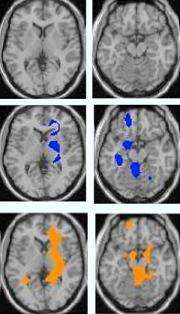
Each brain image shows the change in brain metabolism when subjects were asked to inhibit their response to food during food stimulation compared with when they were not told to inhibit their response. Two brain sections at different levels of the brain are shown for each group (women, men, and women vs. men). Top row, women: No color indicates that women had no significant differences in brain activity between the two conditions. Middle row, men: Blue colored areas were significantly less active when men were told to inhibit their response to food than they were without inhibition. Third row, women vs. men: Orange color indicates areas where men showed greater decrements with inhibition than women. These brain regions are involved in emotional regulation, conditioning, and the motivation to eat.

(PhysOrg.com) -- A ground-breaking brain-imaging study at the U.S. Department of Energy’s Brookhaven National Laboratory shows that men, but not women, are able to control their brain’s response to their own favorite foods. The study, which will be published online by the Proceedings of the National Academy of Sciences the week of January 19, 2009, may help explain why rates of obesity and eating disorders are higher among women than men, and why women typically have more difficulty losing weight.

“Our findings may help us understand the neurobiological mechanisms underlying the ability to control food intake, and suggest new pharmacological methods or other interventions to help people regulate eating behavior and maintain a healthy weight,” said Gene-Jack Wang, lead author on the study. “The surprising finding of a difference between genders in the ability to inhibit the brain’s response to food and hunger will certainly merit further study.”

The scientists used positron emission tomography (PET) scanning to monitor brain activity in 13 female and 10 male volunteers. In this method, a form of glucose “tagged” with a radioactive tracer molecule is injected into the blood stream while subjects lie in the PET scanner. The scanner tracks the tracer’s signal to monitor the uptake and use of the glucose by various regions of the brain. All study subjects were of normal body weight and had fasted for nearly 20 hours before each of three separate scans, performed in random order.

On one scan day, subjects were presented with their favorite foods — from bacon-egg-and-cheese sandwiches to pizza, cinnamon buns, barbecue ribs, and chocolate cake — warmed, if appropriate, to enhance the enticing aromas and taste. During the scan, subjects were asked to smell, taste, observe, and react to the food, but not eat it. On another day, they were instructed to inhibit their desire for food prior to being tempted with the same foods. A control scan with no food was performed on another day.

The volunteers were also asked to rate the foods and describe their feelings of hunger and their desire to eat during the scans when food was presented.

In both men and women, a variety of brain areas associated with emotional regulation, conditioning, and motivation “lit up,” indicating increased metabolic activity in those regions, in response to the tempting foods when compared with the no-food scans — a finding consistent with earlier work using the same setup at Brookhaven Lab. When asked to inhibit their response to food, both men and women described themselves as less hungry and less interested in eating than when they weren’t trying to inhibit their response. But only the men showed a relative decrease in activity in the food-activated brain regions during the scan when they were asked to inhibit their response.

“Even though the women said they were less hungry when trying to inhibit their response to the food, their brains were still firing away in the regions that control the drive to eat,” Wang said. “In contrast, men’s brain activity decreased along with their self-reports of hunger during the scan when they were asked to keep their hunger in check.”

The researchers believe this is the first study to document such a gender-specific disconnect between subjective reports of an emotional or motivational state and the associated pattern of brain activity.

“This may indicate a difference between the genders in the ability to perceive and respond to internal body signals,” Wang said.

“The finding of a lack of response to inhibition in women is consistent with behavioral studies showing that women have a higher tendency than men to overeat when presented with palatable food or under emotional distress,” Wang said. “This decreased inhibitory control in women could be a major factor contributing to the observed differences in the prevalence rates of obesity and eating disorders such as binge eating between the genders, and may also underlie women’s lower success in losing weight while dieting when compared with men.”

Differences in sex hormones, such as estrogen, may underlie these gender differences and merit further exploration. Sex hormones are known to directly influence food intake, body weight, and fat distribution, as well as the signaling of other molecules involved in regulating eating behavior, the researchers said. This study did not control for variations in the menstrual cycle of the female research subjects.

“A woman’s menstrual cycle can be an important factor in responsiveness to reward and in successful quit attempts for smoking,” said National Institute on Drug Abuse (NIDA) Director Nora Volkow, who was a collaborator on this study. “Its role in inhibiting food-related brain activation will be important to address in future studies.”

This study was funded by the National Institute on Drug Abuse, the National Institute on Alcohol Abuse and Alcoholism, and by the General Clinical Research Center of Stony Brook University.

Provided by Brookhaven National Laboratory

4.1 /5 (8 votes)  

Filter


Move the slider to adjust rank threshold, so that you can hide some of the comments.


Display comments: newest first

makotech222
Jan 20, 2009

Rank: 1 / 5 (2)
I HATE these kinds of studies, they show absolutely nothing. show me the CHEMICALS that make this true and ill believe you, dont just survey a bunch of noobs.
MGraser
Jan 20, 2009

Rank: not rated yet
Um, I guess you want to watch the readouts on their computer before you believe it? Oh wait, look at the pictures at the beginning of the article...

"Even though the women said they were less hungry when trying to inhibit their response to the food, their brains were still firing away in the regions that control the drive to eat," Wang said. "In contrast, men's brain activity decreased along with their self-reports of hunger during the scan when they were asked to keep their hunger in check."

Sounds like a good study to me.
makotech222
Jan 20, 2009

Rank: not rated yet
thats actually a bad quote their using the subject's opinion. some people rate a broken leg at pain level 10, whiles others at 4
moj85
Jan 21, 2009

Rank: not rated yet
Isn't that the point? That men can rate their hunger lower than women? I mean, the study isn't able to draw huge conclusions other than that
thales
Jan 21, 2009

Rank: not rated yet
These brain regions are involved in emotional regulation, conditioning, and the motivation to eat.

Interesting, because I've observed -- without a study, now, or brain scans -- that men seem to be less emotional on average than women.
Rank 4.1 /5 (8 votes)
Related Stories
Relevant PhysicsForums posts
  • Is Everyday Technology Killing Us?
    createdFeb 08, 2012
  • Exercise and weight loss
    createdFeb 08, 2012
  • Why do we have head aches? Our brains can't feel anything.
    createdFeb 07, 2012
  • "The end of diseases" by David Agus, interview from Daily Show with Jon Stewart
    createdFeb 04, 2012
  • Oncolytic adenovirus
    createdFeb 04, 2012
  • Nutrition label stuffs and diets
    createdFeb 02, 2012
  • More from Physics Forums - Medical Sciences

More news stories

Overeating may double risk of memory loss

New research suggests that consuming between 2,100 and 6,000 calories per day may double the risk of memory loss, or mild cognitive impairment (MCI), among people age 70 and older. The study was released today and will be ...

Medicine & Health / Neuroscience

created 4 hours ago | popularity 5 / 5 (2) | comments 0 | with audio podcast

Starve a virus, feed a cure? Findings show how some cells protect themselves against HIV

A protein that protects some of our immune cells from the most common and virulent form of HIV works by starving the virus of the molecular building blocks that it needs to replicate, according to research published online ...

Medicine & Health / Research

created 7 hours ago | popularity 5 / 5 (1) | comments 0 | with audio podcast

Declining health-care productivity in England: Who says so?

Reports that the National Health Service in England has been declining in productivity in the last decade appear to have been accepted as fact. However, a Viewpoint published Online First by The Lancet disputes this. The Vi ...

Medicine & Health / Health

created 2 hours ago | popularity not rated yet | comments 0

Injured boomers beware: Know when to see doctor

(AP) -- It happened to nurse Jane Byron years after an in-line skating fall, business owner Haralee Weintraub while doing "men's" push-ups, and avid cyclist Gene Wilberg while lifting a heavy box.

Medicine & Health / Health

created 9 hours ago | popularity 5 / 5 (1) | comments 0

FDA-approved drug rapidly clears amyloid from the brain, reverses Alzheimer's symptoms in mice

Neuroscientists at Case Western Reserve University School of Medicine have made a dramatic breakthrough in their efforts to find a cure for Alzheimer's disease. The researchers' findings, published in the journal Science, show t ...

Medicine & Health / Neuroscience

created Feb 09, 2012 | popularity 4.9 / 5 (58) | comments 17 | with audio podcast


Scientists discover molecular secrets of 2,000-year-old Chinese herbal remedy

For roughly two thousand years, Chinese herbalists have treated Malaria using a root extract, commonly known as Chang Shan, from a type of hydrangea that grows in Tibet and Nepal. More recent studies suggest that halofuginone, ...

New method to examine batteries -- MRI from the inside

There is an ever-increasing need for advanced batteries for portable electronics, such as phones, cameras, and music players, but also to power electric vehicles and to facilitate the distribution and storage of energy derived ...

A mitosis mystery solved: How chromosomes align perfectly in a dividing cell

Although the process of mitotic cell division has been studied intensely for more than 50 years, Whitehead Institute researchers have only now solved the mystery of how cells correctly align their chromosomes during symmetric ...

Google might launch Drive for cloud storage soon

(PhysOrg.com) -- Google's next big move, according to the Wall Street Journal, is a cloud storage service called Drive. Hardly first to the plate, Google is simply catching up to introducing its cloud reposi ...

Lab study raises questions over nano-particle impact

Tests involving chickens have raised questions about the impact on health from engineered nano-particles, the ultra-fine grains commonly used in drugs and processed foods, scientists said on Sunday.

Researchers find extensive RNA editing in human transcriptome

In a new study published online in Nature Biotechnology, researchers from BGI, the world's largest genomics organization, reported the evidence of extensive RNA editing in a human cell line by analysis of RNA-seq data, demons ...