New clot-buster found
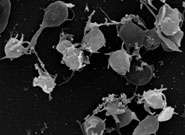
(PhysOrg.com) -- Exciting research into blood clotting by British Heart Foundation (BHF) researchers working at the University of Bristol will take us a step closer to better heart attack prevention and treatment.
Blood clots can be both life-saving and life-threatening; life-saving when they stop bleeding, but life-threatening when they form in diseased arteries feeding the heart. Here they can cause a heart attack, and do so in 146,000 people in the UK every year.
Current anti-clotting medicines, such as aspirin, reduce the risk of heart attack but in some people they can also cause excessive and dangerous bleeding.
Professor Alastair Poole and his BHF-funded team in the Department of Physiology & Pharmacology at the University of Bristol have found in mice that removal of a particular protein - PKCα - from specialist cells in the blood, called platelets, prevents dangerous clot formation but does not cause excessive bleeding.
Professor Poole explains: “Platelets are small cells in the blood that sense when a blood vessel has been damaged. They rapidly become very adhesive and form a protective plaster over the site of damage.”
In heart disease, fatty plaques build up in the walls of the arteries feeding the heart. If one of these ruptures the platelets clump together at the site of damage and can block the vessel, which can cause a heart attack.
Alastair Poole continues: “We’ve discovered that a protein called PKCα is a major controller of platelet stickiness - if you remove PKCα the dangerous blood clots don’t form. Equally important, and surprising, is that we’ve also found that absence of PKCα doesn’t seem to impair the normal control of bleeding, unlike some current anti-clotting medicines.
“It’s too early to put anti- PKCα drugs on the market but we’re excited to have made a step in the right direction towards the development of a new family of potentially useful anti-clotting medicines for heart patients.”
Professor Jeremy Pearson, Associate Medical Director at the BHF, said: "We do have some effective clot-busting and clot-preventing medicines at present, but they can be rather blunt instruments with serious side-effects such as increased bleeding.
“Platelets are a major component of the clotting processes that cause heart attacks and strokes, and many scientists around the world are trying to decipher their inner workings, interactions, and controls toward the development of better, safer, drugs for heart patients.
"BHF supporters in Bristol have helped us to sponsor these excellent scientists to carry out vital research into platelets. These findings are another step forward in the fight against heart disease."
The research is published in The Journal of Clinical Investigation.
The paper: PKCα regulates platelet granule secretion and thrombus formation in mice by Olga Konopatskaya, Karen Gilio, Matthew T. Harper, Yan Zhao, Judith M.E.M. Cosemans, Zubair A. Karim, Sidney W. Whiteheart, Jeffery D. Molkentin, Paul Verkade, Steve P. Watson, Johan W.M. Heemskerk and Alastair W. Poole. The Journal of Clinical Investigation, (2009) vol 2, doi:10.1172/JCI34665. www.jci.org/articles/view/34665
Provided by University of Bristol


