The Ultimate Home Cinematic 21:9 Viewing Experience
January 20, 2009 by John Messina
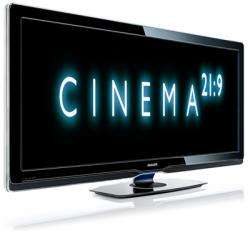
Cinema 21:9 by Philips
(PhysOrg.com) -- Imagine yourself, watching true Cinema 21:9 LCD TV in the privacy of your own home! Philips is the first to come out with Cinema 21:9, as other manufactures are sure to follow in their footsteps. But Philips has taken their Cinema 21:9 one step further with Complimentary three-sided Ambilight Spectra that accurately matches on-screen content to extend the picture beyond the confines of the screen.
As we all know watching a movie in the Cinema is a completely different experience than watching the same movie on a 52" wide screen home TV. The Cinema 21:9 stretches our peripheral vision to totally immerse us in the viewing experience on the screen.
You need Flash installed to watch this ideo
Video: A comparison demo between 16:9 and Cinema 21:9 viewing.
A Cinematic viewing experience is very difficult to replicate on a large 16:9 screen without moving to a letterbox view. And you will still be losing the Cinema experience of the director's original film shot. Philips now opens a whole new era of Cinema movie watching that will have other manufactures competing in the Cinema 21:9 market.
Now regular 16:9 content from TV broadcast and game consoles has been adapted to fill the 21:9 screen. This has been accomplished by using highly advanced formatting technology adapted by Philips.
To see a comparison between 16:9 and Cinema 21:9 viewing experience, watch the short demo video (above). This video will demonstrate how movie content is viewed between both aspect ratios.
© 2009 PhysOrg.com


u get the box efffect
fail
They are therefore saying 16:9 ratio TVs are rubbish and are providing formatting correction to convert 16:9 content to 21:9.
Why can't I argue that 21:9 is crap and I can provide 'highly advanced formatting technology' to convert 21:9 on 16:9?
Highly advanced or not you can't use that as a selling point if the inverse procedure unjustifies the product itself. Follow me?
The only sensible justification for letter-box formats is that it's easier to make a cinema wider rather than taller and most interesting stuff tends to happen along the horisontal axis, therefor if your resources are limited you should concentrate on letterbox aspect ratios first and go to IMAX or something when it comes down in price.
I'll wait.
Sorry, you're confusing me with someone else.
Long live wide screens! :)
In fact all BD movies that I've seen to use this super-wide format are stored with the standard 1920 pixel width and with a reduced height, which shows the second view to be more valid. And it pisses me off, because it is still marketed as "1080p" despite it obviously having less than 1080 pixels height.
Also, if there is any price premium for TVs in this new format, then it is likely you can buy a standard widescreen TV with at least the same width but larger height, and thus larger diagonal, for the same money. If that really turns out to be the case, this format is doomed to failure.
I am very curious about what they do to 16x9 picture to display it on this screen though... I just can't imagine it, no matter if they call it "highly advanced formatting" or whatever, it can only be three things: stretching the image, cutting the image or adding black bars. Can't be good in either case.
Oh, and what in the world would they do to 4:3 images? Imagine that stretched... They can nearly fit two such images side by side... It's a shame, really, that they didn't take this format just a bit further, to 24:9 aspect. That would've been an interesting bonus with some dual-tuner TVs. Though I still would prefer two "normal" TVs :p