Semiconducting Nanotubes Are 'Holy Grail' for Electronic Applications
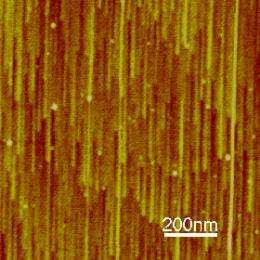
(PhysOrg.com) -- After announcing last April a method for growing exceptionally long, straight, numerous and well-aligned carbon cylinders only a few atoms thick, a Duke University-led team of chemists has now modified that process to create exclusively semiconducting versions of these single-walled carbon nanotubes.
The achievement paves the way for manufacturing reliable electronic nanocircuits at the ultra-small billionths of a meter scale, said Jie Liu, Duke's Jerry G. and Patricia Crawford Hubbard Professor of Chemistry, who headed the effort.
"I think it's the holy grail for the field," Liu said. "Every piece is now there, including the control of location, orientation and electronic properties all together. We are positioned to make large numbers of electronic devices such as high-current field-effect transistors and sensors."
A report on their achievement, co-authored by Liu and a team of collaborators from his Duke laboratory and Peking University in China, was published Jan 20, 2009 in the research journal Nano Letters. Their work was funded by the United States Naval Research Laboratory, the National Science Foundation of China, carbon nanotube manufacturer Unidym Inc., Duke University and the Ministry of Science and Technology of the People's Republic of China.
Liu has filed for a patent on the method. A post doctoral researcher in his laboratory, Lei Ding, was first author of the new report as well as the previous study published April 16, 2008, in the Journal of the American Chemical Society (JACS).
That earlier JACS report described how the researchers coaxed forests of nanotubes to form in long, parallel paths that will not cross each other to impede potential electronic performance. Their method grows the nanotubes on a template made of a continuous and unbroken kind of single quartz crystal used in electronic applications. Copper is also used as a growth promoter.
Carbon nanotubes are sometimes called "buckytubes" because their ends, when closed, take the form of soccer ball-shaped carbon-60 molecules known as buckminsterfullerines, or "buckyballs." The late Richard Smalley, who headed the Rice University laboratory where Liu was based before coming to Duke, shared a Nobel Prize for synthesizing buckyballs.
In addition to being especially tiny, those nanotubes offer other advantages -- including reduced heat output and higher frequency operation -- over current materials used to make miniaturized electronic components such as transistors, said Liu. "Operating at higher frequencies means they would be much better devices for wireless communications," he added.
But the April 2008 JACS report left one unresolved issue blocking use of such numerous, straight and well-aligned nanotubes as electronic components. Only some of the resulting nanotubes acted electronically as semiconductors. Others were the electronic equivalent of metals. To work in transistors, the nanotubes must all be semiconducting, Liu said.
In their new Nano Letters report, the researchers announced success at achieving virtually all-semiconductor growth conditions by making one modification. In their earlier work they had used the alcohol ethanol in the feeder gas to provide carbon atoms as building blocks for the growing nanotubes. In the new work they tried various ratios of two alcohols -- ethanol and methanol -- combined with two other gases they also used previously -- argon and hydrogen.
"We found that by using the right combination of the two alcohols with the argon and hydrogen we could grow exclusively semiconducting nanotubes," Liu said. "It was like operating a tuning knob." Chemically inert argon gas was used to provide a steady feed of the ethanol and methanol, with hydrogen to keep the copper catalyst from oxidizing.
After making the nanotubes by the chemical vapor deposition method in a small furnace set to a temperature of 900 degrees Celsius, the researchers assembled some of them into field-effect transistors to test their electronic properties.
"We have estimated from these measurements that the samples consisted of 95 to 98 percent semiconducting nanotubes," the researchers reported.
As a double-check, the scientists also subjected some nanotubes to Raman spectroscopy, an analytical technique that can differentiate semiconducting and metallic properties by studying how materials interact with various types of lasers.
According to the new Nano Letters report, the introduction of methanol to complement ethanol also shrunk the diameters of the resulting nanotubes and improved their atomic alignments with the underlying quartz crystal.
The resulting nanotubes can only be seen with exceptionally high magnification devices like scanning electron and atomic force microscopes. Whether the hollow carbon cylinders are metallic or semiconducting is a matter of their three dimensional alignments in space -- a trait scientists call "chirality."
The group's next challenge will be to understand at an atomic level how "just so" tuning of growth gas mixtures resulted in the right chirality to produce exclusively semiconducting nanotubes. The researchers are also wondering whether another combination might produce all-metallic nanotubes.
"We want to be able to control that chirality," he said.
Other authors of the Nano Letters report include Alexander Tselev, Dongning Yuan and Thomas McNicholas at Duke, and Yan Li, Jinyong Wang and Haibin Chu at Peking University.
Source: Duke University


