Termite insecticide a potent greenhouse gas
January 21, 2009 Termite insecticide a potent greenhouse gas

Enlarge

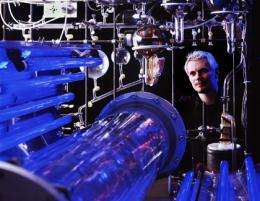
Mads Sulbaek Andersen with Pyrex chamber

(PhysOrg.com) -- An insecticide used to fumigate termite-infested buildings is a strong greenhouse gas that lives in the atmosphere nearly 10 times longer than previously thought, UC Irvine research has found.

Sulfuryl fluoride, UCI chemists discovered, stays in the atmosphere at least 30-40 years and perhaps as long as 100 years. Prior studies estimated its atmospheric lifetime at as low as five years, grossly underestimating the global warming potential.

The fact that sulfuryl fluoride exists for decades - coupled with evidence that levels have nearly doubled in the last six years - concerns study authors Mads Sulbaek Andersen, Donald Blake and Nobel Laureate F. Sherwood Rowland, who discovered that chlorofluorocarbons in aerosol cans and other products damage the ozone layer. That finding led to a worldwide ban on CFCs.

"Sulfuryl fluoride has a long enough lifetime in the atmosphere that we cannot just close our eyes," said Sulbaek Andersen, a postdoctoral researcher in the Rowland-Blake laboratory and lead author of the study. "The level in the atmosphere is rising fast, and it doesn't seem to disappear very quickly."

This study will appear online Jan. 21 in the journal Environmental Science and Technology.

Kilogram for kilogram, sulfuryl fluoride is about 4,000 times more efficient than carbon dioxide at trapping heat, though much less of it exists in the atmosphere.

Its climate impact in California each year equals that of carbon dioxide emitted from about 1 million vehicles. About 60 percent of the world's sulfuryl fluoride use occurs in California.

Sulfuryl fluoride blocks a wavelength of heat that otherwise could easily escape the Earth, the scientists said. Carbon dioxide blocks a different wavelength, trapping heat near the surface.

"The only place where the planet is able to emit heat that escapes the atmosphere is in the region that sulfuryl fluoride blocks," said Blake, chemistry professor. "If we put something with this blocking effect in that area, then we're in trouble - and we are putting something in there."

The chemists worry that emissions will increase as new uses are found for sulfuryl fluoride - especially given the ban of methyl bromide, an ozone-depleting pesticide regulated under the Montreal Protocol. Sulfuryl fluoride emissions are not regulated, though officials do consider it a toxic contaminant.

The insecticide is pumped into a tent that covers a termite-infested structure. When the tent is removed, the compound escapes into the atmosphere. Sulbaek Andersen, Blake and Rowland believe a suitable replacement should be found, one with less global warming potential.

To measure sulfuryl fluoride's atmospheric lifetime, the chemists put it inside a Pyrex chamber with compounds that are well understood in the atmosphere, such as ethane. They shined lamps on the chamber to simulate sunlight, which caused chemical reactions that eliminated the compounds from the air.

By monitoring sulfuryl fluoride changes compared with changes to the well-known compounds, they were able to estimate its atmospheric lifetime.

"This is a cautionary paper," said Rowland, Donald Bren Research Professor of Chemistry and Earth System Science. "It tells us that we need to be thinking globally - and acting locally."

Source: University of California - Irvine


print this article email this article download pdf blog this article bookmark this article     Stumble it Digg this share on Facebook retweet share on Reddit add to delicious
Rate this story - 2.4 /5 (5 votes)

Rank Filter

Move the slider to adjust rank threshold, so that you can hide some of the comments.


Display comments: newest first

  • Velanarris - Jan 21, 2009
    • Rank: 4.5 / 5 (4)
    I wonder if the author of this article realizes that termites are responsible for more methane in the atmosphere than cows.

    http://www.epa.go...ces.html
  • Arkaleus - Jan 21, 2009
    • Rank: 5 / 5 (3)
    The estimated Carbon Indulgency Tax needed to offset this new threat to our Global Climate Security is calucluated to be US$1.40 per person per annum.

    You may remit this payment to:
    Department of Global Security
    c/o Albert Gore
    1 UN plaza
    New York, NY 10028

    We require all mail to be delivered by burro, alpaca, rickshaw, or other zero emission converyance.
  • Soylent - Jan 21, 2009
    • Rank: 1 / 5 (3)
    I wonder if the author of this article realizes that termites are responsible for more methane in the atmosphere than cows.

    http://www.epa.go...ces.html


    You're confusing the US with the entire world. A common mistake unfortunately, but wrong.

    When you compare world cattle methane emissions against termites they're a factor ~4-6 larger. (But cattle emissions should be a whole lot easier to fix since the methanogens steal energy from the cattle when they produce methane and farmers aren't too happy about that either; if you can make cheap enough vaccines against these bacteria it's a win-win)
  • barakn - Jan 21, 2009
    • Rank: 2.4 / 5 (5)
    I wonder if Velanarris realizes how few termites there are threatening structures in California vs. the world population of termites.
  • Velanarris - Jan 22, 2009
    • Rank: 5 / 5 (3)
    I wonder if Velanarris realizes how few termites there are threatening structures in California vs. the world population of termites.

    No, I'm fairly well aware, and there are no apples to apples comparisons of the impacts of termites in California vs the effects of this insecticide.

    And Soylent, I'm also well aware the US is not the world, but I'm sure they use this gas to eradicate termites many more places than just California, or the US in general.
  • Choice - Jan 25, 2009
    • Rank: 1 / 5 (2)
    I think this discussion is missing the point: we either should find a different insecticide or build these structures using non-wood materials, or both. That's progress. Arkaleus: I heard that one while riding on my dinosaur.
  • theophys - Jan 26, 2009
    • Rank: 5 / 5 (1)
    Dang it! I could barely remember all the green house gasses before, now I get another one with an extremely forgetable name. So now my list is: CO2, Methane, Water Vapor, That-One-With-Nitrogen, and That-Termite-One. Can we just hurry up and reduce emmissions so I can commit things with easier names to memory?
  • GrayMouser - Jan 26, 2009
    • Rank: 5 / 5 (1)
    Dang it! I could barely remember all the green house gasses before, now I get another one with an extremely forgetable name. So now my list is: CO2, Methane, Water Vapor, That-One-With-Nitrogen, and That-Termite-One. Can we just hurry up and reduce emmissions so I can commit things with easier names to memory?

    It's simple... If it's gaseous, it's a green-house gas. If it's solid, it's a potential green-house gas (given that the Earth gets hot enough.)
  • theophys - Jan 26, 2009
    • Rank: not rated yet
    It's simple... If it's gaseous, it's a green-house gas. If it's solid, it's a potential green-house gas (given that the Earth gets hot enough.)

    Actualy, a lot of gasses and solids would actualy act as reverse green house gasses. They would reflect more in the spectrums from the sun than in the spectrums emmitted by earth. So, luckily, I only have five toi remember.
  • Velanarris - Jan 27, 2009
    • Rank: 5 / 5 (1)
    Probably more than 5 but do you want to have to keep track of things in the realm of parts per trillion? This gas probably sits somewhere close to that.

January 21, 2009 all stories

Comments: 10

2.4 /5 (5 votes)
  • Stumble this up

  • Digg this

  • share this

  • hide
  • Related Stories

  • Termite killer lingers as a potent greenhouse gas
    created Mar 10, 2009 | popularity not rated yet | comments 0
  • Two 'new' greenhouse gases growing
    created Mar 24, 2009 | popularity not rated yet | comments 0
  • New decontamination system kills anthrax rapidly without lingering effects
    created Jan 29, 2008 | popularity not rated yet | comments 0
  • Absorbing Hydrogen Fluoride Gas to Enhance Crystal Growth
    created 12 hours ago | popularity not rated yet | comments 0
  • Flying by the skin of our teeth
    created Aug 19, 2009 | popularity not rated yet | comments 0


  • hide
  • Relevant PhysicsForums posts

  • Question about Thermohaline Circulation
    created 10 hours ago
  • Weather - not climate - extremes
    created 14 hours ago
  • Another climate update
    created 16 hours ago
  • Meteor crater discoveries
    created 17 hours ago
  • More from Physics Forums - Earth

Other News

Earth

Earth's atmosphere came from outer space, find scientists

Space & Earth / Earth Sciences

created 8 hours ago | popularity 4.1 / 5 (13) | comments 4

(PhysOrg.com) -- The gases which formed the Earth's atmosphere - and probably its oceans - did not come from inside the Earth but from outer space, according to a study by University of Manchester and University ...


Rear Wheel Trouble Continues

Spirit Rover: Rear Wheel Trouble Continues

Space & Earth / Space Exploration

created 5 hours ago | popularity 5 / 5 (4) | comments 0

(PhysOrg.com) -- Results of diagnostic tests on Spirit's right-rear wheel on Sol 2109 (Dec. 8, 2009) continue to indicate a troubled wheel, which may leave the rover with only four operable wheels.


mars surface

Rare Scottish mineral may indicate life on Mars

Space & Earth / Space Exploration

created 13 hours ago | popularity 3.4 / 5 (14) | comments 5

(PhysOrg.com) -- A team of NASA (National Aeronautics and Space Administration) scientists is looking for clues about life on Mars in an earthy clay mineral found only in Aberdeenshire in Scotland.


An unusual light phenomenon above the Norwegian city of Skjeroy

New Russian missile failure sparks UFO frenzy

Space & Earth / Space Exploration

created 10 hours ago | popularity 5 / 5 (4) | comments 10

Russia's new nuclear-capable missile suffered another failed test launch, the defence ministry said Thursday, solving the mystery of a spectacular plume of white light that appeared over Norway.


Cassini closes in on the centuries-old mystery of Saturn's moon Iapetus

Cassini closes in on the centuries-old mystery of Saturn's moon Iapetus

Space & Earth / Space Exploration

created 8 hours ago | popularity 4.5 / 5 (2) | comments 0

Extensive analyses and modeling of Cassini imaging and heat-mapping data have confirmed and extended previous ideas that migrating ice, triggered by infalling reddish dust that darkens and warms the surface, ...