New understanding of the origin of galaxies
January 21, 2009 Galaxy Formation

Enlarge

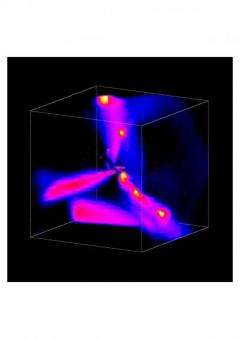
Computer simulation of galaxy formation shows matter flowing into the center of a galaxy through three cold gas streams. Such pictures provide the basis for the new theory of galaxy formation via these streams. Credit: The Hebrew University of Jerusalem

A new theory as to how galaxies were formed in the Universe billions of years ago has been formulated by Hebrew University of Jerusalem cosmologists. The theory takes issue with the prevailing view on how the galaxies came to exist.

The new theory, motivated by advanced astronomical observations and based on state-of-the-art computer simulations, maintains that the galaxies primarily formed as a result of intensive cosmic streams of cold gas (mostly hydrogen) and not, as current theory contends, due primarily to galactic mergers. The researchers show that these mergers had only limited influence on the cosmological makeup of the universe as we know it.

The results of the cosmology research group, led by Prof. Avishai Dekel, who holds the Andre Aisenstadt Chair of Theoretical Physics at the Racah Institute of Physics of the Hebrew University, appear in the current issue of the journal Nature.

The galaxies are the building blocks of the Universe. Each of them comprises some hundred billion radiant stars, such as our sun, which extend across about 50,000 light years. Every galaxy is embedded in a spherical halo made of dark matter that cannot be seen but is detected through its massive gravitational attraction. The exact nature of this matter is still unknown.

The galaxies are composed into two major types: spiral and elliptical. The spiral galaxies, such as our Milky Way, are rotating disks, rich in hydrogen gas, and are constantly forming new stars. The young stars give the spiral galaxies a blue tint. In contrast, the elliptical galaxies have bodies with a larger, more rounded shape, and are made of old, red stars that are devoid of gas. They are therefore referred to as red and dead.

The attempt to understand the way in which these two types of galaxies form is the primarily challenge facing modern cosmological researchers. The formation of galaxies is an essential stage in the cosmological process that leads to the formation of life.

The accepted model until now has as its basis the idea of spherical gas infall into a central disk, followed by mergers between disks. The assumption is that the stars formed slowly within the gaseous disks, and that the disks converted into globes when they merged. In such a merger, the colliding gas clouds produce a big burst of new stars at a rate of hundreds of solar masses per year.

This model has lately been put to question as a result of astronomical observations using new and more powerful telescopes which enable observations at greater depth into the Universe, making it possible thus to examine what happened in the galaxies some ten billion years ago (about three billion years after the Big Bang which first established the Universe). "The large galaxies, as they appear in this early stage, indeed created stars at a very rapid rate, but this does not appear to be at all a result of galactic mergers," says Prof. Dekel. The astronomical observations were led by researchers in Garching, Germany, headed by Prof. Reinhard Genzel of the Max Planck Institute, whose group is collaborating with the Hebrew University researchers.

The question that emerged was how these galaxies were able to form stars so quickly and in large quantities at such an early stage without massive galactic mergers.

In the article published in Nature, Prof. Dekel and his Hebrew University and French associates, pose their new theoretical model, which explains these observed phenomena. Their findings are based on computer simulations carried out by the French researchers headed by Prof. Romain Teyssier. The simulations, using one of the most powerful supercomputers in Europe, made it possible in an unprecedented manner to carry out a detailed investigation of how galaxies formed in the early Universe.

The picture that emerges is of galaxy-building that results from a continuous flow of cold gas along a few narrow streams rather than by mergers. These gas streams follow the filaments of the "cosmic web" that defines the large-scale structure of matter in the Universe, filaments that feed the dark-matter halos in the first place. These cold gas streams penetrate through the dark-matter halo of each galaxy and the hot gas that fills it and reach the center, where they become a rotating disk. These disks, each subject to its own, local, gravitational forces, break into a few giant clumps in which the gas converts into stars very efficiently.

In their calculations, Dekel and his group show that the rate of star formation, as predicted by this theory, is compatible with the observed rate. The researchers refer to these massive star formers in the early universe as Stream-Fed Galaxies (SFG). The galaxy merger phenomenon, in this view, was not the primary factor as maintained in current theory.

Prof. Dekel and his Hebrew University associates, Prof. Re'em Sari and Dr. Daniel Ceverino, worked out a simple physical theory that explains the formation of giant clumps in the early massive disks, and how they are driven by the cosmic streams. They predict that the migration of these clumps to the disk centers led to the formation of elliptical galaxies already in the early Universe, independent of galaxy mergers. They are thus making the revolutionary proposal that the role of cosmic gas streams is not limited only to the formation of star-forming disks, but that these streams are also responsible for the subsequent formation of the red-and-dead elliptical galaxies. New state-of-the-art simulations confirm this theory.

Source: The Hebrew University of Jerusalem


print this article email this article download pdf blog this article bookmark this article     Stumble it Digg this share on Facebook retweet share on Reddit add to delicious
Rate this story - 4.5 /5 (15 votes)

Rank Filter

Move the slider to adjust rank threshold, so that you can hide some of the comments.


Display comments: newest first

  • Honor - Jan 21, 2009
    • Rank: 2.3 / 5 (3)
    does anyone think the ad for wight-loss on this page are completely disgusting? are all science fans fat like that? lol
  • jeffsaunders - Jan 21, 2009
    • Rank: 5 / 5 (2)
    This looks like a shift in thinking a little closer along the lines of plasma physics. We are talking about cold gas streams here but what makes a gas stream?

    Why would all the gas flow in the same direction along the same path?

    I think we must be talking plasma here as plasma does travel in a stream.
  • brant - Jan 21, 2009
    • Rank: 5 / 5 (2)
    Almost. Plasma. And then what would cause plasma to form into filaments.......lectromagnetism....
  • yep - Jan 22, 2009
    • Rank: 5 / 5 (2)
    The plasma universe theory is not new. In the late 1800's Physicist Kristian Birkeland discovered these filaments now called Bikeland currents. Irving Langmuir coined the term plasma in the early 1900's. And in 1937 Hannes Alfven argued that plasma pervaded the universe.
    http://www.electr...xOLD.htm
    http://www.holosc...ndex.php
    These sites will let you take the last 80 years of cosmology and throw it into the trash heap of history. David Talbott and Wallace Thornhill Are modern day Galileo's.
    The conspiracy nut in me wonders why the establishment has been ignoring these realities for so long. I suppose it could be the same reason JP Morgan defunded Tesla's Wardenclyffe tower.
  • MrGrynch - Jan 22, 2009
    • Rank: 5 / 5 (1)
    Its not conspiracy.. its an unwillingness to potentially have to let go of long-held beliefs, especially when so many have devoted their lives in this endeavour.

    This article as well as a recent article on the CBR present serious challenges to the established dogma (and it is dogma). In my opinion, plasma cosmology is finally emerging as a serious contender for a new cosmology. The timetable has been long, but in the history of such far-reaching ideologies, its actually a fairly fast transition.

    Some exciting times lie ahead!
    -G
  • earls - Jan 22, 2009
    • Rank: not rated yet
    Ho-ho! Look at the ignorance run rampant while you all pat each other on the back attempting to suggest quantum forces are scalable to the astrophysical arena.

    The first thing you need to realize is that all large scale cosmic structures are electrically neutral. How do I know this? My swaths of evidence right over... Here... I... Swear I just had it. Hold on it's close I know it.

    Secondly, understand that when something has mass, it seeks out other mass until all of the mass returns to its original form as an ultra dense point that will once again explo... expand "for fun."

    These condensing large scale structures are just a stepping stone between the expansion and recollapsing. Perfectly natural physical behavior with no need to invoke fancy, feeble forces like completely neutralized Electromagnetism.

    Gravity was discovered (mathematically explained) first, the world we live in is electrically neutral (hiccup) so it only makes sense that if we extrapolate with these paradigms, everything will make sense.

    Get. It. Straight.

    GAWD!!
  • barkster - Jan 22, 2009
    • Rank: not rated yet
    ....lectromagnetism....
    I wish we could get more probes outside the heliopause, fast. This $#!^ fascinates me to no end.

    ... and so does that "shocking secret" that coffee companies don't want me to know.

January 21, 2009 all stories

Comments: 7

4.5 /5 (15 votes)
  • Stumble this up

  • Digg this

  • share this

  • hide
  • Related Stories

  • Stars Fueled by Dark Matter Could Hold Secrets to the Universe
    created Nov 03, 2009 | popularity not rated yet | comments 0
  • Dark Matter in a Galaxy
    created Oct 30, 2009 | popularity not rated yet | comments 0
  • Dark matter sleuths to design world's largest WIMP catcher
    created Oct 29, 2009 | popularity not rated yet | comments 0
  • Astronomers explore 'last blank space' on map of the Universe
    created Oct 28, 2009 | popularity not rated yet | comments 0
  • Galaxy cluster smashes distance record
    created Oct 22, 2009 | popularity not rated yet | comments 0


  • hide
  • Relevant PhysicsForums posts

  • The shape of our solar system's orbits.
    created Nov 07, 2009
  • Above or Below the Line of Nodes
    created Nov 07, 2009
  • Supernova vs. Nova?
    created Nov 07, 2009
  • Supernova's Gamma Rays and Comets
    created Nov 06, 2009
  • Our Moon
    created Nov 06, 2009
  • Question about a Carl Zeiss lens
    created Nov 05, 2009
  • More from Physics Forums - General Astronomy

Other News

Scientists seek safe carbon dioxide storage for 'greener' power generation (w/ Video)

Space & Earth / Environment

created 13 minutes ago | popularity not rated yet | comments 0

The U.S. Department of Energy (DOE) has announced plans to fund research at the University of Alabama at Birmingham (UAB) School of Engineering on technologies that would help reduce greenhouse gas emissions through the capture ...


Antarctica glacier retreat creates new carbon dioxide store

Antarctica glacier retreat creates new carbon dioxide store

Space & Earth / Earth Sciences

created 3 hours ago | popularity 5 / 5 (1) | comments 1

Large blooms of tiny marine plants called phytoplankton are flourishing in areas of open water left exposed by the recent and rapid melting of ice shelves and glaciers around the Antarctic Peninsula. This ...


Success in 'space elevator' competition (AP)

Success in 'space elevator' competition (Update 3)

Space & Earth / Space Exploration

created Nov 05, 2009 | popularity 4.3 / 5 (33) | comments 53

(AP) -- A robot powered by a ground-based laser beam climbed a long cable dangling from a helicopter on Wednesday to qualify for prize money in a $2 million competition to test the potential reality of the ...


In a Galaxy Far, Far Away...

In a Galaxy Far, Far Away...

Space & Earth / Astronomy

created Nov 06, 2009 | popularity 4.8 / 5 (5) | comments 15

(PhysOrg.com) -- Astronomers have published the discovery of the farthest known object in the cosmos: a star that exploded when the universe was only 630 million years old -- only 4.6% of its current age. ...


'Dropouts' pinpoint earliest galaxies

'Dropouts' pinpoint earliest galaxies

Space & Earth / Astronomy

created Nov 06, 2009 | popularity 4.2 / 5 (10) | comments 13

Astronomers, conducting the broadest survey to date of galaxies from about 800 million years after the Big Bang, have found 22 early galaxies and confirmed the age of one by its characteristic hydrogen signature ...