City of Newark first in nation using cars to power grid
January 21, 2009
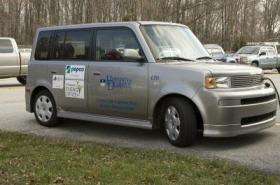
Shot of electric car owned by Willett Kempton, UD Professor of Marine Policy. Kempton plugs in the car at his home every night and on campus during the day. When not in service, he says, it stores enough electricity to power 7-8 houses on his block for 30 minutes. Credit: Kathy Atkinson, University of Delaware
This month, the City of Newark, Delaware became the first electric utility in the US to use a car to store and provide power for the local electric grid.
The vehicle, which runs on electricity alone, is specifically designed to store energy and improve grid reliability. University of Delaware researchers helped develop the concept, called Vehicle-to-Grid (V2G). With the City of Newark's approval, the UD team is now conducting V2G testing at two outlets within the City's service territory.
Cities including San Francisco and Austin, TX have seriously considered the idea, but Newark (population: 30,000) is the first to officially put it into action.
This video is not supported by your browser at this time.
B-roll shows electric car, inside and out, plug and electric meter.
University of Delaware Associate Professor of Marine Policy Willett Kempton explained how the technology benefits the grid operator. Currently, there is no energy storage built into the electric grid system, meaning that electricity usage and electricity generation must be simultaneous. As fluctuating renewable sources, such as solar and wind power, become a larger fraction of our electric generation, energy storage will help grid operators smooth power output fluctuations."Wind tends to blow stronger at night when the electric load is low," he said. "If electric vehicles charged at night with wind power, the grid operator could use the energy in the batteries, when vehicles aren't needed for driving and are plugged in, to help maintain grid reliability. The vehicle owner would then be paid for providing these energy services at a greater value than what they paid for the electricity."
Those savings add up to thousands per year.
Kempton plugs his car in at his Newark home, and while it sits, he says, it stores enough energy to power 7 to 8 homes on his block for approximately 30 minutes.
Kempton and his team plan to have a fleet of six vehicles by the end of 2009, two at UD and four operated by the state of Delaware. The test fleet will be used to demonstrate multiple V2G vehicles working together and supplying energy as a single power plant. The City of Newark's approval paves the way for larger-scale adoption of V2G electric vehicles nationwide, helping to advance the nation's electric grid infrastructure and reduce oil consumption.
The City of Newark is responsible for ensuring the energy source will not feed power back to the grid when power lines are down. This approval process for V2G electric vehicles is similar to the process used to certify solar photovoltaic systems. It is critical to maintaining the safety of line workers during a power outage.
Sam Sneeringer, the City's Assistant Electric Director, describes the reasoning behind the certification process by saying, "Solar PV systems and V2G vehicles are tested to the same standards and treated the same within the city's approval process because electricity from the car's batteries or from a solar panel is indistinguishable to the electric grid and presents the same potential safety risks to linemen."
The University of Delaware and utility company, Delmarva Power, conducted initial testing of this safety requirement before the vehicle was thoroughly tested to IEEE standards at the National Renewable Energy Laboratory in Golden, Colo.
Source: University of Delaware
-
Engineers build first sub-10-nm carbon nanotube transistor
Feb 01, 2012 |
4.9 / 5 (31) |
30
-
Something old, something new: Evolution and the structural divergence of duplicate genes
Jan 31, 2012 |
4.6 / 5 (7) |
1
-
The hidden nanoworld of ice crystals: Revealing the dynamic behavior of quasi-liquid layers
Jan 30, 2012 |
5 / 5 (3) |
1
-
Stock market network reveals investor clustering
Jan 27, 2012 |
3.9 / 5 (23) |
8
-
Of microchemistry and molecules: Electronic microfluidic device synthesizes biocompatible probes
Jan 26, 2012 |
5 / 5 (1) |
0
-
Calling function with no input argument
3 hours ago
-
Force free body diagram problem on gym equipment
4 hours ago
-
Empirical data regarding shower heads and water
12 hours ago
-
feed hold button on CNC lathe
Feb 09, 2012
-
RFAC in Fortran
Feb 09, 2012
-
dynamics 2/32
Feb 08, 2012
- More from Physics Forums - General Engineering
More news stories
Expat French get Internet vote for first time
French citizens will for the first time this year be able to vote in a parliamentary election over the Internet, an experiment that could be extended to other elections if successful.
1 hour ago |
not rated yet |
0
"Twisted Metal" gamers get shot at real gunplay
Fans of "Twisted Metal" will get to welcome a long-awaited sequel of the car-battle videogame with a real-world bang by blasting an ice cream truck to bits with a machine gun.
56 minutes ago |
not rated yet |
0
New error-correcting codes guarantee the fastest possible rate of data transmission
Error-correcting codes are one of the triumphs of the digital age. Theyre a way of encoding information so that it can be transmitted across a communication channel such as an optical fiber o ...
Technology / Computer Sciences
7 hours ago |
5 / 5 (3) |
4
|
Small modular reactor design could be a 'SUPERSTAR'
(PhysOrg.com) -- Though most of today's nuclear reactors are cooled by water, we've long known that there are alternatives; in fact, the world's first nuclear-powered electricity in 1951 came from a reactor ...
Technology / Energy & Green Tech
6 hours ago |
4.2 / 5 (10) |
14
|
Advanced power-grid model finds low-cost, low-carbon future in West
(PhysOrg.com) -- The least expensive way for the Western U.S. to reduce greenhouse gas emissions enough to help prevent the worst consequences of global warming is to replace coal with renewable and other ...
Technology / Energy & Green Tech
6 hours ago |
5 / 5 (2) |
6
|
Putting the squeeze on planets outside our solar system
(PhysOrg.com) -- Using high-powered lasers, scientists at Lawrence Livermore National Laboratory and collaborators discovered that molten magnesium silicate undergoes a phase change in the liquid state, abruptly ...
Employers feel no love for unscrupulous practice of 'service sweethearting'
A new study led by two Florida State University marketing professors finds that some frontline service employees who are rewarded for hikes in customer loyalty and satisfaction also may engage in "service ...
Human cognitive performance suffers following natural disasters, researchers find
Not surprisingly, victims of a natural disaster can experience stress and anxiety, but a new study indicates that it might also cause them to make more errors - some serious - in their daily lives. In their upcoming Human Fa ...
The power of estrogen -- male snakes attract other males
A new study has shown that boosting the estrogen levels of male garter snakes causes them to secrete the same pheromones that females use to attract suitors, and turned the males into just about the sexiest ...
Curry spice component may help slow prostate tumor growth
Curcumin, an active component of the Indian curry spice turmeric, may help slow down tumor growth in castration-resistant prostate cancer patients on androgen deprivation therapy (ADT), a study from researchers ...
Fool's gold may prove an unlikely alternative to overexploited catalytic materials
Catalytic materials, which lower the energy barriers for chemical reactions, are used in everything from the commercial production of chemicals to catalytic converters in car engines. However, with current catalytic materials ...
Jan 21, 2009
Rank: 5 / 5 (1)
The gov't would have to be involved in financially aiding car owners before most would be interested, I would think.
Jan 21, 2009
Rank: not rated yet
Jan 22, 2009
Rank: not rated yet
Jan 22, 2009
Rank: not rated yet
Apr 13, 2009
Rank: not rated yet
I hope not. Better to let the market take care of that. People will voluntarily make their car batteries available to the grid if the price is right.
That said, I have a suspicion that that price is a lot higher than advocates think it is. I ran the numbers on in-home lead-acid batteries for a proposed remote microgrid a couple of years ago, and IIRC discovered that cycle degradation adds up to over 50 cents per round-trip kWh.
In my view V2G can only work after a big battery breakthrough.
There's a reason why car manufacturers are mass-producing hybrids, but not plug-in hybrids. The batteries are very expensive and very easy to degrade if not managed very carefully. The Prius carefully maintains its battery charge in the 60-80% range. That's only 20% of the total capacity being used. They do that because going outside that range shortens the life of that very expensive battery. The battery is barely cost-effective when carefully managed in this way. The next battery breakthrough may make plug-in hybrids viable. But taking on the needs of the vehicle AND the grid is asking a lot. Batteries are not there yet.
And whatever battery we are using in the future, utilities would have to pay a premium above the deprecation, because people would be taking on the risk of not having a fully charged battery when they need it.