Seabird's ocean lifestyle revealed
January 21, 2009 Seabird's ocean lifestyle revealed

Enlarge

(PhysOrg.com) -- An important British seabird has been tracked for the first time using miniature positioning loggers. The results are giving a team led by Oxford University zoologists information that could help conserve wildlife around Britain’s shores.

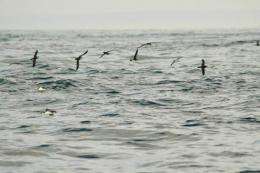
The Manx Shearwater is a seabird that migrates 20,000km from the UK to South America and then back again across the Atlantic Ocean. The birds spend most of the lives at sea and nest in remote locations, only coming ashore at night, so their ocean-going lifestyle has always been something of a mystery.

In two studies the scientists used electronic logging tags to track the Shearwater’s migration and tiny GPS trackers, developed at Oxford University, to map the birds’ long foraging trips. They report their results in papers in Proceedings of the Royal Society B and the journal Ibis.

The results suggest that, during their long migration, all 12 of the birds studied had to make at least one stopover of up to two weeks to ‘refuel’ - behaviour not normally associated with birds that migrate over open seas. They also showed that their migration route takes them further south than had been thought.

'By making stop-overs these 400g birds would not have to carry extra weight, in the form of fat, for the first part of their epic journey as they would if they flew to South America direct,’ said Professor Tim Guilford, from Oxford’s Department of Zoology who led the Oxford team.

The researchers also found that in the two weeks prior to laying their single large egg, female Shearwaters journeyed to distant waters south west of Britain, probably to exploit rich fishing near the continental shelf break. Males stayed nearer their Pembrokeshire colony during breeding: both males and females depend heavily on fisheries within the Irish Sea.

‘In some ways protecting nesting sites on land is easy, what our results shows is that we also need to think about how to protect feeding areas at sea - something which is much more of a challenge,’ said Professor Guilford.

Scientists believe that monitoring wild seabird populations is increasingly important as they are particularly sensitive to environmental change and give an indication of the health of our oceans.

Provided by Oxford University


print this article email this article download pdf blog this article bookmark this article     Stumble it Digg this share on Facebook retweet share on Reddit add to delicious
Rate this story - 5 /5 (1 vote)


January 21, 2009 all stories

Comments: 0

5 /5 (1 vote)
  • Stumble this up

  • Digg this

  • share this

  • hide
  • Related Stories


Other News

Hammerhead shark

Wide heads give hammerheads exceptional stereo view

Biology / Plants & Animals

created 18 hours ago | popularity 4.5 / 5 (6) | comments 4

Hammerhead sharks are some of the Ocean's most distinctive residents. 'Everyone wants to understand why they have this strange head shape,' says Michelle McComb from Florida Atlantic University. One possible ...


Golden Oldie: Key Role for Ancient Protein in Algae Photosynthesis

Golden Oldie: Key Role for Ancient Protein in Algae Photosynthesis

Biology / Biotechnology

created 10 hours ago | popularity not rated yet | comments 1

The discovery that an ancient light harvesting protein plays a pivotal role in the photosynthesis of green algae should help the effort to develop algae as a biofuels feedstock. Researchers with the Lawrence ...


Tough yet stiff deer antler is materials scientist's dream

Biology / Plants & Animals

created 19 hours ago | popularity 3 / 5 (2) | comments 2

Prized for their impressive antlers, red deer have been caught in the hunters' sights for generations. But a deer's antlers are much more than decorative. They are lethal weapons that stags crash together when duelling. John ...


Indonesia rejects Bali plan for turtle sacrifices (AP)

Indonesia rejects Bali plan for turtle sacrifices

Biology / Ecology

created 16 hours ago | popularity 5 / 5 (1) | comments 0

(AP) -- Indonesia has rejected a push by the resort island of Bali for rare turtles to be legally slain in Hindu ceremonies, siding with conservationists of the protected reptiles against religious advocates, ...


Ecologists sound out new solution for monitoring cryptic species

Biology / Ecology

created 19 hours ago | popularity not rated yet | comments 0

Ecologists have at last worked out a way of using recordings of birdsong to accurately measure the size of bird populations. This is the first time sound recordings from a microphone array have been translated into accurate ...