'Astronaut food approach' to medical testing: Dehydrated, wallet-sized malaria tests promise better diagnoses in develop
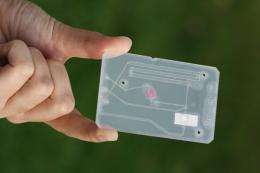
(PhysOrg.com) -- Researchers at the University of Washington have developed a prototype malaria test printed on a disposable Mylar card that could easily slip into your wallet and still work when you took it out, even months later.
Paul Yager, UW bioengineering professor, and colleagues described the prototype cards in the December issue of the journal Lab on a Chip. These cards are a critical step in a long-term project funded by The Bill and Melinda Gates Foundation's Grand Challenges in Global Health Initiative to develop affordable, easy-to-use diagnostic tools for the developing world.
"A pivotal issue in having this technology work is making these tests storable for long periods of time at ambient temperatures," Yager said. "Normally people work with wet reagents. We're saying we can dry the reagents down in order to store them without refrigeration. It's the astronaut-food approach."
The malaria cards contain reagents that would normally require refrigeration, but the researchers figured out a way to stabilize them in dry form by mixing them with sugar. Results showed that malaria antibodies dried in sugar matrices retained 80 percent to 96 percent of their activity after 60 days of storage at elevated temperatures.
The goal of the long-term project is to develop a system with which a clinician can spot a drop of a patient's blood onto a card and feed it into an instrument that gives a yes/no answer for a panel of infectious diseases in 20 minutes or less. Tests with the prototype malaria card reached a result in less than nine minutes using an immunoassay, or antibody-based, approach.
Developing countries, which are most in need of such technology, face unique challenges when it comes to medical care.
"Something as seemingly simple as a blood test for a common disease gets more complicated when money and resources are lacking," said Dean Stevens, UW bioengineering doctoral student and first author on the study.
Clinicians trying to diagnose patients in rural, poor communities in the developing world face hurdles such as unsanitary conditions, lack of refrigeration for the many common lab tests using ingredients that must be kept cold, unreliable power and general lack of resources, Stevens said. In the developing world, healthcare budgets can be as low as $10 per person per year, compared to an average of $4,000 in the U.S. Tests for diseases also need to be fast and easy to use, because health-care workers might only have one visit to diagnose and treat a patient, and thus can't wait days for lab results.
While treatments in poor, rural communities come with their own difficulties, diagnosis is the key to getting good medical care, Stevens said.
"Your treatment is really only as good as your diagnosis," he said.
The malaria-test card is being developed as part of an automated diagnostic system informally called the DxBox, the Dx being medical shorthand for diagnosis. The DxBox team is led by Yager and includes UW bioengineering professor Patrick Stayton; collaborators at PATH, a Seattle-based nonprofit focused on global health; Micronics Inc. of Redmond, Wash.; and Nanogen Inc. of San Diego.
The DxBox consists of a portable, fully automatic reader being developed by Micronics that will process the card-based disposable tests. The UW prototype cards look for the presence of malarial proteins, but the team is also working on other kinds of protein tests as well as a second kind of test for each disease that looks for the pathogen's DNA or RNA.
The UW's malaria cards use features of common lab tests and take into account portability, automation and easy storage. The cards rely on microfluidics, the manipulation of liquids at very small scales. Thin channels crisscross the Mylar sheets, and syringes are used to pump different liquids for the tests through the channels. "It's like plumbing, only the pipes are less than a millimeter wide," Yager said.
Microfluidics not only save space and resources, but working with liquids on such a small scale allows the researchers to do more. "It's not just about making big things small," Yager said. "It's also about doing things that are only possible at that very small scale." The diagnostic tests in the DxBox system run much faster than conventional tests in part because the liquids involved behave differently, a key factor for clinicians who have limited time to spend with their patients.
Currently, the researchers look for colored spots on the card that indicate the presence of malaria proteins. The hue of the color indicates the intensity of the disease. The DxBox can read these small spots automatically, reducing the chance for human error.
While the prototype developed by the UW researchers only tests for malaria, Yager and his collaborators are working towards cards that also will test for five other diseases that, like malaria, cause high-fever symptoms: dengue, influenza, Rickettsial diseases, typhoid and measles. The "fever panel" of six diseases is merely a starting point, Yager said. The UW technology could be adapted to include other diseases in the future.
Other authors on the paper are Camille Petri, undergraduate at Boston College in Chestnut Hill, Mass.; Jennifer Osborn, UW bioengineering doctoral student; Paolo Spicar-Mihalic, UW chemistry doctoral student; and Katherine McKenzie, UW bioengineering doctoral student.
Provided by University of Washington


