Verdict: Supermassive black holes not guilty of shutting down star formation
January 22, 2009 Verdict: Supermassive black holes not guilty of shutting down star formation

Enlarge

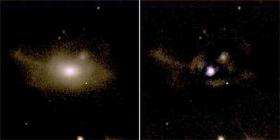
Schawinski and his team compared the light from 177 galaxies, such as the one on the left, to the light emitted by the AGN at their centers (right) to show that the galaxies stop forming stars long before their AGN reach their peak brightness.

(PhysOrg.com) -- A team of Yale University astronomers has discovered that galaxies stop forming stars long before their central supermassive black holes reach their most powerful stage, meaning the black holes can't be responsible for shutting down star formation.

Until recently, astronomers believed that active galactic nuclei (AGN)—the supermassive, extremely energetic black holes at the centers of many young galaxies—were responsible for shutting down star formation in their host galaxies once they grew large enough. It was thought that AGN feed on the surrounding galactic material, producing enormous amounts of energy (expelled in the form of light) and heat the surrounding material so that it can no longer cool and condense into stars.

But new research shows that this shutting-down process appears to take place much earlier in the AGN's lifetime, well before it starts shining brightly. "This high-luminosity phase, when the AGN are at their biggest and brightest and most powerful, is not the phase responsible for the shutdown of star formation," said Kevin Schawinski, a postdoctoral associate in Yale's astronomy department and lead author of the study, published in the Feb. 10 issue of the Astrophysical Journal Letters.

The researchers analyzed images of 177 galaxies taken by two different space telescopes to create a comprehensive view of galaxies with AGN, including ones where the AGN were both obscured by the galaxy's dust and gas, and ones where there was an unobstructed view of the AGN from the Earth's vantage point.

Until now, some astronomers believed they can't see AGN in any galaxies that are still actively forming stars simply because the light from the AGN is obscured by the galaxy's gas and dust. Schawinski and his team are the first to show that in fact there are no bright AGN at the centers of star-forming galaxies.

By subtracting out the light from the AGN, the team discovered that all of the galaxies with bright AGN had stopped forming stars several hundred million years earlier. "The key result is the finding that there is a lack of AGN in galaxies that are currently forming stars," said Meg Urry, head of the Yale team and director of the Yale Center for Astronomy and Astrophysics. "That tells us the AGN doesn't turn on until long after the stars stop forming."

"For the first time, we've measured a real delay between the end of star formation and the onset of a luminous AGN," said Schawinski. As for the real culprit, responsible for shutting down star formation, "it's possible that an earlier, low-luminosity phase is responsible," he said. "Either way, this result shows that our previous understanding of how the shutting-down process works wasn't as simple as we thought."

Provided by Yale University


print this article email this article download pdf blog this article bookmark this article     Stumble it Digg this share on Facebook retweet share on Reddit add to delicious
Rate this story - 4.6 /5 (9 votes)

Rank Filter

Move the slider to adjust rank threshold, so that you can hide some of the comments.


Display comments: newest first

  • theophys - Jan 22, 2009
    • Rank: not rated yet
    I would think the decreasing star formation would happen no matter what's going on in the center of the galaxy. I looks to me like it has more to do with dispersion of materials than it does effects of a black hole thousands of light years away(granted, a really big black hole).
  • earls - Jan 22, 2009
    • Rank: 5 / 5 (1)
    I was about to reinforce your assessment with a comment along the lines of "easy, no more mass = no more stars" but the article seems to indicate that there is plenty of remaining mass well after the stars stop forming for some currently unknown reason.

    Considerably puzzling due to the current theory of gravitational collapse star formation.

    Also, don't black holes eject most of the mass/energy along their axis of rotation versus their plane?

    It would seem that the radiation is a requirement for sustained star formation.

    The article fails to mention if stars can begin to form at some point later in the existence of the galaxy.
  • brant - Jan 22, 2009
    • Rank: 2 / 5 (1)
    They have no clue. They just making stuff up.....
    How do they know when something else happened if they wern't(is that a word?) there?
  • Velanarris - Jan 23, 2009
    • Rank: not rated yet
    They have no clue. They just making stuff up.....
    How do they know when something else happened if they wern't(is that a word?) there?

    When viewing something several thousand or million light years away you are viewing it as it happened several thousand or millions of years ago.

    Take two galaxies of a single type. One is 2 million light years away, the other is 1 million light years away.

    You are theoretically now viewing 2 separate points in time in the evolution of that type of galaxy. Effectively you can observe as though you were there at 1 mya and 2 mya respectively.
  • Honor - Jan 26, 2009
    • Rank: not rated yet
    maybe they form from intersecting gravity waves. haha
  • denijane - Jan 27, 2009
    • Rank: not rated yet
    Hm, I think the article implies that as long as there is active star formation, there is no AGN. Which would say that something in that phase prevents AGN to form (or to show). Weird. Maybe it is to say that AGN forms with whatever material is left from the star formation-material that was unavailable before.But still, the two things should be independent.
  • Thecis - Jan 28, 2009
    • Rank: not rated yet
    Just a thought...
    Is mass the same as fuel for stars?
    If there is plenty of mass, the chance of it becoming a star can only be if there is enough hydrogen and helium. What if these galaxies do not contain the critical amount of those elements anymore? Then star formation would be shut down...
  • Velanarris - Jan 28, 2009
    • Rank: not rated yet
    Just a thought...
    Is mass the same as fuel for stars?

    No, it's a combo of the mass and type of mass. A star made of a 50:50 mix of Hydrogen and Iron would have large mass and an incredibly short lifespan due to the theorized properties of iron in stellar fusion.
  • yep - Feb 25, 2009
    • Rank: not rated yet
    "The standard model of stars is utterly wrong"
    http://www.physor...919.html

January 22, 2009 all stories

Comments: 9

4.6 /5 (9 votes)
  • Stumble this up

  • Digg this

  • share this

  • hide
  • Related Stories

  • Fermi Telescope Detects Gamma-Ray From 'Star Factories' in Other Galaxies
    created Nov 02, 2009 | popularity not rated yet | comments 0
  • Sky merger yields sparkling dividends
    created Oct 13, 2009 | popularity not rated yet | comments 0
  • First black holes born starving (w/ Video)
    created Aug 10, 2009 | popularity not rated yet | comments 0
  • Active galaxies are different near and far
    created Jan 06, 2009 | popularity not rated yet | comments 0
  • Stars stop forming when big galaxies collide
    created Oct 07, 2008 | popularity not rated yet | comments 0


  • hide
  • Relevant PhysicsForums posts

  • Some help with a X-Ray astronomy question please!
    created 22 hours ago
  • Help with Images and Optical Instrument Question..
    created Nov 26, 2009
  • Redshift as a distance indicator
    created Nov 26, 2009
  • Question about 2-body gravity
    created Nov 24, 2009
  • More from Physics Forums - General Astronomy

Other News

Fermi Telescope Peers Deep into Microquasar

Fermi Telescope Peers Deep into Microquasar (w/ Video)

Space & Earth / Astronomy

created 16 hours ago | popularity 4.7 / 5 (10) | comments 0

(PhysOrg.com) -- NASA's Fermi Gamma-ray Space Telescope has made the first unambiguous detection of high-energy gamma-rays from an enigmatic binary system known as Cygnus X-3. The system pairs a hot, massive ...


The Energy Sources of Ultraluminous Galaxies

The Energy Sources of Ultraluminous Galaxies

Space & Earth / Astronomy

created 17 hours ago | popularity 4.5 / 5 (12) | comments 1

(PhysOrg.com) -- Ultraluminous infrared galaxies ((ULIRGs) are galaxies whose luminosity exceeds that of a trillion suns; for comparison, the Milky Way galaxy has a typical (and much more modest) luminosity ...


New climate targets may not change daily life much (AP)

New climate targets may not change daily life much

Space & Earth / Environment

created 21 hours ago | popularity 3.7 / 5 (12) | comments 7

(AP) -- Americans' day-to-day lives won't change noticeably if President Barack Obama achieves his newly announced goal of slashing carbon dioxide pollution by one-sixth in the next decade, experts say.


Space shuttle Atlantis, 7 astronauts back on Earth (AP)

Space shuttle Atlantis, 7 astronauts back on Earth

Space & Earth / Space Exploration

created 17 hours ago | popularity not rated yet | comments 0

(AP) -- Space shuttle Atlantis and its seven astronauts returned to Earth with a smooth touchdown Friday to end an 11-day flight that resupplied the International Space Station.


China is set to launch its second moon orbiter next October, state media have reported

China to launch second lunar probe: state media

Space & Earth / Space Exploration

created 22 hours ago | popularity 5 / 5 (4) | comments 0

China will launch its second moon orbiter next October, state media reported Friday, as it powers ahead with a space programme that has sparked concerns abroad.