Tree deaths have doubled across the western US
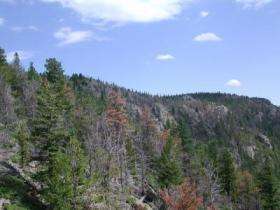
January 22, 2009 Deer Ridge, Rocky Mountain National Park

Enlarge

Increasing tree die-offs in the West are illustrated by these gray, needleless limber pine, the likely victims of drought, interspersed with orange, dead limber and ponderosa pine killed by Rocky Mountain pine beetles in Colorado's Rocky Mountain National Park in recent years. Image courtesy Jeremy Smith, University of Colorado

(PhysOrg.com) -- A new study led by the U.S. Geological Survey and involving the University of Colorado at Boulder indicates tree deaths in the West's old-growth forests have more than doubled in recent decades, likely from regional warming and related drought conditions.

The study, published in the Jan. 23 issue of Science, documented tree deaths in all tree sizes in the West located at varying elevations, including tree types such as pine, fir and hemlock. Significant die-offs also were documented in the interior West -- including Colorado and Arizona -- as well as Northwest regions like northern California, Oregon, Washington and southern British Columbia.

The researchers speculated higher tree deaths could lead to substantial ecological changes in the West, including cascading effects affecting wildlife populations. The tree deaths also could lead to possible increases in atmospheric carbon dioxide levels contributing to warming, which could stem from lower CO2 uptake and storage by smaller trees and increased CO2 emissions from more dead trees on the forest floors.

The study shows the establishment of new, replacement trees is not keeping pace with climbing tree mortality in the study plots, said CU-Boulder geography Professor Thomas Veblen, study co-author. The new study is the largest research project based on long-term forest plots ever published on North American forests, said Veblen.

USGS researchers Phil van Mantgem and Nathan Stephenson led the study. Co-authors included Veblen and Jeremy Smith of CU-Boulder, John Byrne of the U.S. Forest Service Rocky Mountain Research Station, Lori Daniels of the University of British Columbia, Jerry Franklin and Andrew Larson of the University of Washington, Peter Fule of Northern Arizona University and Mark Harmon of Oregon State University.

"This regional warming has contributed to widespread hydrologic changes, such as a declining fraction of precipitation falling as snow, declining water snowpack content, earlier spring snowmelt and runoff, and a consequent lengthening of the summer drought," wrote the researchers in Science.

"The increase in tree mortality rates documented in the study is further compelling evidence of ecosystem responses to recent climate warming," said Veblen. "The findings are consistent with other well documented, climate-induced ecological changes, including increased wildfire activity since the mid-1980s and bark beetle outbreaks that are occurring at unprecedented levels in western North America forests, including Alaska."

Climate records from Colorado's subalpine forests, which are roughly 8,500 to 10,000 feet in elevation, show a marked increase in temperatures over the past 50 years during all seasons of the year, Veblen said. Colorado has experienced drought since the mid-1990s, peaking in 2002 and which became the most severe drought of the past century, he said.

In the Science study, the tree deaths measured in Colorado are all from stands re-measured prior to any stands being attacked in the current bark beetle outbreak, said Veblen. "The previous elevated rates of tree mortality in these forests may have been harbingers of the abrupt increase in tree mortality due to the current bark beetle outbreaks in Colorado."

During the past decade, mountain pine bark beetles have killed roughly 3.5 million acres of lodgepole pine forests in northwestern Colorado, and the outbreak has spread to the study's forest plots on the state's Front Range only within the last year, Veblen said. During the same time period, spruce bark beetles also killed large areas of spruce forest in northern and southwestern Colorado, he said.

"Forest entomologists and ecologists agree that warming temperatures are highly favorable to the population growth and survival of these beetles," said Veblen. "Moisture-stress induced by both warming and reduced snowpack increases tree susceptibility to bark beetle attack."

Veblen said the study suggests increased tree mortality rates may be indicators of climate-induced stress that could increase tree susceptibility to more abrupt causes of tree deaths like bark beetle outbreaks. "Recent events in subalpine forests in Colorado fit that pattern quite well," he said.

Given the evidence that recent climate-induced ecosystem changes are now so abundant, society needs to discuss policies that will help humans adapt to the changes under way, said Veblen. In the context of wildfire management, land managers need to reconsider the effectiveness of both fire suppression and fire mitigation efforts, including fuel reduction projects like timber thinning, he said.

"Instead, we need to consider developing land-use policies that reduce the vulnerability of people and resources to wildfires," Veblen said. "Activities include reducing residential development in or near wildland areas that are naturally fire-prone and where we expect fire risk to increase with continued warming."

The 76 western forest study plots harbored nearly 59,000 living trees. The research team studied the plots during two periods -- from 1955 to 1994 and again from 1998 to 2007, said Veblen. The permanent study plots on Colorado's Front Range were part of a study funded by the Colorado Commission on Higher Education in 1982-83 during a short-lived program when CCHE had a research grant program, Veblen said.

Provided by University of Colorado at Boulder


print this article email this article download pdf blog this article bookmark this article     Stumble it Digg this share on Facebook retweet share on Reddit add to delicious
Rate this story - 2.9 /5 (11 votes)

Rank Filter

Move the slider to adjust rank threshold, so that you can hide some of the comments.


Display comments: newest first

  • Modernmystic - Jan 23, 2009
    • Rank: 3.7 / 5 (3)
    Should be a boon for the logging industry...oh wait we're not allowed to cut down DEAD trees either. We have to let them sit there like gasoline and wait for them to explode into huge forest fires...
  • boredWithScience - Jan 23, 2009
    • Rank: 4 / 5 (4)
    Well I'm disappointed. From the title I thought trees were killing people.
  • GrayMouser - Jan 23, 2009
    • Rank: 5 / 5 (1)
    Well I'm disappointed. From the title I thought trees were killing people.


    They are! They left out the pictures of bloody trails left by the rampaging evergreens.
  • barakn - Jan 23, 2009
    • Rank: 1.5 / 5 (4)
    For the forest products industry, the problem is no longer limited supply, it's limited demand due to a dying world economy. And do a google search for salvage timber sale, and then see if you're not allowed to cut down dead trees.
  • MikeB - Jan 25, 2009
    • Rank: 3 / 5 (2)
    Hmmmm... and all this devastation from a 0.1C to 0.3C temperature rise in the last decade. See here:

    http://www.physor...rbig.jpg

    Wow, those pine forests are on the knife's edge of survivability. I wonder how they have survived through the millenia?
  • Arkaleus - Jan 26, 2009
    • Rank: 5 / 5 (2)
    The reason why our tres are dying in such large numbers is because the natural mechanism of renewal (Forest fire) is no longer allowed to operate in North America. Our forests were constantly burning in past centuries, killing parasites and diseases before they oculd grab hold and spread. Now, due to shortsighted 20th century-style management, our forests are infested and dying off.
  • blackle4ps3 - May 26, 2009
    • Rank: not rated yet
    trees growing well at chernobyl , must be a different type of dump maybe and we don't get oxygen from pine ?

January 22, 2009 all stories

Comments: 7

2.9 /5 (11 votes)
  • Stumble this up

  • Digg this

  • share this

  • hide
  • Related Stories

  • Amazon carbon sink threatened by drought
    created Mar 05, 2009 | popularity not rated yet | comments 0
  • Severe asthma may be a different form of the disease
    created Jan 29, 2008 | popularity not rated yet | comments 0
  • A study proposes a new universal rule to explain the equilibrium of plant populations
    created Sep 18, 2007 | popularity not rated yet | comments 0
  • Review of 1918 pandemic flu studies offers more questions than answers
    created Feb 28, 2007 | popularity not rated yet | comments 0
  • UCSF study will test new vaginal microbicide for herpes and HIV
    created Nov 30, 2006 | popularity not rated yet | comments 0


  • hide
  • Relevant PhysicsForums posts

  • cycles
    created 14 hours ago
  • The Origin of the term 'fossil' fuels
    created Nov 05, 2009
  • co2
    created Nov 03, 2009
  • Early Earths Sulfidic Ocean Conditions
    created Oct 30, 2009
  • vegetation
    created Oct 29, 2009
  • climate change
    created Oct 29, 2009
  • More from Physics Forums - Earth

Other News

Deep creep means milder, more frequent earthquakes along Southern California's San Jacinto fault

Deep creep means milder, more frequent earthquakes along Southern California's San Jacinto fault

Space & Earth / Earth Sciences

created 13 hours ago | popularity 4.7 / 5 (3) | comments 0

With an average of four mini-earthquakes per day, Southern California's San Jacinto fault constantly adjusts to make it a less likely candidate for a major earthquake than its quiet neighbor to the east, the ...


Success in 'space elevator' competition (AP)

Success in 'space elevator' competition (Update 3)

Space & Earth / Space Exploration

created Nov 05, 2009 | popularity 4.3 / 5 (33) | comments 50

(AP) -- A robot powered by a ground-based laser beam climbed a long cable dangling from a helicopter on Wednesday to qualify for prize money in a $2 million competition to test the potential reality of the ...


In a Galaxy Far, Far Away...

In a Galaxy Far, Far Away...

Space & Earth / Astronomy

created Nov 06, 2009 | popularity 4.8 / 5 (5) | comments 17

(PhysOrg.com) -- Astronomers have published the discovery of the farthest known object in the cosmos: a star that exploded when the universe was only 630 million years old -- only 4.6% of its current age. ...


'Dropouts' pinpoint earliest galaxies

'Dropouts' pinpoint earliest galaxies

Space & Earth / Astronomy

created Nov 06, 2009 | popularity 4.2 / 5 (10) | comments 13

Astronomers, conducting the broadest survey to date of galaxies from about 800 million years after the Big Bang, have found 22 early galaxies and confirmed the age of one by its characteristic hydrogen signature ...


Space hotel taking bookings for 2012 opening

Space hotel taking bookings for 2012 opening

Space & Earth / Space Exploration

created Nov 05, 2009 | popularity 4.4 / 5 (21) | comments 11

(PhysOrg.com) -- The first orbiting space hotel is on track to open for its first customers in 2012, but hurry, as bookings are filling fast.