Scientists Find New Way to Produce Hydrogen
January 22, 2009 Scientists Find New Way to Produce Hydrogen

Enlarge

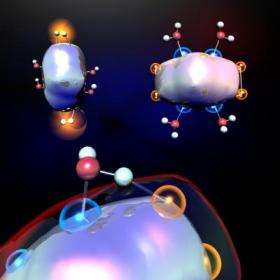
The figure shows aluminum clusters reacting with water to produce hydrogen. The image on the bottom depicts a water molecule (one hydrogen atom (red ball) and two oxygen atoms (silver balls)) splitting on the surface of an aluminum cluster. The blue regions are Lewis-acid sites and the orange regions are Lewis-base sites. The upper-right image shows multiple water molecules binding to the active sites of an aluminum cluster. The upper-left image shows the release of hydrogen (two silver balls surrounded by orange halo). Credit: A.C. Reber, VCU/Penn State

Scientists at Penn State University and the Virginia Commonwealth University have discovered a way to produce hydrogen by exposing selected clusters of aluminum atoms to water. The findings are important because they demonstrate that it is the geometries of these aluminum clusters, rather than solely their electronic properties, that govern the proximity of the clusters' exposed active sites. The proximity of the clusters' exposed sites plays an important role in affecting the clusters' reactions with water. The team's findings will be published in the 23 January 2009 issue of the journal Science.

"Our previous research suggested that electronic properties govern everything about these aluminum clusters, but this new study shows that it is the arrangement of atoms within the clusters that allows them to split water," said A. Welford Castleman Jr., Eberly Family Distinguished Chair in Science and Evan Pugh Professor in the Penn State Departments of Chemistry and Physics. "Generally, this knowledge might allow us to design new nanoscale catalysts by changing the arrangements of atoms in a cluster. The results could open up a new area of research, not only related to splitting water, but also to breaking the bonds of other molecules, as well."

The team, which also includes Penn State graduate students Patrick Roach and Hunter Woodward and Virginia Commonwealth University Professor of Physics Shiv Khanna and postdoctoral associate Arthur Reber, investigated the reactions of water with individual aluminum clusters by combining them under controlled conditions in a custom-designed flow-reactor. They found that a water molecule will bind between two aluminum sites in a cluster as long as one of the sites behaves like a Lewis acid, a positively charged center that wants to accept an electron, and the other behaves like a Lewis base, a negatively charged center that wants to give away an electron. The Lewis-acid aluminum binds to the oxygen in the water and the Lewis-base aluminum dissociates a hydrogen atom. If this process happens a second time with another set of two aluminum sites and a water molecule, then two hydrogen atoms are available, which then can join to become hydrogen gas (H2).

The team found that the aluminum clusters react differently when exposed to water, depending on the sizes of the clusters and their unique geometric structures. Three of the aluminum clusters produced hydrogen from water at room temperature. "The ability to produce hydrogen at room temperature is significant because it means that we did not use any heat or energy to trigger the reaction," said Khanna. "Traditional techniques for splitting water to produce hydrogen generally require a lot of energy at the time the hydrogen is generated. But our method allows us to produce hydrogen without supplying heat, connecting to a battery, or adding electricity. Once the aluminum clusters are synthesized, they can generate hydrogen on demand without the need to store it."

Khanna hopes that the team's findings will pave the way toward investigating how the aluminum clusters can be recycled for continual usage and how the conditions for the release of hydrogen can be controlled. "It looks as though we might be able to come up with ways to remove the hydroxyl group (OH-) that remains attached to the aluminum clusters after they generate hydrogen so that we can reuse the aluminum clusters again and again," he said.

The team plans to continue their research with a goal of refining their new method. This research was supported by the Air Force Office of Scientific Research.

Source: Penn State


print this article email this article download pdf blog this article bookmark this article     Stumble it Digg this share on Facebook retweet share on Reddit add to delicious
Rate this story - 4.6 /5 (36 votes)

Rank Filter

Move the slider to adjust rank threshold, so that you can hide some of the comments.


Display comments: newest first

  • h0dges - Jan 22, 2009
    • Rank: 5 / 5 (3)
    Awesome news
  • robbor - Jan 22, 2009
    • Rank: 3.8 / 5 (4)
    one thing is certain, it takes a lot of energy to make aluminum
  • Yes - Jan 22, 2009
    • Rank: 3.3 / 5 (3)
    No catalysis here, so indeed no energy put into this reaction is an overstatement like robbor mentions.

    We are looking for a catalyst that when we poor water over it, at one end the H2 comes out and on the other end ice? Go and check thermodynamics to find out that this is not possible. Nature still gives nothing for free and probably never will.
  • Arikin - Jan 23, 2009
    • Rank: 5 / 5 (4)
    The article admits that the resulting OH group needs to been "cleaned" from the aluminum clusters. So the catalysis isn't reusable yet and not free from energy requirements...

    But this is true for most catalysts. The difference here is that energy isn't required during the reaction. Most catalysts use energy during the reaction.

    Of course we could go back to just sticking two bare wires into water and electrocute it to death!
  • TJ_alberta - Jan 23, 2009
    • Rank: 5 / 5 (1)
    could be a good way to get around hydrogen storage issues. (and make Draino at the same time)

    could have other applications, removing water from a reaction and introducing hydrogen...
  • Mercury_01 - Jan 23, 2009
    • Rank: 4.7 / 5 (3)
    Oh goodie, now I can fit the equivalent of 15 tons of aluminum in my gastank!
  • Soylent - Jan 23, 2009
    • Rank: 4 / 5 (4)
    The article admits that the resulting OH group needs to been "cleaned" from the aluminum clusters.


    Yes, and we know how to do that. Aluminium hydroxide is essentially purified bauxite; the article hints at there being some more efficient process to convert purified aluminium hydroxide back into aluminium but doesn't elaborate.

    So the catalysis isn't reusable yet and not free from energy requirements...


    And it never will be. It takes energy to split water and that energy comes from oxidizing the aluminium particles.
  • phlipper - Jan 23, 2009
    • Rank: 3 / 5 (2)
    Besides not being reusable, I find it a bit hard to believe the forming of these nano-size shapes from aluminum comes without a huge expense of energy. What would we be buying, energy in/energy out?
  • docknowledge - Jan 23, 2009
    • Rank: 3 / 5 (2)
    It's not one of those articles couched in hysteria: "This discovery changes *everything*". (That phrase makes me want to go for the throat, I swear...) But, not being a chemist, doesn't this suggest chemical interaction due to unexpected factors?: "but this new study shows that it is the arrangement of atoms within the clusters that allows them to split water"
  • ryuuguu - Jan 23, 2009
    • Rank: 5 / 5 (2)
    The hope is if you can find an energy effcient way to remove the OH- insitu this can used in hydrogen generation. Yes it is a big if, but that is the way new processes are engineered. One step at a time.
  • jonnyboy - Jan 24, 2009
    • Rank: not rated yet
    Soylent

    Your whole outlook on life is so positive that I can't believe you are still alive
  • maxmc - Jan 25, 2009
    • Rank: not rated yet
    Wow, teenagers have had Draino boms for forever and scientists just NOW discover what the reaction yields. The sodium hydroxide is a catalyst for the aluminum(pulls off the oxide layer) that lets the water get to the aluminum resulting in violent rapid production of hydrogen gas, get with the times guys! sheesh! lol
  • Velanarris - Jan 26, 2009
    • Rank: not rated yet
    The hope is if you can find an energy effcient way to remove the OH- insitu this can used in hydrogen generation. Yes it is a big if, but that is the way new processes are engineered. One step at a time.


    Yes but how exactly would one do that without expending the same amount of energy in the process? It's a balanced reaction, if you could get free energy in the real world we wouldn't be having this conversation.
  • skevimc - May 15, 2009
    • Rank: not rated yet
    Is the caption correct when it says "depicts a water molecule (one hydrogen atom (red ball) and two oxygen atoms (silver balls))"? Isn't that reversed, i.e. O is the one red ball and H are the two silver balls?

January 22, 2009 all stories

Comments: 14

4.6 /5 (36 votes)
  • Stumble this up

  • Digg this

  • share this

  • hide
  • Related Stories

  • Nano World: Metal foams for catalysis
    created Jun 15, 2006 | popularity not rated yet | comments 0
  • Dark Energy From the Ground Up: Make Way for BigBOSS
    created Aug 07, 2009 | popularity not rated yet | comments 0
  • Nanotubes take flight: Scientists use nanomaterials to grow flying carpets, 'odako' kites
    created Jul 29, 2009 | popularity not rated yet | comments 0
  • Purer water made possible by Sandia advance
    created Jul 21, 2009 | popularity not rated yet | comments 0
  • UW scientists join hunt for 'God' particle to complete 'theory of everything'
    created May 21, 2008 | popularity not rated yet | comments 0


  • hide
  • Relevant PhysicsForums posts

  • Magnetic Oscillation Equations
    created 1hour ago
  • US Physics Test Eligibility
    created 2 hours ago
  • Are Active Noise Control Stereo Possible?
    created 7 hours ago
  • New Supercomputer at Brown University
    created 17 hours ago
  • More from Physics Forums - General Physics

Other News

A view of a superconducting solenoid magnet at the European Organization for Nuclear Research (CERN) near Geneva

CERN atom-smasher restarts after 14-month hiatus: official

Physics / General Physics

created 13 hours ago | popularity 4.4 / 5 (14) | comments 0

The world's biggest atom-smasher, shut down after its inauguration in September 2008 amid technical faults, restarted on Friday, a spokesman for the European Organisation for Nuclear Research said.


Tapering a Free-Electron Laser to Extract More Juice

Tapering a Free-Electron Laser to Extract More Juice

Physics / General Physics

created 13 hours ago | popularity not rated yet | comments 0

(PhysOrg.com) -- Researchers from the NSLS and Science Applications International Corporation (SAIC) have demonstrated a technique that could be used to significantly improve the quantity and quality of light ...


The LHC promises to unlock scientific mysteries about the creation of the Universe and the fundamental nature of matter

Giant atom-smasher set to restart this weekend: CERN

Physics / General Physics

created 21 hours ago | popularity 4 / 5 (4) | comments 7

The world's biggest atom-smasher, which was shut down soon after its inauguration amid technical faults, is set to restart this weekend, the European Organisation for Nuclear Research said on Friday.


Ultra-Powerful Laser Reproduces How Star's Jets Travel through Interstellar Space

Ultra-Powerful Laser Reproduces How Star's Jets Travel through Interstellar Space

Physics / General Physics

created 14 hours ago | popularity 4.3 / 5 (6) | comments 0

(PhysOrg.com) -- A multi-trillion-watt laser at the University of Rochester has simulated a stellar jet -- an outpouring of matter from a fledgling star -- with unprecedented realism.


UCSB physicists move one step closer to quantum computing

UCSB physicists move one step closer to quantum computing

Physics / Quantum Physics

created 17 hours ago | popularity 5 / 5 (6) | comments 0

Physicists at UC Santa Barbara have made an important advance in electrically controlling quantum states of electrons, a step that could help in the development of quantum computing. The work is published ...