Plasmonic whispering gallery microcavity paves the way to future nanolasers
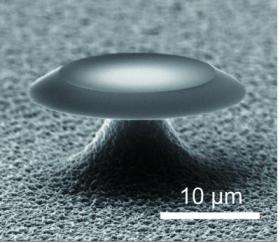
The principle behind whispering galleries - where words spoken softly beneath a domed ceiling or in a vault can be clearly heard on the opposite side of the chamber - has been used to achieve what could prove to be a significant breakthrough in the miniaturization of lasers. Ultrasmall lasers, i.e., nanoscale, promise a wide variety of intriguing applications, including superfast communications and data handling (photonics), and optical microchips for instant and detailed chemical analyses.
Researchers with the U.S. Department of Energy's Lawrence Berkeley National Laboratory (Berkeley Lab) and the California Institute of Technology have developed a "whispering gallery microcavity" based on plasmons - electromagnetic waves that race across the surfaces of metals. Such a plasmon wave has very small wavelength compared with the light, enabling the scaling down optical devices beyond diffraction limit of the light. Cavities are the confined spaces in lasers where light amplification takes place and this new micro-sized metallic cavity for plasmons improves on the quality of current plasmonic cavities by better than an order of magnitude.
"We have shown for the first time that metallic microcavities based on surface plasmons can have a large quality factor and can thereby enable ultra-small device fabrication and strong enhancement of the light," said Xiang Zhang, a mechanical engineer who holds a joint appointment with Berkeley Lab's Materials Sciences Division and the University of California (UC) Berkeley where he directs the NSF Nano-scale Science and Engineering Center.
"Plasmonic microcavities have uniquely different physical properties when compared to dielectric cavities and can extend microcavity research in entirely new ways, particularly at nanoscale dimensions," said Kerry Vahala, a physics professor at Cal Tech and authority on photonic devices. "Our work shows that the full potential of this new class of device can be realized with careful design and material control."
Zhang and Vahala led this collaborative research which is reported in the January 22, 2009 edition of the journal Nature. The paper is entitled: "High-Q surface-plasmon-polariton whispering-gallery microcavity." In addition to Zhang and Vahala, other authors of the paper were Bumki Min, Eric Ostby, Volker Sorger, Erick Ulin-Avila and Lan Yang.
Just as the energy in waves of light is carried through space in discrete or quantized particle-like units called photons, so, too, is the energy in waves of charged gas (plasma) carried in quantized particle-like packets called plasmons, as they travel along metallic surfaces. When photons excite the collective electron oscillations at the interfaces between metal and dielectric (insulator) materials, they can form yet another quasi-particle called a surface plasmon polariton(SPP). Such polaritons play an important role in the optical properties of metals and can be used to manipulate light on a nanoscale.
"Metal-dielectric materials, also known as plasmonics, can be used to confine an optical field to a very small scale, much smaller than conventional insulators," said Min, lead author on the Nature paper and former postdoctoral researcher in Zhang's Lab, now an assistant professor at the Korea Advanced Institute of Science and Technology (KAIST). "This capability, often termed as breaking the light diffraction, is unobtainable with dielectric materials alone."
The main obstacle to working with plasmonic materials for creating nanoscale lasers has been a low quality or "Q" factor, which is a measure of power loss in the lasing cavity - a laser cavity with a high-Q factor has a low power loss. Enter the whispering gallery phenomenon, which Cal Tech's Vahala has used to boost the Q factor of dielectric microcavities. Whispering galleries are found in circular or elliptically shaped buildings, such as St. Paul's Cathedral in London, where the phenomenon was first made famous, or Statuary Hall in the U.S. Capitol building.
The prevailing theory behind why whispering galleries work (first proposed in 1871 by British astronomer George Airy to explain St. Paul's cathedral) is that sound originating at one point along the circumference of an enclosed sphere is reflected to another point along the circumference opposite the source. Vahala and his group applied this idea to dielectric microcavities, and Zhang and Min along with Ostby, Sorger and Ulin-Avila applied the idea to plasmonic microcavities.
"In these sphere-shaped microcavities, optical waves propagate in a similar way that sound waves propagate in a whispering gallery," said Zhang. "They continue to circle around the edge of the cavity sphere and the smoothness of the edge enhances or boosts the cavity's Q factor."
In this study, Zhang and his collaborators created a high-Q SPP whispering gallery microcavity by coating the surface of a high-Q silica microcavity with a thin layer of silver.
Explained Zhang, "Whenever light propagates in a metal it experiences some loss of power and this obviously reduces the performance of a device. Silver is the metal with the lowest loss, that is available."
Whereas previous plasmonic microcavities achieved a best Q factor below 100, the whispering gallery plasmonic microcavity allows Q factors of 1,376 in the near infrared for SPP modes at room temperature.
"This nearly ideal value, which is close to the theoretical metal-loss-limited Q factor, is attributed to the suppression and minimization of radiation and scattering losses that are made possible by the geometrical structure and the fabrication method," said Min, who believes that there is still room for plasmonic Q-factor improvement by geometrical and material optimizations.
Min said one of the first applications of the whispering gallery plasmonic microcavity is likely to be the development of a plasmonic nanolaser.
"To build a working laser, it is essential to have both the laser cavity (or resonator) and the gain media," Min said. "Therefore, we need a good, high-Q plasmonic microcavity to make a plasmonic nanolaser. Our work paves the way to accomplish the demonstration of a real plasmonic nanolaser. In addition, fundamental research can also be pursued with this plasmonic cavity, such as the interaction of a single light emitter with plasmons."
Source: Lawrence Berkeley National Laboratory


