New Catalyst Paves the Path for Ethanol-Powered Fuel Cells
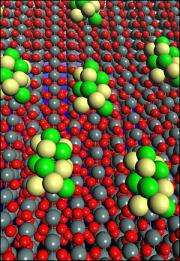
(PhysOrg.com) -- A team of scientists at the U.S. Department of Energy's (DOE) Brookhaven National Laboratory, in collaboration with researchers from the University of Delaware and Yeshiva University, has developed a new catalyst that could make ethanol-powered fuel cells feasible. The highly efficient catalyst performs two crucial, and previously unreachable steps needed to oxidize ethanol and produce clean energy in fuel cell reactions. Their results are published online in the January 25, 2009 edition of Nature Materials.
Like batteries that never die, hydrogen fuel cells convert hydrogen and oxygen into water and, as part of the process, produce electricity. However, efficient production, storage, and transport of hydrogen for fuel cell use is not easily achieved. As an alternative, researchers are studying the incorporation of hydrogen-rich compounds, for example, the use of liquid ethanol in a system called a direct ethanol fuel cell.
"Ethanol is one of the most ideal reactants for fuel cells," said Brookhaven chemist Radoslav Adzic. "It's easy to produce, renewable, nontoxic, relatively easy to transport, and it has a high energy density. In addition, with some alterations, we could reuse the infrastructure that's currently in place to store and distribute gasoline."
A major hurdle to the commercial use of direct ethanol fuel cells is the molecule's slow, inefficient oxidation, which breaks the compound into hydrogen ions and electrons that are needed to generate electricity. Specifically, scientists have been unable to find a catalyst capable of breaking the bonds between ethanol's carbon atoms.
But at Brookhaven, scientists have found a winner. Made of platinum and rhodium atoms on carbon-supported tin dioxide nanoparticles, the research team's electrocatalyst is capable of breaking carbon bonds at room temperature and efficiently oxidizing ethanol into carbon dioxide as the main reaction product. Other catalysts, by comparison, produce acetalhyde and acetic acid as the main products, which make them unsuitable for power generation.
"The ability to split the carbon-carbon bond and generate CO2 at room temperature is a completely new feature of catalysis," Adzic said. "There are no other catalysts that can achieve this at practical potentials."
Structural and electronic properties of the electrocatalyst were determined using powerful x-ray absorption techniques at Brookhaven's National Synchrotron Light Source, combined with data from transmission electron microscopy analyses at Brookhaven's Center for Functional Nanomaterials. Based on these studies and calculations, the researchers predict that the high activity of their ternary catalyst results from the synergy between all three constituents - platinum, rhodium, and tin dioxide - knowledge that could be applied to other alternative energy applications.
"These findings can open new possibilities of research not only for electrocatlysts and fuel cells but also for many other catalytic processes," Adzic said.
Next, the researchers will test the new catalyst in a real fuel cell in order to observe its unique characteristics first hand.
Provided by Brookhaven National Laboratory


