Dinosaur fossils fit perfectly into the evolutionary tree of life
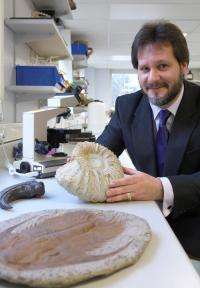
A recent study by researchers at the University of Bath and London’s Natural History Museum has found that scientists’ knowledge of the evolution of dinosaurs is remarkably complete.
Evolutionary biologists use two ways to study the evolution of prehistoric plants and animals: firstly they use radioactive dating techniques to put fossils in chronological order according to the age of the rocks in which they are found (stratigraphy); secondly they observe and classify the characteristics of fossilised remains according to their relatedness (morphology).
Dr Matthew Wills from the University of Bath’s Department of Biology & Biochemistry worked with Dr Paul Barrett from the Natural History Museum and Julia Heathcote at Birkbeck College (London) to analyse statistical data from fossils of the four major groups of dinosaur to see how closely they matched their trees of evolutionary relatedness.
The researchers found that the fossil record for the dinosaurs studied, ranging from gigantic sauropods to two-legged meat eaters such as T. rex, matched very well with the evolutionary tree, meaning that the current view of evolution of these creatures is very accurate.
Dr Matthew Wills explained: “We have two independent lines of evidence on the history of life: the chronological order of fossils in the rocks, and ‘trees’ of evolutionary relatedness.
“When the two tell the same story, the most likely explanation is that both reflect the truth. When they disagree, and the order of animals on the tree is out of whack with the order in the rocks, you either have a dodgy tree, lots of missing fossils, or both.
“What we’ve shown in this study is that the agreement for dinosaurs is remarkably good, meaning that we can have faith in both our understanding of their evolution, and the relative completeness of their fossil record.
“In other words, our knowledge of dinosaurs is very, very good.”
The researchers studied gaps in the fossil record, so-called ‘ghost ranges’, where the evolutionary tree indicates there should be fossils but where none have yet been found. They mapped these gaps onto the evolutionary tree and calculated statistical probabilities to find the closeness of the match.
Dr Wills said: “Gaps in the fossil record can occur for a number of reasons. Only a tiny minority of animals are preserved as fossils because exceptional geological conditions are needed. Other fossils may be difficult to classify because they are incomplete; others just haven’t been found yet.
“Pinning down an accurate date for some fossils can also prove difficult. For example, the oldest fossil may be so incomplete that it becomes uncertain as to which group it belongs. This is particularly true with fragments of bones. Our study made allowances for this uncertainty.
“We are excited that our data show an almost perfect agreement between the evolutionary tree and the ages of fossils in the rocks. This is because it confirms that the fossil record offers an extremely accurate account of how these amazing animals evolved over time and gives clues as to how mammals and birds evolved from them.”
The study, published in the peer-reviewed journal Sytematic Biology, was part of a project funded by the Biotechnology & Biological Sciences Research Council (BBSRC) that aimed to combine different forms of evolutionary evidence to produce more accurate evolutionary trees.
Reference: Wills, M.A., Barrett, P.M. & Heathcote, J.F. ‘The Modified Gap Excess Ratio (GER) and the Stratigraphic Congruence of Dinosaur Phylogenies’ is published in Systematic Biology Volume 57, Issue 6 December 2008 , 891 - 904.
Source: University of Bath


