Scientists Find First Creature With Eyes That Use Both Refractive and Reflective Optics
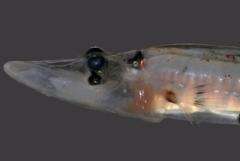
Florida Atlantic University researcher and member of the Center for Ocean Exploration and Deep-Sea Research at Harbor Branch Oceanographic Institute, Dr. Tamara Frank, was part of an international research team that discovered the first vertebrate with eyes that use mirrors rather than lenses to focus light. Results from this research have been published in the January issue of Current Biology.
The article, titled “A Novel Vertebrate Eye Using Both Refractive and Reflective Optics,” describes the unusual eyes of the spookfish, Dolichopteryx longipes. These eyes are tubular, which are similar in structure to the eyes of many other fish that swim in the ocean’s twilight zone where the background light field is very dim.
“What makes this animal so unusual is that each eye is divided into two parts, one pointing upwards and one pointing downwards, making it look like it has four eyes, and four-eyed fish don’t exist,” said Frank.
In the few other species of deep-sea fish that possess split eyes, the upper eye has a lens, like in the spookfish, for focusing light. However, at these depths, there is so little upwelling light that a lens would attenuate light too much in its efforts to focus the light for the lower eye. Therefore, in other fish, the lower eye doesn’t have a lens, resulting in a blurred image. The spookfish however, manages to focus light in the lower eye without using a lens. Light enters the lower portion of the eye and hits a mirror composed of stacks of crystals. The stacks sit roughly parallel to one another, but their angle changes over the surface of the mirror, giving it an overall concave shape. A computer simulation by research team member Dr. Julian Partridge, Bristol University, United Kingdom, showed that orientation of the plates within the mirror's curved surface is perfect for focusing reflected light onto the fish's retina. This is the first time that this type of focusing mechanism has ever been found in a vertebrate.
Many deep-sea or night active animals (including dogs and cats) use mirrors behind the retina to make their eyes more sensitive to light, hence why their eyes seem to glow when a light shines on them. It has been estimated that this reflecting layer, the tapetum, doubles the sensitivity of the eyes that possess them. With these animals, the mirror sits behind the eye and cannot focus light. In the spookfish, the mirror sits in front of the retina and serves to focus light, providing an image that’s much brighter than a lens could produce.
“While this species was first described 120 years ago, the few specimens that have been collected in the past were dead and quite mangled, so very little could be discerned about their visual systems,” said Frank.
The expedition, led by Dr. Hans-Joachim Wagner from Tübingen University in Germany on the German research vessel Sonne, utilized Frank’s “Tucker Trawl,” built by Harbor Branch’s engineering division. The opening/closing net has a special temperature-insulated collecting vessel at the end that can be closed at depth.
This feature enabled the scientists to secure the first-ever living specimen of this very rare fish from a depth of 700 meters over the Tonga Trench off Samoa. Pictures of the live animal immediately revealed that there was something unusual about the eye. Once back on land, the scientists examined the structure of the eye and discovered its unique properties.
Source: Florida Atlantic University


