New liquefaction hazard maps of Santa Clara Valley, Northern California
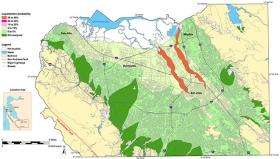
January 27, 2009 San Andreas Fault M 7.8 Scenario

Enlarge

San Andreas Fault M 7.8 Scenario

New hazard maps for communities from San Jose to Palo Alto in Northern California delineate the probability of earthquake-induced liquefaction, based on three scenarios: a magnitude 7.8 on the San Andreas Fault comparable to the 1906 event, a magnitude 6.7 on the Hayward Fault comparable to the 1868 event, and a magnitude 6.9 on the Calavaras Calaveras Fault.

The probability of liquefaction is highest at approximately 33 to 37 percent in some areas along major creeks for the San Andreas Fault scenario when the water table is relatively shallow, according to the report published by the February issue of the Bulletin of the Seismological Society of America (BSSA).

Until now, scientists have offered only qualitative maps of the liquefaction hazard in the Santa Clara Valley. Liquefaction is a physical process that takes place during some earthquakes, causing loose soil to act like water rather than a solid. The liquefied sand or soil may flow and the ground may move and crack, causing damage to surface structures and underground utilities, as it did in the valley during both the 1868 and 1906 earthquakes.

These probabilistic maps detail the degree of hazard within broader hazard zones and thereby provide a perspective on the actual risk to the user.

The high resolution maps can be found at http://earthquake.usgs.gov/regional/nca/liquefaction/ .

Reference: "Scenario Liquefaction Hazard Maps of Santa Clara Valley, Northern California," by Thomas L. Holzer, Thomas E. Noce and Michael J. Bennett of the U.S. Geological Survey in Menlo Park, CA.

Source: Seismological Society of America


print this article email this article download pdf blog this article bookmark this article     Stumble it Digg this share on Facebook retweet share on Reddit add to delicious
Rate this story - 3 /5 (3 votes)


January 27, 2009 all stories

Comments: 0

3 /5 (3 votes)
  • Stumble this up

  • Digg this

  • share this

  • hide
  • Related Stories


  • hide
  • Relevant PhysicsForums posts

Other News

Ghostly 'Spokes' Puff Out From Saturn's Ring's

Ghostly 'Spokes' Puff Out From Saturn's Ring's (w/ Video)

Space & Earth / Space Exploration

created 2 hours ago | popularity 5 / 5 (1) | comments 0

(PhysOrg.com) -- Massive, bright clouds of tiny ice particles hover above the darkened rings of Saturn in an image captured by the Cassini spacecraft on Sept. 22, 2009, around the time of Saturn's equinox. ...


NASA 'Drops' Next Generation Robotic Lander During Autonomous Tests

NASA 'Drops' Next Generation Robotic Lander During Autonomous Tests

Space & Earth / Space Exploration

created 2 hours ago | popularity 4 / 5 (1) | comments 0

(PhysOrg.com) -- NASA has successfully completed a series of autonomous "drop" tests of a robotic lander test article - in a record 10 months - to demonstrate the ability to perform a controlled landing on ...


Space shuttle Atlantis lifts off on supply mission (AP)

Space shuttle Atlantis lifts off on supply mission

Space & Earth / Space Exploration

created 2 hours ago | popularity not rated yet | comments 0

(AP) -- With 100 Internet-savvy NASA fans cheering on the shuttle and churning out constant Twitter updates, Atlantis sailed smoothly into orbit Monday with six astronauts and a full load of spare parts for ...


Close-up movie shows hidden details in the birth of super-suns

Close-up movie shows hidden details in the birth of super-suns (w/ Video)

Space & Earth / Astronomy

created 5 hours ago | popularity 4.7 / 5 (3) | comments 0

(PhysOrg.com) -- The constellation of Orion is a hotbed of massive star formation, most prominently in the Great Nebula that sits in Orion's sword. The glowing gas of the Nebula is powered by a group of young ...


Ancient high-altitude trees grow faster as temperatures rise

Space & Earth / Earth Sciences

created 3 hours ago | popularity 5 / 5 (2) | comments 0

PIC=32536:left]Increasing temperatures at high altitudes are fueling the post-1950 growth spurt seen in bristlecone pines, the world's oldest trees, according to new research.