Nuclear fusion-fission hybrid could contribute to carbon-free energy future
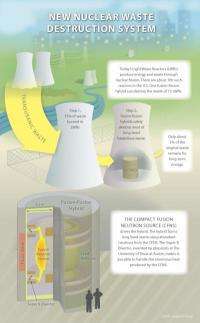
Physicists at The University of Texas at Austin have designed a new system that, when fully developed, would use fusion to eliminate most of the transuranic waste produced by nuclear power plants.
The invention could help combat global warming by making nuclear power cleaner and thus a more viable replacement of carbon-heavy energy sources, such as coal.
"We have created a way to use fusion to relatively inexpensively destroy the waste from nuclear fission," says Mike Kotschenreuther, senior research scientist with the Institute for Fusion Studies (IFS) and Department of Physics. "Our waste destruction system, we believe, will allow nuclear power-a low carbon source of energy-to take its place in helping us combat global warming."
Toxic nuclear waste is stored at sites around the U.S. Debate surrounds the construction of a large-scale geological storage site at Yucca Mountain in Nevada, which many maintain is costly and dangerous. The storage capacity of Yucca Mountain, which is not expected to open until 2020, is set at 77,000 tons. The amount of nuclear waste generated by the U.S. will exceed this amount by 2010.
The physicists' new invention could drastically decrease the need for any additional or expanded geological repositories.
"Most people cite nuclear waste as the main reason they oppose nuclear fission as a source of power," says Swadesh Mahajan, senior research scientist.
The scientists propose destroying the waste using a fusion-fission hybrid reactor, the centerpiece of which is a high power Compact Fusion Neutron Source (CFNS) made possible by a crucial invention.
The CFNS would provide abundant neutrons through fusion to a surrounding fission blanket that uses transuranic waste as nuclear fuel. The fusion-produced neutrons augment the fission reaction, imparting efficiency and stability to the waste incineration process.
Kotschenreuther, Mahajan and Prashant Valanju, of the IFS, and Erich Schneider of the Department of Mechanical Engineering report their new system for nuclear waste destruction in the journal Fusion Engineering and Design.
There are more than 100 fission reactors, called "light water reactors" (LWRs), producing power in the United States. The nuclear waste from these reactors is stored and not reprocessed. (Some other countries, such as France and Japan, do reprocess the waste.)
The scientists' waste destruction system would work in two major steps.
First, 75 percent of the original reactor waste is destroyed in standard, relatively inexpensive LWRs. This step produces energy, but it does not destroy highly radiotoxic, transuranic, long-lived waste, what the scientists call "sludge."
In the second step, the sludge would be destroyed in a CFNS-based fusion-fission hybrid. The hybrid's potential lies in its ability to burn this hazardous sludge, which cannot be stably burnt in conventional systems.
"To burn this really hard to burn sludge, you really need to hit it with a sledgehammer, and that's what we have invented here," says Kotschenreuther.
One hybrid would be needed to destroy the waste produced by 10 to 15 LWRs.
The process would ultimately reduce the transuranic waste from the original fission reactors by up to 99 percent. Burning that waste also produces energy.
The CFNS is designed to be no larger than a small room, and much fewer of the devices would be needed compared to other schemes that are being investigated for similar processes. In combination with the substantial decrease in the need for geological storage, the CFNS-enabled waste-destruction system would be much cheaper and faster than other routes, say the scientists.
The CFNS is based on a tokamak, which is a machine with a "magnetic bottle" that is highly successful in confining high temperature (more than 100 million degrees Celsius) fusion plasmas for sufficiently long times.
The crucial invention that would pave the way for a CFNS is called the Super X Divertor. The Super X Divertor is designed to handle the enormous heat and particle fluxes peculiar to compact devices; it would enable the CFNS to safely produce large amounts of neutrons without destroying the system.
"The intense heat generated in a nuclear fusion device can literally destroy the walls of the machine," says research scientist Valanju, "and that is the thing that has been holding back a highly compact source of nuclear fusion."
Valanju says a fusion-fission hybrid reactor has been an idea in the physics community for a long time.
"It's always been known that fusion is good at producing neutrons and fission is good at making energy," he says. "Now, we have shown that we can get fusion to produce a lot of neutrons in a small space."
Producing an abundant and clean source of "pure fusion energy" continues to be a goal for fusion researchers. But the physicists say that harnessing the other product of fusion-neutrons-can be achieved in the near term.
In moving their hybrid from concept into production, the scientists hope to make nuclear energy a more viable alternative to coal and oil while waiting for renewables like solar and pure fusion to ramp up.
"The hybrid we designed should be viewed as a bridge technology," says Mahajan. "Through the hybrid, we can bring fusion via neutrons to the service of the energy sector today. We can hopefully make a major contribution to the carbon-free mix dictated by the 2050 time scale set by global warming scientists."
The scientists say their Super X Divertor invention has already gained acceptance in the fusion community. Several groups are considering implemented the Super X Divertor on their machines, including the MAST tokamak in the United Kingdom, and the DIIID (General Atomics) and NSTX (Princeton University) in the U.S. Next steps will include performing extended simulations, transforming the concept into an engineering project, and seeking funding for building a prototype.
Source: University of Texas at Austin


