New study identifies how ebola virus avoids the immune system
January 27, 2009 New study identifies how ebola virus avoids the immune system

Enlarge

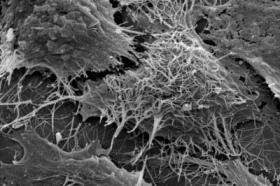
Scanning electron microscope image of Ebola virions (spaghetti-like filaments) on the surface of a tetherin-expressing cell (center). The other three cells seen in this image (upper right and upper and lower left) do not have the filamentous virus on their surfaces. Credit: Paul Bates, Ph.D., University of Pennsylvania School of Medicine

(PhysOrg.com) -- Researchers at the University of Pennsylvania School of Medicine have likely found one reason why the Ebola virus is such a powerful, deadly, and effective virus. Using a cell culture model for Ebola virus infection, they have discovered that the virus disables a cellular protein called tetherin that normally can block the spread of virus from cell to cell.

"Tetherin represents a new class of cellular factors that possess a very different means of inhibiting viral replication," says study author Paul Bates, PhD, Associate Professor of Microbiology at the University of Pennsylvania School of Medicine. "Tetherin is the first example of a protein that affects the virus replication cycle after the virus is fully made and prevents the virus from being able to go off and infect the next cell." These findings appear online this week in the Proceedings of the National Academy of Sciences.

When a cell is infected with a virus like Ebola, which is deadly to 90 percent of people infected, the cell is pirated by the virus and turned into a production factory that makes massive quantities on new virions. These virions are then released from that cell to infect other cells and promote the spreading infection.

Tetherin is one of the immune system's responses to a viral infection. If working properly, tetherin stops the infected cell from releasing the newly made virus, thus shutting down spread to other cells. However, this study shows that the Ebola virus has developed a way to disable tetherin, thus blocking the body's response and allowing the virus to spread.

"This information gives us a new way to study how tetherin works," says Bates. "Binding of a protein produced by Ebola to tetherin apparently inactivates this cellular factor. Understanding how the Ebola protein blocks the activity of tetherin may facilitate the design of therapeutics to inhibit this interaction, allowing the cell's natural defense systems to slow down viral replication and give the animal or person a chance to mount an effective antiviral response and recover."

Previous research had found that tetherin plays a role in the immune system's response to HIV-1, a retrovirus, and that tetherin is also disabled by HIV. These new studies reveal that human cells also use this defense against other types of viruses, such as Ebola, that are not closely related to HIV-1. "Because we see such broad classes of viruses that are affected by tetherin, it's possible that all enveloped viruses are targets of this antiviral system," says Bates. "If so, then understanding how tetherin works and how viruses escape from the effect of tetherin will be very important."

Provided by University of Pennsylvania


print this article email this article download pdf blog this article bookmark this article     Stumble it Digg this share on Facebook retweet share on Reddit add to delicious
Rate this story - 4.5 /5 (11 votes)

Rank Filter

Move the slider to adjust rank threshold, so that you can hide some of the comments.


Display comments: newest first


January 27, 2009 all stories

Comments: 1

4.5 /5 (11 votes)
  • Stumble this up

  • Digg this

  • share this

  • hide
  • Related Stories

  • Sponges against cancer
    created Nov 20, 2009 | popularity not rated yet | comments 0
  • Scientists identify DNA that regulates antibody production
    created Nov 20, 2009 | popularity not rated yet | comments 0
  • New research helps explain why bird flu has not caused a pandemic
    created Nov 19, 2009 | popularity not rated yet | comments 0
  • New culprit for viral infections among elderly -- an overactive immune response
    created Nov 18, 2009 | popularity not rated yet | comments 0
  • Imaging study shows HIV particles assembling around its genome
    created Nov 17, 2009 | popularity not rated yet | comments 0


  • hide
  • Relevant PhysicsForums posts

  • nesfatin
    created 6 hours ago
  • Obsessive Compulsive Disorder
    created Nov 20, 2009
  • West's zone 2 starling resistor respiratory physiology
    created Nov 18, 2009
  • 50-0-50 rule
    created Nov 18, 2009
  • More from Physics Forums - Medical Sciences

Other News

New cancer target for non-Hodgkin's lymphoma

Medicine & Health / Cancer

created 7 hours ago | popularity 5 / 5 (1) | comments 0

Physician-scientists from Weill Cornell Medical College have discovered a molecular mechanism that may prove to be a powerful target for the treatment of non-Hodgkin's lymphoma, a type of cancer that affects lymphocytes, ...


Surface bacteria maintain skin's healthy balance

Medicine & Health / Research

created 8 hours ago | popularity 5 / 5 (3) | comments 0

On the skin's surface, bacteria are abundant, diverse and constant, but inflammation is undesirable. Research at the University of California, San Diego School of Medicine now shows that the normal bacteria living on the ...


Gene mismatch influences success of bone marrow transplants

Medicine & Health / Genetics

created 7 hours ago | popularity not rated yet | comments 0

A commonly inherited gene deletion can increase the likelihood of immune complications following bone marrow transplantation, an international team of researchers reports in the November 22 advance online issue of Nature Ge ...


New understanding about mechanism for cell death after stroke leads to possible therapy

Medicine & Health / Research

created 8 hours ago | popularity not rated yet | comments 0

Scientists at the Brain Research Centre, a partnership of the University of British Columbia Faculty of Medicine and Vancouver Coastal Health Research Institute, have uncovered new information about the mechanism by which ...


Cancer metabolism discovery uncovers new role of IDH1 gene mutation in brain cancer

Medicine & Health / Cancer

created 7 hours ago | popularity not rated yet | comments 0

Agios Pharmaceuticals today announced that its scientists have established, for the first time, that the mutated IDH1 gene has a novel enzyme activity consistent with a cancer-causing gene, or oncogene. This breakthrough ...