Wall Divides East and West Sides of Cosmic Metropolis
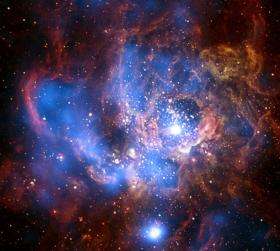
January 27, 2009 Wall Divides East and West Sides of Cosmic Metropolis

Enlarge

Credits: X-ray: NASA/CXC/CfA/R. Tuellmann et al.; Optical: NASA/AURA/ STScI

(PhysOrg.com) -- A new study unveils NGC 604, the largest region of star formation in the nearby galaxy M33, in its first deep, high-resolution view in X- rays. This composite image from Chandra X-ray Observatory data (colored blue), combined with optical light data from the Hubble Space Telescope (red and green), shows a divided neighborhood where some 200 hot, young, massive stars reside.

Throughout the cosmic metropolis, giant bubbles in the cool dust and warm gas are filled with diffuse, multi-million degree gas that emits X-rays. Scientists think these bubbles are generated and heated to X- ray temperatures when powerful stellar winds from the young massive stars collide and push aside the surrounding gas and dust. So, the vacated areas are immediately repopulated with the hotter material seen by Chandra.

However, there is a difference between the two sides of this bifurcated stellar city. (See annotated image for the location of the "wall".) On the western (right) side, the amount of hot gas found in the bubbles corresponds to about 4300 times the mass of the sun. This value and the brightness of the gas in X-rays imply that the western part of NGC 604 is entirely powered by winds from the 200 hot massive stars.

This result is interesting because previous modeling of other bubbles usually predicted them to be fainter than observed, so that additional heating from supernova remnants is required. The implication is that in this area of NGC 604, none or very few of the massive stars must have exploded as supernovas.

The situation is different on the eastern (left) side of NGC 604. On this side, the X-ray gas contains 1750 times the mass of the sun and winds from young stars cannot explain the brightness of the X-ray emission. The bubbles on this side appear to be much older and were likely created and powered by young stars and supernovas in the past.

A similar separation between east and west is seen in the optical results. This implies that a massive wall of gas shields the relatively quiet region in the east from the active star formation in the west.

This study was led by Ralph Tuellmann of the Harvard Smithsonian Center for Astrophysics and was part of a very deep, 16-day long observation of M33 called the Chandra ACIS Survey of M33, or ChASeM33.

Provided by NASA


print this article email this article download pdf blog this article bookmark this article     Stumble it Digg this share on Facebook retweet share on Reddit add to delicious
Rate this story - 4.2 /5 (5 votes)

Rank Filter

Move the slider to adjust rank threshold, so that you can hide some of the comments.


Display comments: newest first

  • theophys - Jan 27, 2009
    • Rank: not rated yet
    Mr. Gorbachev, tear down that cosmic wall!
    I know it has basically no relevence to the article, but how often do you get a chance to use a Reagan quote in reference to astrophysics?
  • Thecis - Jan 28, 2009
    • Rank: 1 / 5 (1)
    hahaha.
    You must be ashamed of yourself. A good quote can do wonders but to use a phrase said by an american actor that got lucky?? ;-)
  • LuckyBrandon - Jan 28, 2009
    • Rank: 5 / 5 (1)
    do you think those WIMPs can jump the wall?
  • theophys - Jan 29, 2009
    • Rank: 1 / 5 (1)
    hahaha.
    You must be ashamed of yourself. A good quote can do wonders but to use a phrase said by an american actor that got lucky?? ;-)

    It's a good phrase, even if the president who said it kinda sucked.
  • jonnyboy - Feb 01, 2009
    • Rank: not rated yet
    theo, whenever you get the urge to add a comment, don't!!!!

    Pull the plug instead
  • theophys - Feb 02, 2009
    • Rank: not rated yet
    Looks like we have a Reagan fan. Or a hater of corny jokes.

January 27, 2009 all stories

Comments: 6

4.2 /5 (5 votes)
  • Stumble this up

  • Digg this

  • share this

  • hide
  • Related Stories

  • XMM-Newton celebrates decade of discovery
    created Dec 09, 2009 | popularity not rated yet | comments 0
  • RIT astronomer mines Spitzer Space Telescope data for massive starbursts
    created Dec 08, 2009 | popularity not rated yet | comments 0
  • Cosmic rays hunted down: Physicists are closing in on the origin of cosmic rays
    created Dec 07, 2009 | popularity not rated yet | comments 0
  • Team using Subaru Telescope makes major discovery
    created Dec 03, 2009 | popularity not rated yet | comments 0
  • Stellar family portrait takes imaging technique to new extremes
    created Dec 03, 2009 | popularity not rated yet | comments 0


  • hide
  • Relevant PhysicsForums posts

Other News

Earth

Earth's atmosphere came from outer space, find scientists

Space & Earth / Earth Sciences

created 9 hours ago | popularity 4.1 / 5 (13) | comments 5

(PhysOrg.com) -- The gases which formed the Earth's atmosphere - and probably its oceans - did not come from inside the Earth but from outer space, according to a study by University of Manchester and University ...


mars surface

Rare Scottish mineral may indicate life on Mars

Space & Earth / Space Exploration

created 14 hours ago | popularity 3.5 / 5 (15) | comments 5

(PhysOrg.com) -- A team of NASA (National Aeronautics and Space Administration) scientists is looking for clues about life on Mars in an earthy clay mineral found only in Aberdeenshire in Scotland.


Rear Wheel Trouble Continues

Spirit Rover: Rear Wheel Trouble Continues

Space & Earth / Space Exploration

created 5 hours ago | popularity 5 / 5 (4) | comments 0

(PhysOrg.com) -- Results of diagnostic tests on Spirit's right-rear wheel on Sol 2109 (Dec. 8, 2009) continue to indicate a troubled wheel, which may leave the rover with only four operable wheels.


An unusual light phenomenon above the Norwegian city of Skjeroy

New Russian missile failure sparks UFO frenzy

Space & Earth / Space Exploration

created 11 hours ago | popularity 5 / 5 (4) | comments 10

Russia's new nuclear-capable missile suffered another failed test launch, the defence ministry said Thursday, solving the mystery of a spectacular plume of white light that appeared over Norway.


Cassini closes in on the centuries-old mystery of Saturn's moon Iapetus

Cassini closes in on the centuries-old mystery of Saturn's moon Iapetus

Space & Earth / Space Exploration

created 9 hours ago | popularity 4.5 / 5 (2) | comments 0

Extensive analyses and modeling of Cassini imaging and heat-mapping data have confirmed and extended previous ideas that migrating ice, triggered by infalling reddish dust that darkens and warms the surface, ...