Big cats, wild pigs and short-eared dogs -- oh, my!
January 27, 2009 Jaguar Camera Trap

Enlarge

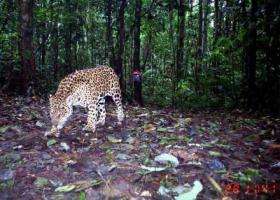
A jaguar recently captured in a camera trap in Ecuador. Credit: Santiago Espinosa

The Wildlife Conservation Society (WCS) released photos today from the first large-scale census of jaguars in the Amazon region of Ecuador—one of the most biologically rich regions on the planet.

The ongoing census, which began in 2007, is working to establish baseline population numbers as oil exploration and subsequent development puts growing pressure on wildlife in Ecuador's Yasuni National Park and adjacent Waorani Ethnic Reserve. Together, these two protected areas make up some 6,500 square miles (16,800 square kilometers) of wilderness.

The research is being carried out by a team led by WCS research fellow Santiago Espinosa. Espinosa's team, which includes several members of the Waorani indigenous group, set up a complex system of "camera traps," that photograph animals remotely when they trip a sensor that detects body heat. His work is being funded by WCS, WWF, and the University of Florida.

So far the team has taken 75 pictures of jaguars, which can be individually identified through their unique pattern of spots. Other images show jaguar prey species, such as white-lipped peccaries, and other rarely seen species, including two pictures of a short-eared dog, a relative of foxes and wolves.

"The main threats to jaguars in Ecuador are habitat degradation and loss due to various human activities," said Espinosa. "Bushmeat hunting by local communities has increased due to road development that provides access to otherwise isolated areas. Additionally, people hunt bushmeat to sell commercially in local markets, rather than simply for their own consumption. There is competition for food as people hunt the same prey species as the jaguar. If the prey species disappear, the jaguar will be gone."

Espinosa's preliminary data show far fewer jaguars in more hunted areas compared to remote study sites. In his first survey at a heavily hunted site within Yasuni National Park, Espinosa identified only three individual jaguars. At his second study site in a rarely hunted and remote area, he distinguished 14 different jaguars—almost five times as many as near the populated site.

Espinosa and WCS plan to extend the jaguar camera trap surveys to other areas of Ecuador, working with local communities in both the Amazon region and along the coast where most of the forests are gone but still may provide refuge to jaguars.

Source: Wildlife Conservation Society


print this article email this article download pdf blog this article bookmark this article     Stumble it Digg this share on Facebook retweet share on Reddit add to delicious
Rate this story - 4 /5 (5 votes)


January 27, 2009 all stories

Comments: 0

4 /5 (5 votes)
  • Stumble this up

  • Digg this

  • share this

  • hide
  • Related Stories

  • Study explores violent world of raptors
    created 4 hours ago | popularity not rated yet | comments 0
  • Rocket science leads to new whale discovery
    created 19 hours ago | popularity not rated yet | comments 0
  • Report shows dramatic decline in Siberian tigers
    created 20 hours ago | popularity not rated yet | comments 0
  • BoarCroc, RatCroc, DogCroc, DuckCroc and PancakeCroc
    created Nov 19, 2009 | popularity not rated yet | comments 0
  • Extinct goat was cold-blooded
    created Nov 18, 2009 | popularity not rated yet | comments 0


Other News

Redback spiders were first spotted in Japan in 1995

Venomous Aussie redback spiders invading Japan

Biology / Ecology

created 4 hours ago | popularity not rated yet | comments 0

Australia's venomous redback spiders are on the march in Japan, where they are believed to have arrived years ago as stowaways on cargo ships, a wildlife expert warned Wednesday.


Sustainable Corn Production Supports Advanced Biofuel Feedstocks

Sustainable Corn Production Supports Advanced Biofuel Feedstocks

Biology / Biotechnology

created 1hour ago | popularity 5 / 5 (1) | comments 1

(PhysOrg.com) -- Researchers worldwide are trying to economically convert cellulosic biomass such as corn stover into "cellulosic ethanol." But Agricultural Research Service (ARS) scientists have found that ...


Study explores violent world of raptors

Biology / Plants & Animals

created 4 hours ago | popularity not rated yet | comments 0

A journey that started with a box of bird feet carried three Montana State University graduate students into the gruesome world of raptors and led to their findings being published in a prominent journal.


Asian carp may have breached barrier protecting Lake Michigan

Biology / Ecology

created 12 hours ago | popularity 5 / 5 (4) | comments 0

Two feared species of Asian carp have zoomed beyond the $9 million electric barriers built to keep them out of Lake Michigan. Now, the only thing left between the carp and the Great Lakes is a lock and dam in southern Chicago.


Got a pain? -- Have a cup of Brazilian mint

Biology / Plants & Animals

created 14 hours ago | popularity 4.6 / 5 (7) | comments 0

For thousands of years it has been prescribed by traditional healers in Brazil to treat a range of ailments from headaches and stomach pain to fever and flu.