Physical therapists test mechanical arm to help patients recover from stroke, traumatic brain injury
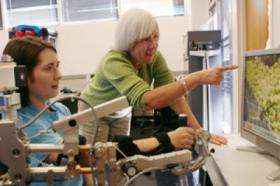
Physical therapists at UT Southwestern Medical Center are evaluating a new mechanical arm that allows people recovering from neurological injuries such as strokes and traumatic brain injury to enter a virtual world where they can repeatedly practice movements needed to regain arm strength and movement.
UT Southwestern is one of fewer than a dozen sites testing how the Armeo device, with its virtual environment and weight support system for the arm, stacks up against traditional therapies in which individuals physically pick up objects.
Studies have demonstrated that repetition is key to quicker recovery from neurological injuries, and researchers hope that Armeo's ability to counter gravitational forces will allow patients to perform the required tasks more often than when they are aided by therapists, said Dr. Patricia Smith, professor and vice chair of physical therapy at UT Southwestern.
"If I work with someone for 30 minutes in a traditional program, they might be able to practice five specific tasks three times. We think we can triple that using the Armeo, possibly more, so we're in the process of testing its efficacy," said Dr. Smith, who studies motor recovery and quality of life issues of people recovering from stroke.
Aubrey White is a study participant. She was in dance class, having just completed a successful season on her high-school drill team, when she suffered a stroke four years ago.
"When I first woke up, I was fully paralyzed," she said. "I couldn't feel anything on my right side and I couldn't talk."
Ms. White began her journey to learn to walk and talk again after successful surgery by Dr. Duke Samson, chairman of neurological surgery at UT Southwestern, for arterial venous malformation.
"I have just always seen it as a temporary thing that I have to work through," said the now 21-year-old Texas A&M University student, who lives independently in a second-floor townhome. "I go to the grocery store. I cook and clean. I drive myself back and forth to class and from here to there."
While she has remastered her gross motor skills, Ms. White is using the Armeo to fine tune the function of her right arm.
"I saw it and thought this is really cool, like a video game," said the college senior, who finds gripping objects most difficult. "I like that it gives you functional tasks versus just doing the movement. It gives you a goal and that's really helpful for me. It's more entertaining than regular therapy."
Armeo's weight support system allows an individual to master a wide range of movements and complete a highly repetitive number of tasks, even with limited function in the affected arm.
"It doesn't control your muscle. It takes the weight off your arm," Dr. Smith said. "You can take gravity away, so the individual can generate force in an easier environment."
Assigned tasks are based on using different muscles, and include virtual exercises such as cleaning a stove, washing a window, catching fish and capturing raindrops in a mug. The exercises also help stroke patients plan perceptually what steps they need to take. The counter-gravitational support can then be reduced over time so the individual bears more and more weight independently. A computer then records speed and frequency of repetitions to track progress.
Arm functions are more diverse and complex than walking, but both are based on a similar therapeutic strategy called neural plasticity, said Dr. Smith, a board certified clinical specialist in neurologic physical therapy. Neural plasticity encourages the brain to reorganize itself by building new synapses and using otherwise suppressed neural networks to compensate for damaged or injured ones. To do so, the brain needs specific and meaningful tasks to perform over and over, so the increased repetitions available through the aid of robotics are expected to be beneficial, Dr. Smith said.
Source: UT Southwestern Medical Center


