Black hole outflows from Centaurus A detected with APEX
January 28, 2009
Black hole outflows from Centaurus A detected with APEX

Enlarge

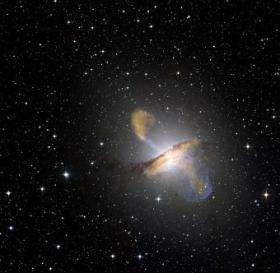
Colour composite image of Centaurus A, revealing the lobes and jets emanating from the active galaxy’s central black hole. This is a composite of images obtained with three instruments, operating at very different wavelengths. The 870-micron submillimetre data, from LABOCA on APEX, are shown in orange. X-ray data from the Chandra X-ray Observatory are shown in blue. Visible light data from the Wide Field Imager (WFI) on the MPG/ESO 2.2 m telescope located at La Silla, Chile, show the background stars and the galaxy’s characteristic dust lane in close to "true colour". Credit: ESO/WFI (Optical); MPIfR/ESO/APEX/A.Weiss et al. (Submillimetre); NASA/CXC/CfA/R.Kraft et al. (X-ray)

(PhysOrg.com) -- Astronomers have a new insight into the active galaxy Centaurus A (NGC 5128), as the jets and lobes emanating from the central black hole have been imaged at submillimetre wavelengths for the first time. The new data, from the Atacama Pathfinder Experiment (APEX) telescope in Chile, which is operated by ESO, have been combined with visible and X-ray wavelengths to produce this striking new image.

Centaurus A is our nearest giant galaxy, at a distance of about 13 million light-years in the southern constellation of Centaurus. It is an elliptical galaxy, currently merging with a companion spiral galaxy, resulting in areas of intense star formation and making it one of the most spectacular objects in the sky. Centaurus A hosts a very active and highly luminous central region, caused by the presence of a supermassive black hole, and is the source of strong radio and X-ray emission.

In the image, we see the dust ring encircling the giant galaxy, and the fast-moving radio jets ejected from the galaxy centre, signatures of the supermassive black hole at the heart of Centaurus A. In submillimetre light, we see not only the heat glow from the central dust disc, but also the emission from the central radio source and - for the first time in the submillimetre - the inner radio lobes north and south of the disc. Measurements of this emission, which occurs when fast-moving electrons spiral around the lines of a magnetic field, reveal that the material in the jet is travelling at approximately half the speed of light. In the X-ray emission, we see the jets emerging from the centre of Centaurus A and, to the lower right of the galaxy, the glow where the expanding lobe collides with the surrounding gas, creating a shockwave.

The Large APEX Bolometer Camera (LABOCA), built by the Max-Planck-Institute for Radio Astronomy (MPIfR), is mounted on APEX, a 12-metre diameter submillimetre-wavelength telescope located on the 5000 m high plateau of Chajnantor in the Chilean Atacama region. APEX is a collaboration between the MPIfR, the Onsala Space Observatory and ESO. The telescope is based on a prototype antenna constructed for the next generation Atacama Large Millimeter/submillimeter Array (ALMA) project. Operation of APEX at Chajnantor is entrusted to ESO.

The APEX observations of Centaurus A are presented in the paper by Axel Weiss et al. 2008, LABOCA observations of nearby, active galaxies, A&A, 490, 77-86. http://arxiv.org/abs/0808.3358

Provided by ESO

4.7 /5 (14 votes)  

Filter


Move the slider to adjust rank threshold, so that you can hide some of the comments.


Display comments: newest first

Going
Jan 28, 2009

Rank: not rated yet
There is currently (Jan 09) an excellent documentary on the National Geographic channel called " Cosmic Monsters" about galactic center massive black holes.

There is currently (Jan 09) an excellent documentary on the Discovery channel called " Cosmic Monsters" about galactic center massive black holes.
Going
Jan 28, 2009

Rank: not rated yet
There is currently (Jan 09) an excellent documentary on the National Geographic channel called " Cosmic Monsters" about galactic center massive black holes.
See http://uk.youtube...BhEa-ypk&feature=related
Sophos
Jan 29, 2009

Rank: not rated yet
Centaurus A is our nearest giant galaxy, at a distance of about 13 million light-years in the southern constellation of Centaurus. It is an elliptical galaxy, currently merging with a companion spiral galaxy,


Doesn't that mean 13 million years ago is was currently merging
Rank 4.7 /5 (14 votes)
Relevant PhysicsForums posts
  • Never ending outer space.....
    created20 hours ago
  • Neutron Star fragments?
    created22 hours ago
  • stationary or not?
    createdFeb 11, 2012
  • Scale of the Universe
    createdFeb 10, 2012
  • Titan's lack of impact craters
    createdFeb 09, 2012
  • Real pictures of black hole eating a star?
    createdFeb 08, 2012
  • More from Physics Forums - General Astronomy

More news stories

Salvage workers begin pumping fuel from Italian shipwreck

Salvage workers Sunday began pumping fuel from the shipwrecked Italian cruise liner Costa Concordia, a day ahead of schedule, officials said.

Space & Earth / Environment

created 5 hours ago | popularity not rated yet | comments 0

Latin America mining boom clashes with conservation

Latin America is experiencing a mining boom as prices rise fuelled by a hike in global demand, but the region is also being hit by a wave of violent protests, strikes and rallies by environmentalists.

Space & Earth / Environment

created 13 hours ago | popularity 5 / 5 (1) | comments 1

Political leaders play key role in how worried Americans are by climate change: study

More than extreme weather events and the work of scientists, it is national political leaders who influence how much Americans worry about the threat of climate change, new research finds.

Space & Earth / Environment

created Feb 06, 2012 | popularity 5 / 5 (7) | comments 73

NASA budget will axe Mars deal with Europe: scientists

US President Barack Obama's budget proposal to be submitted next week for 2013 will cut NASA's budget by 20 percent and eliminate a major partnership with Europe on Mars exploration, scientists said Thursday.

Space & Earth / Space Exploration

created Feb 10, 2012 | popularity 5 / 5 (3) | comments 58

Humans may have helped the decline of African rainforests 3000 years ago

(PhysOrg.com) -- Large areas of rainforests in Central Africa mysteriously disappeared over three thousand years ago, to be replaced by savannas. The prevailing theory has been that the cause was a change ...

Space & Earth / Environment

created Feb 10, 2012 | popularity 4.1 / 5 (14) | comments 21 | with audio podcast report


Declining health-care productivity in England: Who says so?

Reports that the National Health Service in England has been declining in productivity in the last decade appear to have been accepted as fact. However, a Viewpoint published Online First by The Lancet disputes this. The Vi ...

Scientists discover molecular secrets of 2,000-year-old Chinese herbal remedy

For roughly two thousand years, Chinese herbalists have treated Malaria using a root extract, commonly known as Chang Shan, from a type of hydrangea that grows in Tibet and Nepal. More recent studies suggest that halofuginone, ...

New method to examine batteries -- MRI from the inside

There is an ever-increasing need for advanced batteries for portable electronics, such as phones, cameras, and music players, but also to power electric vehicles and to facilitate the distribution and storage of energy derived ...

Overeating may double risk of memory loss

New research suggests that consuming between 2,100 and 6,000 calories per day may double the risk of memory loss, or mild cognitive impairment (MCI), among people age 70 and older. The study was released today and will be ...

A mitosis mystery solved: How chromosomes align perfectly in a dividing cell

Although the process of mitotic cell division has been studied intensely for more than 50 years, Whitehead Institute researchers have only now solved the mystery of how cells correctly align their chromosomes during symmetric ...

Lab study raises questions over nano-particle impact

Tests involving chickens have raised questions about the impact on health from engineered nano-particles, the ultra-fine grains commonly used in drugs and processed foods, scientists said on Sunday.