Deceiving cell walls
January 28, 2009
Inhibition of Autolysis and Cell Separation in Bacterial Cultures

Enlarge

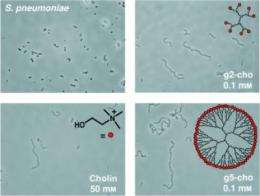
Choline-binding proteins from Streptococcus pneumoniae recognize distinctive multivalent choline architectures on the bacterial cell wall. Choline-functionalized dendrimers are potent inhibitors of these essential enzymes, with a 1000-10000-fold higher affinity than free choline, resulting in inhibition of autolysis and cell separation in bacterial cultures at low micromolar concentrations. (C) Wiley-VCH 2009

(PhysOrg.com) -- Approximately 1.6 million people die worldwide every year as a result of pneumococcal infection, which causes grave illnesses, including pneumonia, meningitis, and middle-ear infections. Children and the elderly are especially at risk. Vaccines are only effective against a few of the pneumococcal types and increasing resistance to antibiotics is making treatment more difficult.

Researchers led by Jesús M. Sanz at the Miguel Hernandez University (Elche, Spain) and Maarten Merkx at the Eindhoven University of Technology (Netherlands) have now introduced a highly promising new approach for the development of drugs to treat pneumococci. As they report in the journal Angewandte Chemie, the scientists copied the choline architecture of the pneumococcal cell wall. They were thus able to trap the choline-binding proteins that have a critical effect on the infectiousness of pneumococcal bacteria.

The cell walls of pneumococci contain special polymers, called teichoic acids, that are equipped with phosphocholine groups and induce a characteristic choline architecture on the cell walls. The choline groups act as docking stations for a number of special proteins that are involved in important processes such as cell-wall division, the release of bacterial toxins, and adhesion to infected tissues. These choline-binding proteins (CBP) contain domains with multiple neighboring choline-binding sites. The protein LytA, for example, has a domain with four choline-binding sites.

If choline is added to a culture of pneumococci, the molecules occupy the choline binding sites of the CBPs so that the proteins can no longer bind to the cell walls of the pneumococci. Although the bacteria continue to multiply, the individual cells can no longer separate from each other, which results in long chains of linked cells. In addition, the toxin-releasing self-destruction (autolysis) typical of pneumococci at the end of their life cycle is stopped.

However, choline is not suitable for use as a drug because an effective dose would be far too high. The researchers thus developed the foundation for a new drug that binds CBP much more strongly than individual choline molecules. Their trick: the drug imitates the choline architecture of the cell wall by presenting multiple choline groups. As a scaffold for their assembly of choline groups, the researchers chose to use dendrimers (tree-like branched molecules), attaching the choline groups to the tips of the "branches". The choline ends can simultaneously occupy multiple choline binding sites of the CBP. The dendrimer frameworks are flexible enough to meet the spatial demands of the application. The required dosage of this CBP inhibitor lies within the range that is acceptable for pharmaceuticals.

Paper: Jesús M. Sanz, Multivalent Choline Dendrimers as Potent Inhibitors of Pneumococcal Cell-Wall Hydrolysis Angewandte Chemie International Edition 2009, 48, No. 5, 948�, doi: 10.1002/anie.200803664

Provided by Wiley

4.5 /5 (2 votes)  

Rank 4.5 /5 (2 votes)
Relevant PhysicsForums posts

More news stories

Scientists discover molecular secrets of 2,000-year-old Chinese herbal remedy

For roughly two thousand years, Chinese herbalists have treated Malaria using a root extract, commonly known as Chang Shan, from a type of hydrangea that grows in Tibet and Nepal. More recent studies suggest that halofuginone, ...

Chemistry / Biochemistry

created 4 hours ago | popularity 4.7 / 5 (12) | comments 4 | with audio podcast

New method to examine batteries -- MRI from the inside

There is an ever-increasing need for advanced batteries for portable electronics, such as phones, cameras, and music players, but also to power electric vehicles and to facilitate the distribution and storage of energy derived ...

Chemistry / Analytical Chemistry

created 4 hours ago | popularity 5 / 5 (5) | comments 0 | with audio podcast

Hydrogen from acidic water: Researchers develop potential low cost alternative to platinum for splitting water

A technique for creating a new molecule that structurally and chemically replicates the active part of the widely used industrial catalyst molybdenite has been developed by researchers with the Lawrence Berkeley ...

Chemistry / Materials Science

created Feb 09, 2012 | popularity 4.8 / 5 (16) | comments 21 | with audio podcast

Fool's gold may prove an unlikely alternative to overexploited catalytic materials

Catalytic materials, which lower the energy barriers for chemical reactions, are used in everything from the commercial production of chemicals to catalytic converters in car engines. However, with current catalytic materials ...

Chemistry / Materials Science

created Feb 10, 2012 | popularity 4.4 / 5 (8) | comments 8 | with audio podcast

Research provides octagonal window of opportunity for carbon capture

(PhysOrg.com) -- Filtering carbon dioxide, a greenhouse gas, from factory smokestacks is a necessary, but expensive part of many manufacturing processes. However, a collaborative research team from the National ...

Chemistry / Materials Science

created Feb 08, 2012 | popularity 5 / 5 (2) | comments 5 | with audio podcast


Overeating may double risk of memory loss

New research suggests that consuming between 2,100 and 6,000 calories per day may double the risk of memory loss, or mild cognitive impairment (MCI), among people age 70 and older. The study was released today and will be ...

Google might launch Drive for cloud storage soon

(PhysOrg.com) -- Google's next big move, according to the Wall Street Journal, is a cloud storage service called Drive. Hardly first to the plate, Google is simply catching up to introducing its cloud reposi ...

Injured boomers beware: Know when to see doctor

(AP) -- It happened to nurse Jane Byron years after an in-line skating fall, business owner Haralee Weintraub while doing "men's" push-ups, and avid cyclist Gene Wilberg while lifting a heavy box.

Lab study raises questions over nano-particle impact

Tests involving chickens have raised questions about the impact on health from engineered nano-particles, the ultra-fine grains commonly used in drugs and processed foods, scientists said on Sunday.

A mitosis mystery solved: How chromosomes align perfectly in a dividing cell

Although the process of mitotic cell division has been studied intensely for more than 50 years, Whitehead Institute researchers have only now solved the mystery of how cells correctly align their chromosomes during symmetric ...

Starve a virus, feed a cure? Findings show how some cells protect themselves against HIV

A protein that protects some of our immune cells from the most common and virulent form of HIV works by starving the virus of the molecular building blocks that it needs to replicate, according to research published online ...