Researchers may have found why women have an edge on salt-sensitive hypertension
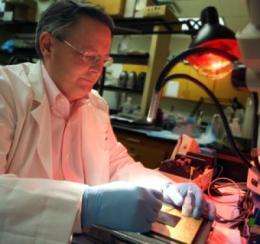
Researchers may have found why women have an edge in keeping a healthier balance between the amount of salt they eat and excrete - at least before reaching menopause.
Premenopausal women are known to have fewer problems with salt-sensitive hypertension and hypertension in general, but afterward their risks are essentially the same as men, says Dr. David Pollock, renal physiologist in the Vascular Biology Center at the Medical College of Georgia.
The reason appears to be related to female hormones and a new-found role of a cell receptor previously thought to be only harmful, he and colleagues report in the February issue of Hypertension.
Their finding points to the need for gender studies on how these endothelin A, or ETA, receptors work in the blood vessels and tubules of the kidney. They also may help explain the swelling that occurs in some patients taking powerful new ETA antagonists, which are in use for pulmonary hypertension and under study for conditions such as diabetic nephropathy and uncontrolled hypertension. These antagonists block the action of ETA receptors which are believed to raise blood pressure and help reshape blood vessels into thick, rigid pipes.
ETA receptors have been considered the evil sibling of endothelin B, or ETB, receptors, which are believed to stimulate nitric oxide production, blood vessel relaxation and salt excretion, Dr. Pollock says. "Normally the ETB receptor system is a decision maker about how much sodium to keep and how much to excrete."
As with Dr. Pollock's rats, people with ETB receptor problems are said to be salt sensitive. "We know from other studies we have done that this endothelin B receptor is critical to keeping you from becoming hypertensive when you eat salt," Dr. Pollock says.
The body gets the sodium it needs from food and a healthy kidney should be able to eliminate excess from a high-salt diet so there is always a balance between what is consumed and excreted. Salt-sensitive hypertension means kidneys hold onto too much salt. When the kidneys realize the blood pressure is getting too high they try to get rid of salt. If they can't, in an ironic twist, blood pressure goes even higher to help literally force salt out of the kidneys. That approach eventually works but over time the high-pressure pounding away at blood vessels can cause heart attack, stroke and/or kidney failure, the type of end stage organ damage associated with hypertension, Dr. Pollock says.
In female rats at least, ETA receptors are less prone to reduce blood flow to the kidneys compared to males and actually increases sodium excretion without increasing blood pressure. Researchers found this by studying a rat missing the ETB receptor. When they gave the animals the protein endothelin to see if it could help them excrete salt without an ETB receptor, males did not respond but females experienced a significant improvement. When they took out the ovaries, female rats responded more like the males. Dr. Pollock says estrogen seems to drive the beneficial action of the ETA receptor. Additionally, researchers found stimulation of the ETB receptor increased urine output and sodium excretion in both sexes, suggesting that it was not a player in the differing responses between males and females.
"According to what we know, blocking the ETA receptor is a good thing and blocking the ETB receptor is a bad thing," Dr. Pollock says. Their findings indicate that actually may depend on whether you are a male or female rat and point to the need for human studies, he adds.
MCG researchers plan more laboratory studies to more specifically determine what different receptor subtypes are doing in the kidney's tubules and vasculature while colleagues at the University of Edinburgh in Scotland are beginning studies to look at how ETA receptor blockers impact sodium excretion in humans.
Source: Medical College of Georgia


