Tiny plants with a global impact - results of climate change experiment published
January 28, 2009
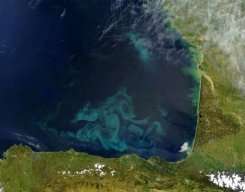
Clouds of blue and green phytoplankton swirl and twine in the waters of the Bay of Biscay

Clouds of blue and green phytoplankton swirl and twine in the waters of the Bay of Biscay in this NASA Terra satellite image in 2004. Proposals to combat global warming by sowing the sea with iron to promote carbon-gobbling plankton may be badly overblown, according to a study published on Wednesday.

A possible solution to global warming may be further away than ever, according to a new report published in the prestigious scientific journal Nature this week.

Scientists measuring how much of the greenhouse gas carbon dioxide is locked away in the deep ocean by plankton when it dies found that it was significantly less than previous estimates.

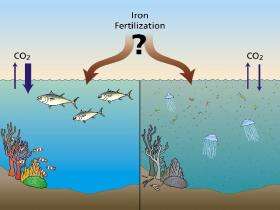
Plankton is a natural sponge for carbon dioxide. It occurs naturally in the ocean and its growth is stimulated by iron which it uses to photosynthesise and grow. When plankton dies it sinks to the bottom of the ocean locking away some of the carbon it has absorbed from the atmosphere.

Fertilising plankton by the artificial addition of iron has long been proposed as a potential way to geo-engineer the removal of carbon dioxide from the atmosphere.
Tiny plants with a global impact - results of climate change experiment published
Enlarge

Carbon sequestering

Researchers analysed an area of the Southern ocean known to be naturally rich in iron and their report reveals that the amount of carbon sequestered to the deep ocean for a given input of natural iron falls far short of previous geo-engineering estimates. This has serious implications for proposals to influence climate change through iron fertilisation of the sea.

Yet some researchers believe that the theory should not be discounted and that more research is needed

Dr Gary Fones is a marine biogeochemist at the University of Portsmouth’s School of Earth and Environmental Science. He was part of the team which carried out the study around the Crozet islands in the Southern ocean.

He said: “We know that carbon is transported to the deep ocean and seabed via the plankton, but the question is how much and for how long?” The combined results of all the studies undertaken so far indicate that there could be other factors influencing the amount of carbon exported.

“No-one has found a solution yet to tackle the issue of global warming and further research is needed to determine exactly what’s going on, particularly with regards to iron fertilisation.”

The report is timely as it coincides with the recent halt of a controversial Indo-German expedition also in the Southern Ocean. Just days ago, a ship carrying scientists from India and Germany were prevented from dumping iron into the sea as part of an experiment to artificially fertilise the ocean and stimulate phytoplankton growth.

Reports suggest that the German government suspended the operation following claims by green campaigners that it breaches a UN moratorium on ocean fertilisation. But the scientists involved believe that legitimate scientific experiments were specifically approved by the Convention for Biological Diversity (CBD) and they assert that the research is crucial to understanding more.

Dr Fones agrees. He argues that the experiment is not so-called geo-engineering for profit but is part of an important piece of research. He said:

“Efforts to find a solution to global warming are under threat by those people who are most concerned about climate change. But legitimate experiments like this one are crucial to learning more about the effects of iron fertilisation and will help scientists evaluate the merits of such a scheme.”

He agrees that adding iron in large quantities could potentially damage the whole biological food chain but argues that the German-Indian experiment is literally a drop in the ocean. Experiments like this will have a minimal impact on the surrounding area but will massively further our understanding of the science.”

Provided by University of Portsmouth

Filter


Move the slider to adjust rank threshold, so that you can hide some of the comments.


Display comments: newest first

GrayMouser
Jan 28, 2009

Rank: 3 / 5 (4)
Isn't it wonderful how, when somebody wants to do an experiment to confirm or deny a theory, all of the modelers say that the experiment doesn't need to be done because their model shows it won't work (or not as well as predicted)?
MikeB
Jan 28, 2009

Rank: 3 / 5 (2)
How much cooler do we need to make the earth. My wife and I can't even agree on what temperature to set the thermostat at. Maybe we should have a vote, state by state, so that we can agree on what temperature we would like the climate scientists to set the thermostat at.
GrayMouser
Jan 28, 2009

Rank: 1 / 5 (2)
How much cooler do we need to make the earth. My wife and I can't even agree on what temperature to set the thermostat at. Maybe we should have a vote, state by state, so that we can agree on what temperature we would like the climate scientists to set the thermostat at.


How about county by county?
lengould100
Mar 03, 2009

Rank: not rated yet
suspended the operation following claims by green campaigners


Yappy doomers are just worried that the experiment might actually work, thus enabling some continuation of modern civilization.
Rank 4 /5 (10 votes)
Relevant PhysicsForums posts
  • Do some geologists actually act a lot like Randy Marsh?
    createdFeb 11, 2012
  • Discrepancy between oxygen and carbon-dioxide levels
    createdFeb 09, 2012
  • where gems are found in the world
    createdFeb 09, 2012
  • Wind Waves in Reservoir ~ Wind run-up and Wind set-up
    createdFeb 08, 2012
  • Balance of oxygen in the atmosphere
    createdFeb 01, 2012
  • The case for a methanol-based economy
    createdJan 30, 2012
  • More from Physics Forums - Earth

More news stories

Latin America mining boom clashes with conservation

Latin America is experiencing a mining boom as prices rise fuelled by a hike in global demand, but the region is also being hit by a wave of violent protests, strikes and rallies by environmentalists.

Space & Earth / Environment

created 11 hours ago | popularity 5 / 5 (1) | comments 1

Salvage workers begin pumping fuel from Italian shipwreck

Salvage workers Sunday began pumping fuel from the shipwrecked Italian cruise liner Costa Concordia, a day ahead of schedule, officials said.

Space & Earth / Environment

created 3 hours ago | popularity not rated yet | comments 0

Political leaders play key role in how worried Americans are by climate change: study

More than extreme weather events and the work of scientists, it is national political leaders who influence how much Americans worry about the threat of climate change, new research finds.

Space & Earth / Environment

created Feb 06, 2012 | popularity 5 / 5 (6) | comments 73

NASA budget will axe Mars deal with Europe: scientists

US President Barack Obama's budget proposal to be submitted next week for 2013 will cut NASA's budget by 20 percent and eliminate a major partnership with Europe on Mars exploration, scientists said Thursday.

Space & Earth / Space Exploration

created Feb 10, 2012 | popularity 5 / 5 (3) | comments 58

Humans may have helped the decline of African rainforests 3000 years ago

(PhysOrg.com) -- Large areas of rainforests in Central Africa mysteriously disappeared over three thousand years ago, to be replaced by savannas. The prevailing theory has been that the cause was a change ...

Space & Earth / Environment

created Feb 10, 2012 | popularity 4.1 / 5 (14) | comments 20 | with audio podcast report


Google might launch Drive for cloud storage soon

(PhysOrg.com) -- Google's next big move, according to the Wall Street Journal, is a cloud storage service called Drive. Hardly first to the plate, Google is simply catching up to introducing its cloud reposi ...

Scientists discover molecular secrets of 2,000-year-old Chinese herbal remedy

For roughly two thousand years, Chinese herbalists have treated Malaria using a root extract, commonly known as Chang Shan, from a type of hydrangea that grows in Tibet and Nepal. More recent studies suggest that halofuginone, ...

New method to examine batteries -- MRI from the inside

There is an ever-increasing need for advanced batteries for portable electronics, such as phones, cameras, and music players, but also to power electric vehicles and to facilitate the distribution and storage of energy derived ...

Lab study raises questions over nano-particle impact

Tests involving chickens have raised questions about the impact on health from engineered nano-particles, the ultra-fine grains commonly used in drugs and processed foods, scientists said on Sunday.

Injured boomers beware: Know when to see doctor

(AP) -- It happened to nurse Jane Byron years after an in-line skating fall, business owner Haralee Weintraub while doing "men's" push-ups, and avid cyclist Gene Wilberg while lifting a heavy box.

A mitosis mystery solved: How chromosomes align perfectly in a dividing cell

Although the process of mitotic cell division has been studied intensely for more than 50 years, Whitehead Institute researchers have only now solved the mystery of how cells correctly align their chromosomes during symmetric ...