Mountain caribou's ancient ancestry revealed
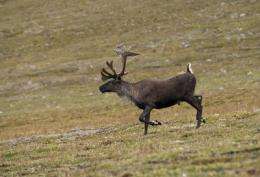
The declining mountain caribou populations of Canada's southern Rockies are a more distinct breed than scientists previously believed, according to a new study by University of Calgary researchers that is shedding light on the ancient ancestry of the mountain-dwelling herbivores.
In a study published in the current issue of the journal Molecular Ecology, Faculty of Environmental Design PhD candidate Byron Weckworth and his research group describe how Alberta and British Columbia's mountain caribou populations are remnants of blending between the two major subspecies of caribou that likely occurred during the end of the last ice age about 10,000 years ago.
"These are special animals because they are not woodland caribou or tundra caribou, but a very interesting combination of the two," Weckworth said. "Mountain caribou are an important part of the genetic diversity of the entire species and maintaining that diversity will be critical as caribou face the impacts of continued human development and climate change into the future."
An analysis of mountain caribou DNA and 10 years of tracking the migratory patterns of populations across the southern Rockies in the Yellowstone-to-Yukon corridor, including western Alberta and eastern BC, showed that mountain caribou are hybrids of migratory tundra caribou and sedentary woodland caribou. The researchers believe the blending likely occurred during glacial retreat at the end of the last ice age when both subspecies of caribou could have expanded into the newly ice-free corridor along the eastern slopes of the Rockies.
"Their DNA is basically part woodland and part tundra, which is fascinating because this mixture is apparent given the genetic expression of migratory behavior." Weckworth said. "Among these mountain caribou we see a wide range of behavior from some individuals that don't migrate at all to some that move up to 100 kilometres between the foothills and the mountains every year. Populations contain both migratory and non-migratory individuals, and it is exactly this type of variation that provides them with the flexibility to adapt to a landscape that is changing due to climatic conditions and human activities."
Their findings could lead to a change in how the endangered populations are managed due to their unique genetics and behavior. For example, the Little Smoky population in Alberta has been declining for over a decade because of human-caused habitat changes that are believed to be altering predator-prey relationships. Genetic analyses confirm that the Little Smoky population is different from other caribou populations in west-central Alberta, and is likely the last remnant of distinct boreal caribou along the eastern slopes of the Canadian Rockies.
The study, which was supported by Weyerhaeuser, the Canadian Association of Petroleum Producers, Shell Canada, Parks Canada, and Alberta Department of Sustainable Resource Development, concludes that new conservation plans may be required to reflect the mountain caribou's unique nature.
"It is impossible to predict all the impacts of something like climate change, but we know that migration has been an important adaptive response in the past, and so it is best to preserve this unique genetic and behavioral variability to better enable caribou to adapt to an uncertain future," Weckworth said.
The article "Survival in the Rockies of an endangered hybrid swarm from diverged caribou (Rangifer tarandus) lineages" by Allan D. McDevitt, Stefano Mariani, Mark Hebblewhite, Nicholas J. Decesare, Luigi Morgantini, Dale Seip, Byron V. Weckworth and Marco Musiani is available online at: www3.interscience.wiley.com/jo … rnal/119878204/issue .
Source: University of Calgary


