NASA Invites Public to Choose Hubble's Next Discovery
January 28, 2009 Hubble Space Telescope

Hubble Space Telescope

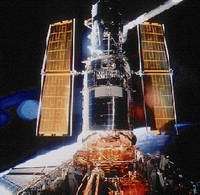
(PhysOrg.com) -- NASA is giving everyone the opportunity to use the world's most celebrated telescope to explore the heavens and boldly look where the Hubble Space Telescope has never looked before.

NASA is inviting the public to vote for one of six candidate astronomical objects for Hubble to observe in honor of the International Year of Astronomy. The options, which Hubble has not previously photographed, range from far-flung galaxies to dying stars. Votes can be cast until March 1. Hubble's camera will make a high resolution image revealing new details about the object that receives the most votes. The image will be released during the International Year of Astronomy's "100 Hours of Astronomy" from April 2 to 5.

Space enthusiasts can cast their vote at: http://YouDecide.Hubblesite.org

Everyone who votes also will be entered into a random drawing to receive one of 100 copies of the Hubble photograph made of the winning celestial body.

NASA also invites teachers and students to participate in an accompanying Hubble Space Telescope classroom collage activity that integrates art, science and language arts. Students in participating classes will select their favorite Hubble images and assemble them in a collage. Students in each class also will choose their favorite object from the image voting contest and write essays about why they made their selections.

The Hubble Space Telescope, launched in 1990, was designed so that it can be repaired in space by astronauts. The next servicing mission to the telescope is targeted to launch on space shuttle Atlantis May 12, 2009. Mission objectives include extending Hubble's operational life by five years, repairing its out-of-commission instruments and enhancing its scientific power. To do so, astronauts will replace gyroscopes and batteries on the telescope, repair the Space Telescope Imaging Spectrograph and the Advanced Camera for Surveys and install two new instruments -- the Wide Field Camera 3 and the Cosmic Origins Spectrograph.

For more information about the servicing mission, visit: http://hubble.nasa.gov/missions/sm4.php

For more information about the Hubble Space Telescope, visit: http://www.nasa.gov/hubble

Provided by NASA


print this article email this article download pdf blog this article bookmark this article     Stumble it Digg this share on Facebook retweet share on Reddit add to delicious
Rate this story - 5 /5 (4 votes)


January 28, 2009 all stories

Comments: 0

5 /5 (4 votes)
  • Stumble this up

  • Digg this

  • share this

  • hide
  • Related Stories

  • NASA's Great Observatories Celebrate International Year of Astronomy
    created 29 minutes ago | popularity not rated yet | comments 0
  • Swift, XMM-Newton satellites tune into a middleweight black hole
    created 6 hours ago | popularity not rated yet | comments 0
  • 'Dropouts' pinpoint earliest galaxies
    created Nov 06, 2009 | popularity not rated yet | comments 0
  • Kepler Mission Update
    created Nov 06, 2009 | popularity not rated yet | comments 0
  • Hubble Image Showcases Star Birth in M83, the Southern Pinwheel
    created Nov 05, 2009 | popularity not rated yet | comments 0


  • hide
  • Relevant PhysicsForums posts

  • Favourite Astronomy Book?
    created 11 hours ago
  • dark energy
    created 11 hours ago
  • The shape of our solar system's orbits.
    created Nov 07, 2009
  • Above or Below the Line of Nodes
    created Nov 07, 2009
  • More from Physics Forums - General Astronomy

Other News

Electronic Waste Needs to Go Green

Space & Earth / Environment

created 4 minutes ago | popularity not rated yet | comments 0

(PhysOrg.com) -- Americans love their consumer electronics, but what happens to all the gadgets when their useful life is over? Despite being one of the largest generators of "e-waste" in the world, the U.S. has no federal ...


Noise Evidence Could Expand Hurricane Record

Noise Evidence Could Expand Hurricane Record

Space & Earth / Earth Sciences

created 11 minutes ago | popularity not rated yet | comments 0

As sea-surface temperatures rise across the globe, some scientists believe that hurricane frequency and intensity may increase. A fresh technique offers promise to generate new data from long-dead storms, ...


New NASA 3-D Video Shows Thunderstorms in Tropical Storm Ida

New NASA 3-D Video Shows Thunderstorms in Tropical Storm Ida (w/ Video)

Space & Earth / Earth Sciences

created 44 minutes ago | popularity not rated yet | comments 0

(PhysOrg.com) -- NASA's Tropical Rainfall Measuring Mission, or TRMM satellite has the ability to provide data that can be made into three-dimensional images. Visualizers at NASA's Goddard Space Flight Center ...


The 2009 Leonid Meteor Shower

The 2009 Leonid Meteor Shower

Space & Earth / Space Exploration

created 32 minutes ago | popularity not rated yet | comments 0

This year's Leonid meteor shower peaks on Tuesday, Nov. 17th. If forecasters are correct, the shower should produce a mild but pretty sprinkling of meteors over North America followed by a more intense outburst ...


NASA's Great Observatories Celebrate International Year of Astronomy

NASA's Great Observatories Celebrate International Year of Astronomy

Space & Earth / Astronomy

created 29 minutes ago | popularity not rated yet | comments 0

(PhysOrg.com) -- A never-before-seen view of the turbulent heart of our Milky Way galaxy is being unveiled by NASA on Nov. 10. This event will commemorate the 400 years since Galileo first turned his telescope ...