Names give cows a lotta bottle
January 28, 2009 Names give cows a lotta bottle

Enlarge

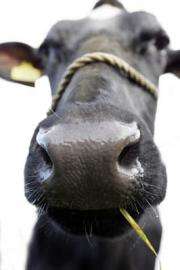
(PhysOrg.com) -- A cow with a name produces more milk than one without, scientists at Newcastle University have found. Drs Catherine Douglas and Peter Rowlinson have shown that by giving a cow a name and treating her as an individual, farmers can increase their annual milk yield by almost 500 pints.

The study, published online today in the academic journal Anthrozoos, found that on farms where each cow was called by her name the overall milk yield was higher than on farms where the cattle were herded as a group.

“Just as people respond better to the personal touch, cows also feel happier and more relaxed if they are given a bit more one-to-one attention,” explains Dr Douglas, who works in the School of Agriculture, Food and Rural Development at Newcastle University.

"What our study shows is what many good, caring farmers have long since believed.

“By placing more importance on the individual, such as calling a cow by her name or interacting with the animal more as it grows up, we can not only improve the animal's welfare and her perception of humans, but also increase milk production."

Dairy farmer Dennis Gibb, who co-owns Eachwick Red House Farm outside Newcastle with his brother Richard, says he believes treating every cow as an individual is “vitally important”.

“They aren’t just our livelihood - they’re part of the family,” says Dennis. “We love our cows here at Eachwick and every one of them has a name. Collectively we refer to them as ‘our ladies’ but we know every one of them and each one has her own personality.”

What the study found

The Newcastle University study looked at how farmers’ attitudes to their cows influenced milk production.

Dr Douglas and Dr Rowlinson questioned 516 UK dairy farmers about how they believed humans could affect the productivity, behaviour and welfare of dairy cattle.

Almost half - 46 per cent - said the cows on their farm were called by name. Those that called their cows by name had a 258 litre higher milk yield than those who did not.

Sixty six per cent of farmers said they “knew all the cows in the herd” and 48 per cent agreed that positive human contact was more likely to produce cows with a good milking temperament.

Almost 10 per cent said that a fear of humans resulted in a poor milking temperament.

Dr Douglas added: “Our data suggests that on the whole UK dairy farmers regard their cows as intelligent beings capable of experiencing a range of emotions.

“Placing more importance on knowing the individual animals and calling them by name can - at no extra cost to the farmer - also significantly increase milk production."

Academic paper: Exploring stock managers’ perceptions of the human-animal relationship on dairy farms and an association with milk production. Catherine Douglas (nee Bertenshaw) and Peter Rowlinson

Published in: Anthrozoos, Berg Publishing. DOI: 10.2752/089279307X224764

Provided by Newcastle University


print this article email this article download pdf blog this article bookmark this article     Stumble it Digg this share on Facebook retweet share on Reddit add to delicious
Rate this story - 4 /5 (6 votes)


January 28, 2009 all stories

Comments: 0

4 /5 (6 votes)
  • Stumble this up

  • Digg this

  • share this

  • hide
  • Related Stories

  • Ig Nobel: Researchers named the cream of the crop
    created Oct 02, 2009 | popularity not rated yet | comments 0
  • Pharmaceutical breakthrough may make a range of drugs cheaper and more available
    created Jan 31, 2008 | popularity not rated yet | comments 0
  • Study links chemical to inhibited milk synthesis, secretion in humans
    created Oct 08, 2007 | popularity not rated yet | comments 0
  • Colorado county copes with methane mystery
    created Nov 02, 2009 | popularity not rated yet | comments 0
  • Study of baby teeth yields new findings on nuclear fallout
    created Oct 21, 2009 | popularity not rated yet | comments 0


  • hide
  • Relevant PhysicsForums posts

Other News

Museum: Galileo's fingers, tooth are found (AP)

Museum: Galileo's fingers, tooth are found

Other Sciences / Archaeology & Fossils

created 18 hours ago | popularity not rated yet | comments 5

(AP) -- Two fingers and a tooth removed from Galileo Galilei's corpse in a Florentine basilica in the 18th century and given up for lost have been found again and will soon be put on display, an Italian museum ...


Measure to change U. of Neb. stem-cell rule fails (AP)

Measure to change U. of Neb. stem-cell rule fails (Update 2)

Other Sciences / Other

created 18 hours ago | popularity 5 / 5 (1) | comments 0

(AP) -- The University of Nebraska's governing board on Friday voted not to place tighter restrictions on embryonic stem cell research than those outlined under federal guidelines, which were expanded after ...


Researcher: Faint writing seen on Shroud of Turin (AP)

Researcher: Faint writing seen on Shroud of Turin (Update)

Other Sciences / Archaeology & Fossils

created Nov 20, 2009 | popularity 1.9 / 5 (23) | comments 23

(AP) -- A Vatican researcher has rekindled the age-old debate over the Shroud of Turin, saying that faint writing on the linen proves it was the burial cloth of Jesus. Experts say the historian may be reading ...


Three of a kind

Three of a kind: Revealing language’s universal essence

Other Sciences / Social Sciences

created Nov 20, 2009 | popularity 3.9 / 5 (11) | comments 6

(PhysOrg.com) -- On the surface, English, Japanese, and Kinande, a member of the Bantu family of languages spoken in the Democratic Republic of Congo, have little in common. It is not just that the vocabularies ...


Maya

New insights into the life of the Maya

Other Sciences / Archaeology & Fossils

created Nov 16, 2009 | popularity 4.6 / 5 (15) | comments 7

(PhysOrg.com) -- Ancient artifacts are almost always concerned with rich and powerful religious and political leaders, but new excavations of an ancient Maya site have unearthed a pyramid decorated with murals ...