Taking the Stress Out of Magnetic Field Detection
January 28, 2009 Taking the Stress Out of Magnetic Field Detection

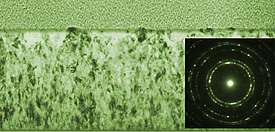
Transmission electron microscope (TEM) images show sections of a continuous 400-nanometer-thick magnetic film of a nickle-iron-copper-molybdenum alloy (top) and a film of the same alloy layered with silver every 100 nanometers (bottom). By relieving strain in the film, the silver layers promote the growth of notably larger crystal grains in the layered material as compared to the monolithic film (several are highlighted for emphasis). Electron diffraction patterns (insets) tell a similar story—the material with larger crystal grains display sharper, more discrete scattering patterns. (Color added for clarity.) Credit: Bonevich, NIST

(PhysOrg.com) -- Researchers at the National Institute of Standards and Technology have discovered that a carefully built magnetic sandwich that interleaves layers of a magnetic alloy with a few nanometers of silver “spacer” has dramatically enhanced sensitivity—a 400-fold improvement in some cases. This material could lead to greatly improved magnetic sensors for a wide range of applications from weapons detection and non-destructive testing to medical devices and high-performance data storage.

Those applications and many others are based on thin films of magnetic materials in which the direction of magnetization can be switched from one orientation to another. An important characteristic of a magnetic film is its saturation field, the magnitude of the applied magnetic field that completely magnetizes the film in the same direction as the applied field—the smaller the saturation field, the more sensitive the device.

The saturation field is often determined by the amount of stress in the film—atoms under stress due to the pull of bonds with neighboring atoms are more resistant to changing their magnetic orientation. Metallic films develop not as a single monolithic crystal, like diamonds, but rather as a random mosaic of microscopic crystals called grains. Atoms on the boundaries between two different grains tend to be more stressed, so films with a lot of fine grains tend to have more internal stress than coarser grained films. Film stress also increases as the film is made thicker, which is unfortunate because thick films are often required for high magnetization applications.

The NIST research team discovered that magnetic film stress could be lowered dramatically by periodically adding a layer of a metal, having a different crystal structure or lattice spacing, in between the magnetic layers. Although the mechanism isn’t completely understood, according to lead author William Egelhoff Jr., the intervening layers disrupt the magnetic film growth and induce the creation of new grains that grow to be larger than they do in the monolithic films. The researchers prepared multilayer films with layers of a nickel-iron-copper-molybdenum magnetic alloy each 100 nanometers (nm) thick, interleaved with 5-nm layers of silver. The structure reduced the tensile stress (over a monolithic film of equivalent thickness) by a factor of 200 and lowered the saturation field by a factor of 400.

The work has particular application in the design of “flux concentrators,” magnetic structures that draw in external magnetic field lines and concentrate them in a small region. Flux concentrators are used to amplify fields in compact magnetic sensors used for a wide variety of applications.

* W.F. Egelhoff, Jr., J. Bonevich, P. Pong, C.R. Beauchamp, G.R. Stafford, J. Unguris, and R.D. McMichael. 400-fold reduction in saturation field by interlayering. J. Appl. Phys. 105, 013921 (2009). Published online Jan. 13, 2009. DOI:10.1063/1.3058673

Provided by NIST


print this article email this article download pdf blog this article bookmark this article     Stumble it Digg this share on Facebook retweet share on Reddit add to delicious
Rate this story - 3.8 /5 (4 votes)

Rank Filter

Move the slider to adjust rank threshold, so that you can hide some of the comments.


Display comments: newest first

  • 3432682 - Jan 29, 2009
    • Rank: not rated yet
    It would be nice to know some of the specific applications, other than the general "amplify fields in compact magnetic sensors used for a wide variety of applications" at the very end.

    For instance, would this help in hard drives read/write heads?

January 28, 2009 all stories

Comments: 1

3.8 /5 (4 votes)
  • Stumble this up

  • Digg this

  • share this

  • hide
  • Related Stories

  • Capture of nanomagnetic 'fingerprints' a boost for next-generation information storage media
    created Jan 29, 2009 | popularity not rated yet | comments 0
  • Warming up for Magnetic Resonance Imaging
    created May 08, 2008 | popularity not rated yet | comments 0
  • HYPER-CEST MRI breaks new ground in molecular imaging
    created Oct 19, 2006 | popularity not rated yet | comments 0
  • First vortex 'chains' observed in engineered superconductor
    created Dec 12, 2005 | popularity not rated yet | comments 0
  • Nanomagnets bend the rules
    created Apr 19, 2005 | popularity not rated yet | comments 0


  • hide
  • Relevant PhysicsForums posts

  • Do you know elementary physics?
    created 1hour ago
  • Bicycles and their mad skillz
    created 1hour ago
  • Clarification of doubts on rolling motion
    created 5 hours ago
  • dropping meat on weighing scale
    created 6 hours ago
  • More from Physics Forums - General Physics

Other News

Aquatic creatures mix ocean water

Physics / General Physics

created 1hour ago | popularity not rated yet | comments 0

Understanding mixing in the ocean is of fundamental importance to modeling climate change or predicting the effects of an El Niño on our weather. Modern ocean models primarily incorporate the effects of winds and tides. However, ...


Nuclear weapons: Predicting the unthinkable

Physics / General Physics

created 4 hours ago | popularity 1 / 5 (1) | comments 0

If a nuclear weapon were detonated in a metropolitan area, how large would the affected area be? Where should first responders first go? According to physicist Fernando Grinstein, we have some initial understanding to address ...


Generating electricity from air flow

Physics / General Physics

created 4 hours ago | popularity 3.5 / 5 (4) | comments 1

A group of researchers at the City College of New York is developing a new way to generate power for planes and automobiles based on materials known as piezoelectrics, which convert the kinetic energy of motion into electricity. ...


Butterfly proboscis to sip cells

Physics / General Physics

created 1hour ago | popularity not rated yet | comments 0

A butterfly's proboscis looks like a straw -- long, slender, and used for sipping -- but it works more like a paper towel, according to Konstantin Kornev of Clemson University. He hopes to borrow the tricks of this piece ...


Restored machine to explore mysteries of Big Bang (AP)

Restored machine to explore mysteries of Big Bang

Physics / General Physics

created Nov 21, 2009 | popularity 4.5 / 5 (16) | comments 14

(AP) -- Scientists are preparing the world's largest atom smasher to explore the depths of matter after successfully restarting the $10 billion machine following more than a year of repairs.