Researchers 'unzip' molecules to measure interactions keeping DNA packed in cells
January 28, 2009
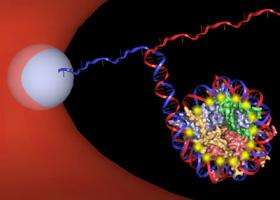
A DNA molecule containing a nucleosome is unzipped using a microsphere held in an optical trap, allowing precise mapping of histone-DNA interactions within the nucleosome. Yellow dots indicate the locations of strong interactions, determined to near-base pair accuracy.
(PhysOrg.com) -- Anyone who has ever battled a stuck zipper knows it's a good idea to see what's stuck, where and how badly -- and then to pull hard. A Cornell research team's experiments involve the "unzipping" of single DNA molecules. By mapping the hiccups, stoppages and forces along the way, they have gained new insight into how genes are packed and expressed within cells.
The research, "High-resolution dynamic mapping of histone-DNA interactions in a nucleosome," published online Jan. 11, 2009, in Nature Structural and Molecular Biology, was led by Michelle Wang, associate professor of physics and Howard Hughes Medical Institute Investigator. Collaborators on the project included physics graduate student Michael Hall and John Lis, the Barbara McClintock Professor of Molecular Biology and Genetics.
DNA - the molecules that contain genetic information - are nucleic acids often illustrated as long, thin strands of double helices. DNA fits inside cell nuclei by being wound like thread around proteins called histones, forming tightly packed bundles called nucleosomes. But that same DNA must often be uncoiled and accessed by such enzymes as RNA polymerase, which the researchers liken to a motor because it moves along the DNA in the process of gene transcription.
"There is this paradox," Lis explained. "On one hand you need compaction and the packing away of DNA. On the other hand, you need accessibility, so the cellular machines can read the information contained in the DNA."
Trying to understand what happens during that unwrapping process is at the heart of this research team's efforts. By unzipping each DNA double helix through a nucleosome using an optical trap -- a technique developed in Wang's lab -- they unwrapped strands of DNA from their histone cores, observing, with near-base pair accuracy, the interactions that took place along the way.
"Our hope is that if we can establish and understand the interactions within the nucleosome, we can begin to understand how the motor proteins can invade the nucleosome," Wang said.
Optical trapping involves a focused beam of light that can "trap" small objects. A refractive sphere is chemically attached to the DNA strand, and the optical trap moves the sphere, allowing the researchers to unzip the DNA strands apart by pulling, Hall explained. By doing so, the researchers re-created what happens in the cell when DNA uncoils from the histone core, and they measured the blips along the way -- for example, when the DNA strand had to be pulled apart from a protein molecule -- and how much force was needed to keep going.
"It's really like a zipper," Hall said. "And when there is a protein in there, it's kind of like you have a piece of cloth stuck. You know you can get it out, but you just have to pull harder, and then it pops out. That's basically the same way we can detect where the interactions are with the proteins."
The researchers have performed the first direct, precise measurements of histone-DNA interactions. Their findings could help uncover how changes to the histones or DNA sequences affect how motor proteins access genetic information in cells.
"If we have that knowledge, we can extrapolate that information to apply to different scenarios and different motor motions," Wang said.
Reference: Nature Structural and Molecular Biology, doi: 10.1038/nsmb.1526
Provided by Cornell University
-
Using the body's own immune system in the fight against cancer
18 hours ago |
3 / 5 (2) |
1
-
In autism, gene findings may help explain biology, guide drug discovery
Feb 07, 2012 |
not rated yet |
0
-
Buying statins online could damage your health, scientists warn
Feb 07, 2012 |
5 / 5 (1) |
0
-
A therapist in your pocket
Feb 07, 2012 |
4.5 / 5 (2) |
0
-
It's not solitaire: Brain activity differs when one plays against others
Feb 06, 2012 |
4.8 / 5 (5) |
2
-
Engineers build first sub-10-nm carbon nanotube transistor
Feb 01, 2012 |
4.9 / 5 (31) |
30
-
Something old, something new: Evolution and the structural divergence of duplicate genes
Jan 31, 2012 |
4.6 / 5 (7) |
1
-
The hidden nanoworld of ice crystals: Revealing the dynamic behavior of quasi-liquid layers
Jan 30, 2012 |
5 / 5 (3) |
1
-
Stock market network reveals investor clustering
Jan 27, 2012 |
3.9 / 5 (23) |
8
-
Of microchemistry and molecules: Electronic microfluidic device synthesizes biocompatible probes
Jan 26, 2012 |
5 / 5 (1) |
0
More news stories
Entire genome of extinct human decoded from fossil
(PhysOrg.com) -- In 2010, Svante Pääbo and his colleagues presented a draft version of the genome from a small fragment of a human finger bone discovered in Denisova Cave in southern Siberia. The ...
Feb 07, 2012 |
4.7 / 5 (58) |
44
|
Why are there so few fish in the Earth's oceans?
(PhysOrg.com) -- A Stony Brook University researcher has found that, contrary to popular belief, there are not plenty of fish in the sea.
Feb 08, 2012 |
4.3 / 5 (17) |
26
|
Miami battling invasion of giant African snails
No one knows how they got there. But an invasion of African giant snails has southern Florida in a panic over potential crop damage, disease and general yuckiness surrounding the slimy gastropods.
Feb 10, 2012 |
4.5 / 5 (2) |
5
Deciding to go left or right: Researchers use device to determine that lower animals can navigate too
For decades, scientists have associated binary decision making opting to go left or right with higher-ranking animals, including humans. A team of Harvard researchers, however, is rewriting that ...
Feb 09, 2012 |
4 / 5 (1) |
4
|
Study shows chimps able to understand needs of others
(PhysOrg.com) -- By setting up a unique experiment, a small team of researchers has found that chimpanzees are able to understand need in other chimps, despite their general disinclination to offer aid when ...
Google might launch Drive for cloud storage soon
(PhysOrg.com) -- Google's next big move, according to the Wall Street Journal, is a cloud storage service called Drive. Hardly first to the plate, Google is simply catching up to introducing its cloud reposi ...
Latin America mining boom clashes with conservation
Latin America is experiencing a mining boom as prices rise fuelled by a hike in global demand, but the region is also being hit by a wave of violent protests, strikes and rallies by environmentalists.
Love a click away in Indonesia's Twitter Republic
He was a geeky kid from Yogyakarta, she a glamorous city girl in Jakarta. In a country with one of the world's most vibrant social networking scenes they fell in love on Twitter.
Walney offshore wind farm is world's biggest (for now)
(PhysOrg.com) -- The Walney wind farm on the Irish Sea--characterized by high tides, waves and windy weather--officially opened this week. The farm is treated in the press as a very big deal as the Walney ...
GPS court ruling leaves US phone tracking unclear
A US Supreme Court decision requiring a warrant to place a GPS device on the car of a criminal suspect leaves unresolved the bigger issue of police tracking using mobile phones, legal experts say.
Europeans protest controversial Internet pact
Tens of thousands of people marched in protests in more than a dozen European cities Saturday against a controversial anti-online piracy pact that critics say could curtail Internet freedom.