Some of Earth's climate troubles should face burial at sea, scientists say
January 28, 2009
Some of Earth's climate troubles should face burial at sea, scientists say

Enlarge

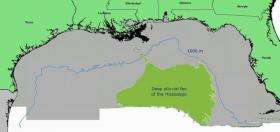
Just past the continental shelf in the Gulf of Mexico -- the shelf is marked with the blue line -- a fan of sediment has formed on the seafloor made up of silt and debris that settles out of Mississippi River waters flowing into the gulf. These alluvial, or submarine, fans are found wherever rivers run into the ocean. Crop residues sunk in such fans would become covered with silt, further ensuring that carbon would be locked away for long periods. S. Strand/UW/U.S. Geological Survey

(PhysOrg.com) -- Making bales with 30 percent of global crop residues -- the stalks and such left after harvesting -- and then sinking the bales into the deep ocean could reduce the build up of global carbon dioxide in the atmosphere by up to 15 percent a year, according to just published calculations.

That is a significant amount of carbon, the process can be accomplished with existing technology and it can be done year after year, according to Stuart Strand, a University of Washington research professor. Further the technique would sequester -- or lock up -- the carbon in seafloor sediments and deep ocean waters for thousands of years, he says.

All these things cannot be said for other proposed solutions for taking carbon dioxide out of the atmosphere, methods such as ocean fertilization, growing new forests or using crop residues in other ways, says Strand, who is lead author of a paper on the subject in the journal Environmental Science & Technology, published by the American Chemical Society.

Strand has devised a formula to measure the carbon-sequestration efficiency of this process and others using crop residues, something no one has done before.

Carefully tallying how much carbon would be released during the harvest, transportation and sinking of 30 percent of U.S. crop residues and comparing that to how much carbon could be sequestered, Strand says the process would be 92 percent efficient. That's more efficient than any other use of crop residue he considered, including simply leaving crop residue in the field, which is 14 percent efficient at sequestering carbon, or using crop residue to produce ethanol, which avoids the use fossil fuels, but is only 32 percent efficient.

Worldwide, farming is mankind's largest-scale activity. Thirty percent of the world's crop residue represents 600 megatons of carbon that, if sequestered in the deep ocean with 92 percent efficiency, would mean the amount of carbon dioxide in the atmosphere would be reduced from 4,000 megatons of carbon to 3,400 megatons annually, Strand says. That's about a 15 percent decrease.

The proposed process would remove only above-ground residue. Strand bases his calculations on using 30 percent of crop residue because that's what agricultural scientists say could sustainably be removed, the rest being needed to maintain carbon in the soil. Crop residue would be baled with existing equipment and transported by trucks, barges or trains to ports, just as crops are. The bales would be barged to where the ocean is 1,500 meters, or nearly a mile, deep and then the bales would be weighted with rock and sunk.

"The ocean waters below 1,500 meters do not mix significantly with the upper waters," Strand says. "In the deep ocean it is cold, oxygen is limited and there are few marine organisms that can break down crop residue. That means what is put there will stay there for thousands of years."

The article calls for research on the environmental effects of sinking crop residues in the ocean, effects that most likely will be borne by organisms living in the ocean sediments where the bales fall.

Strand says one way to minimize environmental effects would be to drop the residue onto alluvial fans found off the continental shelf wherever rivers pour into the ocean. Alluvial fans, sometimes call submarine fans when underwater, form as silt and debris from river water settles to the seafloor. Runoff from current agricultural fields means alluvial fans in the ocean are already partly made up of crop residue. Any bales dumped there would quickly be covered with silt, further ensuring the carbon would be sequestered for long periods.

Effects might also be minimized by concentrating the residue in a compact area. At the Mississippi alluvial fan in the Gulf of Mexico, spreading 30 percent of U.S. crop residue in an annual layer 4 meters, or 13 feet, deep would cover 260 square kilometers, or 100 square miles. That's about 0.02 percent of the area of the Gulf of Mexico, Strand says.

"Whatever the environmental impacts of sinking crop residue in the oceans turn out to be, they will need to be viewed in light of the damage to oceans because of acidification and global warming if we don't remove carbon dioxide from the atmosphere," Strand says.

Co-author of the paper is Gregory Benford, a professor of physics at the University of California, Irvine.

Strand, a faculty member with the UW's College of Forest Resources, is an environmental engineer known for his work on using plants to remediate contaminated groundwater, soil and sediment. He said he's been interested in ways to remove carbon dioxide from the atmosphere for nearly a decade and first read about sequestering crop residue in the deep ocean in Climatic Science in 2001. Benford was a co-author on that paper.

Strand says he thinks any method for removing excess carbon dioxide must do seven things: move hundreds of megatons of carbon, sequester that carbon for thousands of years, be repeatable for centuries, be something that can be implemented immediately using methods already at hand, not cause unacceptable environmental damage and be economical. He says sequestering crop residue in the deep ocean fits the criteria better than any other proposed solution.

"To help save the upper ocean and continental ecosystems from severe disruption by climate change, we must not only stop our dependence on fossil fuels, but also go carbon negative," Strand says. "Fossil fuels that are removed from sediments and burned are producing the increased atmospheric carbon that is driving climate warming. Sequestering crop residue biomass in the deep ocean is essentially recycling atmospheric carbon back into deep sediments."

Provided by University of Washington

2.8 /5 (17 votes)  

Filter


Move the slider to adjust rank threshold, so that you can hide some of the comments.


Display comments: newest first

GrayMouser
Jan 28, 2009

Rank: 3 / 5 (6)
Let's pollute the oceans with organic matter...

Right!
NeilFarbstein
Jan 28, 2009

Rank: 3.7 / 5 (7)
very wasteful of fertilizer. Over the decades it will deplete the soil making it worthless. There are several methods of making ethanol, methane and bio diesel from crop residues, they will recycle carbon dioxide, it may even become a cheap way of fueling trucks.
LuckyBrandon
Jan 29, 2009

Rank: 3.4 / 5 (5)
i agreee with the lets pollute the oceans more comment...this is just a plain stupid idea to me. dumping that much crap into the ocean, and expecting it to not have a lasting effect, like say, changing the currents in the water masses this is done in...that could end up a big a** problem that we are not able to deal with yet.
DGBEACH
Jan 29, 2009

Rank: 5 / 5 (1)
They have made no mention of the Phosphor contained in these materials from the heavy fertilization needed to grow these crops on nutrient-depleted land. Just a little can increase algae blooms, imagine millions of tons of material soaked in it...it'll be a real disaster!
Velanarris
Jan 31, 2009

Rank: 5 / 5 (1)
The real disaster will be when these residues rot under the ocean and force the oxygen out of the water causing apoxia for wildlife and damaging the food chain irreverably.
Rank 2.8 /5 (17 votes)
Relevant PhysicsForums posts
  • Do some geologists actually act a lot like Randy Marsh?
    createdFeb 11, 2012
  • Discrepancy between oxygen and carbon-dioxide levels
    createdFeb 09, 2012
  • where gems are found in the world
    createdFeb 09, 2012
  • Wind Waves in Reservoir ~ Wind run-up and Wind set-up
    createdFeb 08, 2012
  • Balance of oxygen in the atmosphere
    createdFeb 01, 2012
  • The case for a methanol-based economy
    createdJan 30, 2012
  • More from Physics Forums - Earth

More news stories

Salvage workers begin pumping fuel from Italian shipwreck

Salvage workers Sunday began pumping fuel from the shipwrecked Italian cruise liner Costa Concordia, a day ahead of schedule, officials said.

Space & Earth / Environment

created 8 hours ago | popularity 5 / 5 (1) | comments 0

Latin America mining boom clashes with conservation

Latin America is experiencing a mining boom as prices rise fuelled by a hike in global demand, but the region is also being hit by a wave of violent protests, strikes and rallies by environmentalists.

Space & Earth / Environment

created 16 hours ago | popularity 5 / 5 (1) | comments 1

Political leaders play key role in how worried Americans are by climate change: study

More than extreme weather events and the work of scientists, it is national political leaders who influence how much Americans worry about the threat of climate change, new research finds.

Space & Earth / Environment

created Feb 06, 2012 | popularity 5 / 5 (7) | comments 73

NASA budget will axe Mars deal with Europe: scientists

US President Barack Obama's budget proposal to be submitted next week for 2013 will cut NASA's budget by 20 percent and eliminate a major partnership with Europe on Mars exploration, scientists said Thursday.

Space & Earth / Space Exploration

created Feb 10, 2012 | popularity 5 / 5 (3) | comments 58

Humans may have helped the decline of African rainforests 3000 years ago

(PhysOrg.com) -- Large areas of rainforests in Central Africa mysteriously disappeared over three thousand years ago, to be replaced by savannas. The prevailing theory has been that the cause was a change ...

Space & Earth / Environment

created Feb 10, 2012 | popularity 4.1 / 5 (14) | comments 21 | with audio podcast report


Scientists discover molecular secrets of 2,000-year-old Chinese herbal remedy

For roughly two thousand years, Chinese herbalists have treated Malaria using a root extract, commonly known as Chang Shan, from a type of hydrangea that grows in Tibet and Nepal. More recent studies suggest that halofuginone, ...

New method to examine batteries -- MRI from the inside

There is an ever-increasing need for advanced batteries for portable electronics, such as phones, cameras, and music players, but also to power electric vehicles and to facilitate the distribution and storage of energy derived ...

Google might launch Drive for cloud storage soon

(PhysOrg.com) -- Google's next big move, according to the Wall Street Journal, is a cloud storage service called Drive. Hardly first to the plate, Google is simply catching up to introducing its cloud reposi ...

A mitosis mystery solved: How chromosomes align perfectly in a dividing cell

Although the process of mitotic cell division has been studied intensely for more than 50 years, Whitehead Institute researchers have only now solved the mystery of how cells correctly align their chromosomes during symmetric ...

Lab study raises questions over nano-particle impact

Tests involving chickens have raised questions about the impact on health from engineered nano-particles, the ultra-fine grains commonly used in drugs and processed foods, scientists said on Sunday.

Starve a virus, feed a cure? Findings show how some cells protect themselves against HIV

A protein that protects some of our immune cells from the most common and virulent form of HIV works by starving the virus of the molecular building blocks that it needs to replicate, according to research published online ...