Sub-atomic-scale Writing Using a Quantum Hologram Sets New Size Record (Video)
January 28, 2009 Sub-atomic-scale Writing Using a Quantum Hologram Sets New Size Record

Enlarge

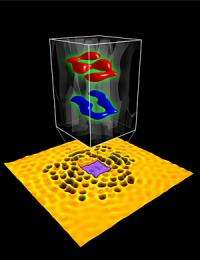
The initials for Stanford University are written in electron waves on a piece of copper and projected into a tiny hologram.

(PhysOrg.com) -- Physicists have set a new world record for the smallest writing, with features of letters as small as 0.3 nanometers, or roughly one third of a billionth of a meter. The accomplishment demonstrates that information can be stored more densely than previously thought. The research was conducted at the Stanford Institute for Materials and Energy Sciences (SIMES), a joint institute of Stanford University and the U.S. Department of Energy's SLAC National Accelerator Laboratory.

In achieving this feat, Stanford researchers have reclaimed bragging rights for creating the world’s smallest writing, a distinction the university first gained in 1985 and lost in 1990.

The researchers encoded the letters "S" and "U" (as in Stanford University) within the interference patterns formed by quantum electron waves on the surface of a sliver of copper. The wave patterns even project a tiny hologram of the data, which can be viewed with a powerful microscope.

"How densely can you encode information on a computer chip?" said Hari Manoharan the assistant professor of physics who directed the work of physics graduate student Chris Moon and other researchers. "The assumption has been that basically the ultimate limit is when one atom represents one bit, and then there's no more room—in other words it's impossible to scale down below the level of atoms. But in this experiment we’ve stored some 35 bits per electron to encode each letter. So one bit per atom is no longer the limit for information density."

The quest for small writing has played a role in the development of nanotechnology for 50 years, beginning decades before "nano" became a household word. During a now-legendary talk in 1959, the remarkable physicist Richard Feynman argued that there were no physical barriers preventing machines and circuitry from being shrunk drastically. He called his talk, "There's Plenty of Room at the Bottom."

Feynman offered a $1,000 prize for anyone who could find a way to rewrite a page from an ordinary book in text 25,000 times smaller than the usual size (a scale at which the entire contents of the Encyclopedia Britannica would fit on the head of a pin). He held onto his money until 1985, when he mailed a check to Stanford grad student Tom Newman, who, working with Electrical Engineering Professor Fabian Pease, used electron beam lithography to engrave the opening page of Dickens' A Tale of Two Cities in such small print that it could be read only with an electron microscope.

That record held until 1990, when IBM researchers famously spelled out the letters of their company name by arranging 35 individual xenon atoms.

Now, in a paper published online Sunday in the journal Nature Nanotechnology, the researchers describe how they’ve created letters one fortieth the size of the original prize winning effort and less than one quarter of the size of the IBM initials.

Working in a vibration-proof basement lab, Manoharan and Moon began their writing project with a scanning tunneling microscope, a device that not only sees objects at a very small scale but can also be used to move around individual atoms. The team used it to drag single carbon monoxide molecules into a desired pattern on a copper chip the size of a fingernail.

On the two-dimensional surface of the copper, electrons zip around, behaving as both particles and waves, bouncing off the carbon monoxide molecules the way ripples in a shallow pond might interact with stones placed in the water. The ever-moving waves interact with the molecules and with each other to form standing "interference patterns" that vary with the placement of the molecules.

By altering the arrangement of the molecules, the researchers can create different waveforms, effectively encoding information for later retrieval. To encode and read out the data at unprecedented density, the scientists have devised a new technology, Electronic Quantum Holography.

In a traditional hologram, laser light is shined on a 2-dimensional image and a ghostly 3D object appears. In the new holography, the 2-dimensional "molecular holograms" are illuminated not by laser light but by the electrons that are already in the copper in great abundance. The resulting "electronic object" can be read with the scanning tunneling microscope.

Several images can be stored in the same hologram, each created at a different electron wavelength. The researchers read them separately, like stacked pages of a book. The experience, Moon said, is roughly analogous to an optical hologram that shows one object when illuminated with red light and a different object in green light.

For Manoharan, the true significance of the work lies in storing more information in less space. ""We miniaturized their size so drastically that we ended up with the smallest writing in history. And we write the letters so small that the bits that comprise them are subatomic in size," he said. "There's a grand new horizon below, in the subatomic regime. Indeed, there's even more room at the bottom than we ever imagined."

In addition to Moon and Manoharan, authors of the Nature Nanotechnology paper, "Quantum Holographic Encoding in a Two-Dimensional Electron Gas," are physics graduate student Laila Mattos, electrical engineering graduate student Brian Foster and applied physics graduate student Gabriel Zeltzer.

The research was supported by the Office of Basic Energy Sciences within the Department of Energy Office of Science, the Office of Naval Research, the National Science Foundation, and the Stanford-IBM Center for Probing the Nanoscale.

Provided by Stanford University


print this article email this article download pdf blog this article bookmark this article     Stumble it Digg this share on Facebook retweet share on Reddit add to delicious
Rate this story - 4.5 /5 (19 votes)

Rank Filter

Move the slider to adjust rank threshold, so that you can hide some of the comments.


Display comments: newest first

  • h0dges - Jan 28, 2009
    • Rank: not rated yet
    Very impressive stuff indeed. Kudos!
  • brant - Jan 28, 2009
    • Rank: 1 / 5 (2)
    Nice!!!!

    Now are electrons really waves, or particles? I suspect that they will be shown to be one or the other, probably waves...
  • Soylent - Jan 29, 2009
    • Rank: not rated yet
    Now are electrons really waves, or particles?


    Neither.
  • SmartK8 - Jan 29, 2009
    • Rank: not rated yet
    Intimidating technology. *thumbs up*
  • barkster - Jan 29, 2009
    • Rank: 2 / 5 (2)
    Awesome!... Where can I get one?
  • Merkk - Jan 29, 2009
    • Rank: 1 / 5 (2)
    After reading this Apple unveiled their newest iPod, the .3nano! Able to hold all recorded knowledge on a spec of dust!
  • HenkZw - Jan 29, 2009
    • Rank: 4 / 5 (2)
    Aren't they cheating a bit ? If they need many
    atoms to create an interference pattern that results in a pattern that is smaller than those many atoms, what is then the 'real' size of the letters ? Of course the fact that the letters are 'on top of each other' (if I understand correctly) should count.
  • Leathersoup - Jan 29, 2009
    • Rank: not rated yet
    Many corporations are looking forward to using this prtint at the bottom of ads.
  • holoman - Jan 29, 2009
    • Rank: 4 / 5 (1)
    http://www.azonan...sID=9628

    ferroelectric/multiferroics will be the future of many applications.

    Many atoms of different materials make up ferroelctrics having greater than 256 bit patterns per molecule (3 to 5 nm) in which the molecule can be
    used for holographic applications having NO contact writing / reading tool.


  • guiding_light - Jan 30, 2009
    • Rank: 4.5 / 5 (2)
    I think bit counting is pretty important. Maybe they considered STM image pixels, but this can all be very noisy or easily disturbed. I can claim to access (30/0.3)^2=10000 states from a 30 nm square area flash cell - same bit density, but ridiculously noisy.
  • gongii - Jan 30, 2009
    • Rank: 4 / 5 (1)
    Since the information here is electron holographic, it only makes practical sense in the context of an optical processor or optical computer based on electron waves instead of light. In other words, you need an image processor to process the readout data. Even with the ideal optical processor, the image is ideally formed in parallel pixels, but the rastered STM images are inherently serial in data throughput.
  • guiding_light - Jan 30, 2009
    • Rank: 5 / 5 (1)
    Much better coverage at arstechnica: http://arstechnic...-yet.ars

    The sample voltage must be controlled to within millivolts; otherwise your hologram changes. A given set of hologram patterns can be ridiculously hard to invert; you need to run some algorithms beforehand. I wonder if there is a current computational limit.

  • nanomvp - Jan 31, 2009
    • Rank: not rated yet
    At such low energies, the electrons' wavelength is actually quite large. Room temperature is 0.026 eV, which gives 7.6 nm wavelength.

January 28, 2009 all stories

Comments: 13

4.5 /5 (19 votes)
  • Stumble this up

  • Digg this

  • share this

  • hide
  • Related Stories

  • Physicists are first to 'squeeze' light to quantum limit
    created Jan 02, 2009 | popularity not rated yet | comments 0
  • MRI spots DCIS in mice
    created Oct 01, 2008 | popularity not rated yet | comments 0
  • Scientists create world's thinnest balloon, just 1 atom thick
    created Sep 19, 2008 | popularity not rated yet | comments 0
  • Researchers develop better X-ray nanomirrors
    created Jun 10, 2008 | popularity not rated yet | comments 0
  • Unraveling the Mercury mystery: Boldly going where no one has gone before
    created Apr 09, 2008 | popularity not rated yet | comments 0


  • hide
  • Relevant PhysicsForums posts

  • how to fit min. area ellipse around data point
    created 2 hours ago
  • nn junctions
    created 3 hours ago
  • Elliptical Orbits
    created 5 hours ago
  • mass time acceleration => watts
    created 11 hours ago
  • gravitation among individual particles
    created 12 hours ago
  • Tyres - why is wider better for lateral grip?
    created 12 hours ago
  • More from Physics Forums - General Physics

Other News

Magnetic nanoparticles to simultaneously diagnose, monitor and treat

Nanotechnology / Bio & Medicine

created 4 hours ago | popularity not rated yet | comments 0

Whether it's magnetic nanoparticles (mNPs) giving an army of 'therapeutically armed' white blood cells direction to invade a deadly tumour's territory, or the use of mNPs to target specific nerve channels and induce nerve-led ...


New Digital 'Electronics' Concept May Continue Moore's Law

New Digital 'Electronics' Concept May Continue Moore's Law

Nanotechnology / Nanophysics

created 22 hours ago | popularity 4.6 / 5 (41) | comments 3

(PhysOrg.com) -- Computers of the future could be operating not on electrons, but on tiny waves traveling through an electron "fluid," if a new proposal is successful. The new circuit design, recently introduced ...


Nanoparticles may cause DNA damage across a cellular barrier

Nanoparticles may cause DNA damage across a cellular barrier

Nanotechnology / Bio & Medicine

created 15 hours ago | popularity 4.1 / 5 (7) | comments 1

(PhysOrg.com) -- Scientists have shown in the laboratory that metal nanoparticles damaged the DNA in cells on the other side of a cellular barrier. The research, by the University of Bristol, is published ...


How Size Matters For Catalysts: Study Links Size, Activity, Electronic Properties

How Size Matters For Catalysts: Study Links Size, Activity, Electronic Properties

Nanotechnology / Nanomaterials

created 18 hours ago | popularity 3.7 / 5 (3) | comments 0

(PhysOrg.com) -- University of Utah chemists demonstrated the first conclusive link between the size of catalyst particles on a solid surface, their electronic properties and their ability to speed chemical ...


Nanotechnology: A risky frontier?

Nanotechnology / Nanomaterials

created 21 hours ago | popularity 5 / 5 (3) | comments 0

Inside a cramped back room at Rushford Hypersonic, a start-up headquartered in southeastern Minnesota, sits a cube-like machine that throws a mean atomic fastball. At the push of a button, the reactor hurls atoms toward a ...