The Power of Light: Moving Macroscopic Amounts of Matter
January 29, 2009 By Lisa Zyga
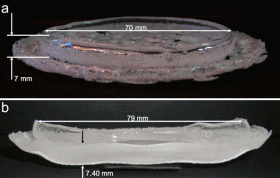
A quartz glass structure that formed after (a) 95 seconds and (b) 300 seconds of laser annealing, where the sample in (b) is a cross-section. Scientists discovered that, under intense light irradiation, molten silicon powder particles can form macroscopic structures up to 7 mm high. Image credit: J. Günster, et al. (c)2009 AIP.
(PhysOrg.com) -- Since 1970, scientists have been working with “optical tweezers” - lasers that move microscopic amounts of matter using forces originating from the light matter interaction. Now, for the first time, researchers have demonstrated that light-induced forces can move macroscopic amounts of matter, as well.
The German team, led by Jens Günster of the CiC Ceramic Institute Clausthal GmbH in Clausthal-Zellerfeld, Germany, in collaboration with researchers from the Deutsches Zentrum für Luft und Raumfahrt, Institute of Composite Structures and Adaptive Systems in Braunschweig, Germany, has recently published the achievement in a recent issue of Applied Physics Letters. The scientists described a phenomenon not yet observed: Under intense light irradiation, molten silicon powder particles (about 40 micrometers in diameter) can form macroscopic structures up to 7 mm high.
“We regard the fact that laser light can directly apply forces to a dielectric liquid on a macroscopic level as a finding of great significance,” Günster told PhysOrg.com. Those applied forces are direct, yet don’t require any physical contact with the liquid.
In experiments, the researchers used a CO2 laser to melt a pile of pure silicon powder, which has a melting temperature of 1713°C (3115°F). At its highest power output of 12 kW, the laser could melt the silicon powder almost instantaneously. However, the researchers lowered the power output to 9.6 kW to avoid excessive evaporation of the silicon. After a few minutes, most of the silicon melted into a liquid pool about 7 mm deep. Yet, before the melting, some of the partially molten silicon particles peeled off the surface, starting at the point of highest laser intensity. The matter curled into 7-mm-high protrusions parallel to the silicon’s horizontal surface, forming against gravity and surface tension, and even surviving the liquid state. When the scientists turned the laser off, the solid structures were preserved.
To explain this novel light-matter interaction, the researchers developed a model in which light-induced forces couple to the molten silica. They explain that, in order for light to move macroscopic amounts of matter and form surface protrusions, the material must have a low surface tension. The scientists performed the same experiment with silicon powder compacts (in which the powder particles are adhesively linked to each other by van der Waals forces, providing greater mechanical strength). But when heating the powder compacts with the laser, the researchers found that surface protrusions did not form, which is likely due to the powder compacts’ greater surface tension.
With the ability to control the light irradiation, the melting phenomenon could have applications in several areas, such as the mechanical manipulation of ceramics/glass melts directly by laser radiation, the initialization and control of self-organizing processes, and the styling/design of specific geometries. In the future, the researchers want to understand the interaction further.
“We are planning to show in more sophisticated experiments the nature of the laser matter coupling,” said Günster. He added that they also plan to investigate “laser-induced manipulation of piezoceramic materials and the design of new piezoceramic actuators.”
More information: Günster, J.; Oelgardt, C.; Heinrich, J.G.; and Melcher, J. “The power of light: Self-organized formation of macroscopic amounts of silica melts controlled by laser light.” Applied Physics Letters 94, 021114 (2009).
Copyright 2008 PhysOrg.com.
All rights reserved. This material may not be published, broadcast, rewritten or redistributed in whole or part without the express written permission of PhysOrg.com.
-
New territory in nuclear fission explored with ISOLDE
Jan 17, 2011 |
3.7 / 5 (3) |
4
-
Extending Moore's Law: Expitaxial graphene shows promise for replacing silicon in electronics
Jan 07, 2011 |
4.7 / 5 (15) |
10
-
Nano-infused filters prove effective: Scientists build better catalyst with nanotube membranes
Apr 26, 2010 |
4.9 / 5 (7) |
0
-
Nanotechnologists reveal the frictional characteristics of atomically thin sheets (w/ Video)
Apr 01, 2010 |
4.1 / 5 (9) |
0
-
Lasers used to make first boron-nitride nanotube yarn (w/ Video)
Dec 02, 2009 |
4.8 / 5 (15) |
2
-
Engineers build first sub-10-nm carbon nanotube transistor
Feb 01, 2012 |
4.9 / 5 (29) |
30
-
Something old, something new: Evolution and the structural divergence of duplicate genes
Jan 31, 2012 |
4.6 / 5 (7) |
1
-
The hidden nanoworld of ice crystals: Revealing the dynamic behavior of quasi-liquid layers
Jan 30, 2012 |
5 / 5 (3) |
1
-
Stock market network reveals investor clustering
Jan 27, 2012 |
4 / 5 (22) |
8
-
Of microchemistry and molecules: Electronic microfluidic device synthesizes biocompatible probes
Jan 26, 2012 |
5 / 5 (1) |
0
-
How is zeno paradox of motion solved
1 hour ago
-
Good books for studying physics on own
2 hours ago
-
Kinetic energy and crumple zones
4 hours ago
-
Finding the E field with a changing p???
6 hours ago
-
All matter being liquid in 10^65 years if proton decay doesn't occur.
7 hours ago
-
The acceleration of an Elephant and a Paper Clip
8 hours ago
- More from Physics Forums - General Physics
More news stories
Physicists 'record' magnetic breakthrough
An international team of scientists has demonstrated a revolutionary new way of magnetic recording which will allow information to be processed hundreds of times faster than by current hard drive technology.
15 hours ago |
4.4 / 5 (29) |
12
|
Diamond light, brighter than the sun
Its the size of five football pitches and generates light 10 billion times brighter than the sun. As the Diamond Light Source celebrates its tenth anniversary this year, Penny Bailey visits one of the ...
18 hours ago |
4.3 / 5 (6) |
13
|
With single laser pulses on single molecules
(PhysOrg.com) -- Physicists at MPQ (Max Planck Institute) succeed in resolving the internal dynamics of individual molecules using UV femtosecond laser pulses.
19 hours ago |
5 / 5 (1) |
1
|
Searching for a solid that flows like a liquid
(PhysOrg.com) -- A series of neutron scattering experiments at Oak Ridge National Laboratory and other research centers is exploring the key question about a long-sought quantum state of matter called supersolidity: ...
Feb 03, 2012 |
4.3 / 5 (7) |
17
|
Physicists push for underground testing facility
Pran Nath, the Matthews Distinguished Professor of Physics at Northeastern University, is among a group of leading theoretical physicists who have asked the Department of Energy to develop a large underground ...
Feb 02, 2012 |
4.6 / 5 (5) |
12
Scientists develop biological computer to encrypt and decipher images
Scientists at The Scripps Research Institute in California and the TechnionIsrael Institute of Technology have developed a "biological computer" made entirely from biomolecules that is capable of deciphering ...
Mars-bound NASA rover carries coin for camera checkup
(PhysOrg.com) -- The camera at the end of the robotic arm on NASA's Mars rover Curiosity has its own calibration target, a smartphone-size plaque that looks like an eye chart supplemented with color chips ...
Entire genome of extinct human decoded from fossil
(PhysOrg.com) -- In 2010, Svante Pääbo and his colleagues presented a draft version of the genome from a small fragment of a human finger bone discovered in Denisova Cave in southern Siberia. The ...
Haptic cube lets you feel tomorrow's temps
(PhysOrg.com) -- Will it be an invention joining a storage room of other inventions? Or kicked further up to gadget boutiques for the very rich? Or a popular gadget for many worldwide? Whatever its destiny, ...
Computer security firm Symantec extorted by hackers
Computer security firm Symantec on Tuesday confirmed it tried to turn the tables on hackers who threatened to release stolen source code if a demand for $50,000 was not met.
California hits wind energy milestone: About 5 percent of power from wind
California now gets about 5 percent of its electricity from wind power, according to data released Tuesday by the California Wind Energy Association.
Jan 29, 2009
Rank: 1.5 / 5 (2)
Jan 29, 2009
Rank: not rated yet
Jan 29, 2009
Rank: not rated yet
still half asleep, so will have to look back on this comment of mine to see if it makes sense later :)
Jan 29, 2009
Rank: not rated yet
Jan 29, 2009
Rank: not rated yet
Jan 30, 2009
Rank: 5 / 5 (2)
The physical laws they teach in introductory physics courses don't take into account relativity so newton's laws are incomplete and only are exactly correct for low velocities. For extremely large velocity, relativistic effects become predominant, and at the speed of light, you can't really understand anything without relativity. The correct equation for momentum in relativity tells us that you don't need a mass to have momentum, and that is all we need to know, because if there is a collision there will most likely be momentum exchange, which we look upon as a force.
Jan 30, 2009
Rank: not rated yet
Feb 01, 2009
Rank: 1 / 5 (1)
Feb 01, 2009
Rank: not rated yet
That the speed of light (the particle/wave) is constant in any medium is a consequence of the laws of Electromagnetism (the classical version of which was almost entirely discovered by experiment.)
Wikipedia Page on Minkowski Space: http://en.wikiped...pacetime
The maximum speed in a Minkowski space is a property of that space (by definition.) Thus, if our universe can be described, on some level, as Minkowsian, there must be some maximum speed. The defining property of a Minkowski space is Lorentz Covariance, a property our universe (as far as we know) has (i.e. there has never been an experiment demonstrating a violation that has been reproduced.)
[url]http://en.wikiped...lativity[/url]
[url]http://en.wikiped...lativity[/url]
Feb 01, 2009
Rank: not rated yet
m=0 for a photon - and zero by anything is zero.
therefore the energy of light is zero.
Whats wrong here?
1. E mc^2
2. Photons always have mass?
3. The dead or alive cat has eaten the photon and we are not sure where it is, was or maybe, depending on your inertial frame of reference?
Feb 01, 2009
Rank: 1 / 5 (1)
Feb 02, 2009
Rank: 5 / 5 (2)
Actually, E=m*c^2 only applies in the rest frame of a particle. Since light only exists when it is in motion, the full formula must be used: E=y*m*c^2 where y=1/sqrt(1-(v/c)^2). Since y goes to infinity as v goes to c, a massless particle could exist as long as it travels at c (since the product of infinity and zero can be any number.)
In fact, the energy and momentum of a photon are not directly given by Special Relativity they are simply allowed to exist. It is quantum mechanics that gives us the energy of a photon as E=h*f. There is an equation that relates energy to momentum, it is: E^2 = (p*c)^2 (m*c^2)^2 since m=0, E^2=(p*c)^2 thus, E=p*c and since E=h*f p=h*f/c (where p is the momentum, and f the frequency, of the photon.)
Feb 02, 2009
Rank: 3 / 5 (2)
You might want to consider the cases where light travels at lees than c in a medium other than vacuum and extrapolate into a mass quantity. You might also want to clarify the peacock terms such as "allowed to exist" (lol) and how an abstract idea such as a product of 'infinity and zero' gives a photon an arbitary mass value (any number, pick a number, oh, thats right God does play dice!).
If you can't blind them with science, baffle them with bullshit.
Feb 02, 2009
Rank: 5 / 5 (1)
Since m is the rest mass of a photon, its energy would be 0 when traveling through other media if it were as simple as the photons traveling slower (i.e. it would not interact, and would for all intents and purposes cease to exist.) In reality, in order to describe light one must consider Relativistic Electrodynamics.
If one really wants to get technical, nothing happens in Special Relativity, by itself. Minkowskian space-time is used as a base for doing dynamics using either assumed configurations of particles, or fields (e.g. Electromagnetism.) Since photons only exist due to Electrodynamics (or Quantum Electrodynamics (QED)) one must use this to determine their properties. There is no fact in Special Relativity (SR), by itself, that determines the energy of a photon.
In reality, light is not made up of particles, it is both a particle and a wave. The energy and momentum of a "photon" are present in the electric and magnetic fields that are its constituents. Since SR does not address the energy and momentum of fields (though there are ways to address such when one models fields in SR), it does not matter that in a vacuum light travels at the maximum speed, and that it travels at a lower speed in some other medium.
As far as explaining "allowed to exist," I will try to rephrase/correct what I said. Suppose we wish to determine the energy of a particle whose rest mass (m) is equal to 0. The usual equation for energy, E=y*m*c^2 evaluates as E=y*0*c^2, the only variable in this equation is the velocity of the massless particle. For all values of the velocity of the particle except when it is equal to c, E=0. If the velocity of the particle is c, the energy of the particle is undefined. By E^2=(p*c)^2 (m*c^2)^2, which for a massless particle reduces to E=p*c, for any velocity other than the speed of light, the energy and momentum of said particle is 0. Since a particle with 0 energy and 0 momentum could not interact (since it could neither gain nor impart any energy or momentum), it would, for all intents and purposes, not exist. Thus, the only meaningful way a massless particle could exist in SR would be traveling at c. However, E=infinity*0*c^2= undefined, since the 0 in the equation does not represent the value of a function (of velocity,if it did, one could define the value via l'Hopital's Rule), there is no way to define the energy of a massless particle with only SR, one may only say that a massless particle could exist (and that it could interact.)
Sorry for the long post, but I thought I should be thorough.
Feb 04, 2009
Rank: not rated yet
did they melt pure silicON or pure silicA?
The photos were either of quartz/silica, or they were shot in IR.
Feb 05, 2009
Rank: not rated yet
Feb 09, 2009
Rank: not rated yet