No such thing as a 'born leader,' study in fish finds
January 29, 2009 stickleback

Enlarge

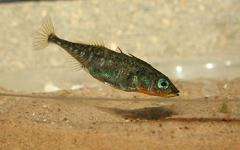
Male threespine stickleback. Credit: Jeffrey S. McKinnon, University of Wisconsin-Whitewater

Followers are just as important to good leadership as are the leaders themselves, reveals a new study of stickleback fish published online on January 29th in Current Biology, a Cell Press publication.

By randomly pairing fish of varying degrees of "boldness," the researchers showed that each member of a pair adopts the role of leader or follower. More importantly, they found, the behavior of each member of the pair is strongly influenced by its partner.

" Our study shows that the process by which leaders and followers emerge is a dynamic one," said Andrea Manica of the University of Cambridge. "Individuals aren't simply born leaders or followers, but their role in a pair—and, we could speculate, in a larger group—is the result of social feedback where everyone plays a role."

In many animal groups, certain individuals consistently appear at the forefront of coordinated movements, the researchers explained. But exactly how those leaders are chosen has been poorly understood.

In the new study, the researchers studied the behaviors of individual stickleback fish to establish their willingness to leave the cover of some weeds to enter "riskier" waters in search of food, an indication of how bold or shy they tend to be. Those fish were then randomly paired with one another to see which of the two would emerge as the natural leader.

When paired, both the bolder and the shyer of the two fish made more food-gathering trips together and stayed out for longer periods of time. Most of the time, those forays were initiated by whichever of the two fish had independently been shown to behave more boldly.

The findings show that leadership arises from individual differences in the way that fish respond to their partner's movements, they report, a phenomenon they refer to as social feedback.

"If a shy individual is paired with a very bold individual, the latter 'inspires' the former into becoming a very faithful follower," Manica said. "Conversely, a very shy individual seems to bring out the leadership of the bolder companion, which becomes a much stronger leader than if it was paired with a less shy companion."

The results show that leadership is a matter of what one might consider personality, he added. Surprisingly—or perhaps not so surprisingly—though, the personality of the leader is not all important.

Source: Cell Press


print this article email this article download pdf blog this article bookmark this article     Stumble it Digg this share on Facebook retweet share on Reddit add to delicious
Rate this story - 3.8 /5 (4 votes)


January 29, 2009 all stories

Comments: 0

3.8 /5 (4 votes)
  • Stumble this up

  • Digg this

  • share this

  • hide
  • Related Stories

  • Otters reveal their identity
    created Jun 05, 2008 | popularity not rated yet | comments 0
  • Darwin meets Facebook
    created Nov 10, 2009 | popularity not rated yet | comments 0
  • Australian scientists call for urgent 'global cooling' to save coral reefs
    created Nov 09, 2009 | popularity not rated yet | comments 0
  • Processed, high-fat foods linked with depression
    created Nov 02, 2009 | popularity not rated yet | comments 0
  • Fishermen contest plans for Calif. ocean reserves
    created Oct 22, 2009 | popularity not rated yet | comments 0


Other News

Computational microscope peers into the working ribosome

Computational microscope peers into the working ribosome (w/ Video)

Biology / Cell & Microbiology

created 7 hours ago | popularity 4.8 / 5 (5) | comments 0

Two new studies reveal in unprecedented detail how the ribosome interacts with other molecules to assemble new proteins and guide them toward their destination in biological cells. The studies used molecular ...


Bioengineers succeed in producing plastic without the use of fossil fuels

Biology / Biotechnology

created 15 hours ago | popularity 4.8 / 5 (11) | comments 0

A team of pioneering South Korean scientists have succeeded in producing the polymers used for everyday plastics through bioengineering, rather than through the use of fossil fuel based chemicals. This groundbreaking research, ...


Spider secrets decoded in world-first database

Biology / Plants & Animals

created 2 hours ago | popularity not rated yet | comments 0

(PhysOrg.com) -- Queensland scientists have developed a world-first database that catalogues the venom components from hundreds of spiders.


New chameleon species discovered in East Africa

New chameleon species discovered in East Africa (w/ Podcast)

Biology / Plants & Animals

created 10 hours ago | popularity 5 / 5 (1) | comments 0

A new species of chameleon has been discovered in Tanzania by a team of scientists.


A year after discovery, Congo's 'mother lode' of gorillas remains vulnerable

A year after discovery, Congo's 'mother lode' of gorillas remains vulnerable

Biology / Plants & Animals

created 5 hours ago | popularity not rated yet | comments 0

A new study by the Wildlife Conservation Society says that western lowland gorillas living in a large swamp in the Republic of Congo—part of the "mother lode" of more than 125,000 gorillas discovered last ...