Riding -- and reading -- the Earth tide
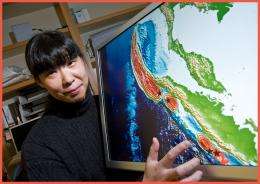
(PhysOrg.com) -- Once a day, Miaki Ishii rides the Earth tide, rising slowly — along with her desk, chair, and entire office — 20 to 30 centimeters before sinking back again.
Ishii isn’t alone on her little journey. She makes it with the rest of us, together with our desks and chairs, houses and office buildings, rising in concert as the solid earth responds to the tug of the moon and the sun.
The Earth tide is a little-known daily event, similar to the oceans’ more familiar tides. But the sun and moon’s gravity doesn’t just pull on water, it deforms the Earth itself, causing the ground beneath us to bulge toward the pulling heavenly body.
Of course, the change is so gradual and occurs across such a large portion of the Earth’s surface that it’s imperceptible to us.
But Ishii isn’t just along for the ride. An assistant professor of earth and planetary sciences, Ishii is reading the Earth tide for what it can tell her about Earth’s internal structure. Together with Jim Davis at the Harvard-Smithsonian Center for Astrophysics, Ishii is using the global positioning system (GPS) network to search for lumps and bumps and deformities and comparing them with what would happen to a hypothetically uniform Earth.
Ishii is hoping to shed light on the composition of the Earth’s mantle — the thick layer that makes up most of the planet’s bulk that lies between the thin, geologically active crust and the Earth’s core.
Geologists believe the mantle is alive: its rocks and minerals, made plastic by the enormous heat and pressure, move in huge, slow convection cycles that Ishii likened to the slow-moving blobs of a lava lamp. Ishii is seeking to understand those cycles and the structures within the mantle, looking for enormous, continent-sized blocks that migrate upward and then cycle back down over long reaches of time.
Parsing the Earth tide for what it can tell her about the mantle’s structure is just one of Ishii’s research directions. Another major focus has the potential to one day lead to more effective earthquake detection and warning systems.
Ishii is working on a better, faster way to locate and characterize earthquakes through back projection of the enormous seismic waves a quake generates. With this method, Ishii hopes that early warnings can be faster and more accurate than they are now. She uses one of the most dramatic recent examples to illustrate what’s at stake: the 2004 Sumatran earthquake that generated a devastating tsunami in the Indian Ocean basin.
Early estimates of that earthquake’s size were conflicting, with some as low as 6.2 and others over 8.0. It was 19 hours after the quake when the first estimate of 9.0 was made and another month before an estimate of 9.2, which is accepted as the quake’s actual strength, Ishii said. That means that tsunami warnings, when they went out, didn’t accurately predict the wave’s size. Though it’s questionable whether even an accurate warning would have helped mitigate the extreme devastation caused by the waves, it’s possible some lives might have been saved.
“Seismic waves propagate like they would if you threw a pebble in a pond,” Ishii said. “You get ripples propagating away from the stone. If you look at it, you know almost immediately where the stone was thrown. With seismic waves, we back-project the curvature of the ripples to see where the ripples started. If you can get the data in real time, this is a quick and easy method to get the magnitude.”
Jim Rice, Mallinckrodt Professor of Engineering Sciences and Geophysics, who also conducts work on earthquakes, said that Ishii’s back projection methods are groundbreaking. They rely on dense networks of seismic instruments, such as those that exist in Japan and which are under construction in the United States. By analyzing when earthquake waves arrive at different instruments, she can map out the wave and its source.
“This is really remarkable work,” Rice said.
The new method, which Ishii estimates is still a year from completion, could also be useful for researchers seeking to create more complete catalogs of earthquakes around the world. Though the U.S. catalogue of earthquakes is complete down to magnitude 3, Ishii said the catalogs in many countries include only the stronger quakes, magnitude 5.5 or above. By being able to back-project earthquakes to accurately determine their strength and location, researchers will have a tool to better understand the occurrence of earthquakes around the world.
“If you have a better catalog, you can understand earthquakes better and understand what sorts of quakes to expect in the future,” Ishii said.
The third avenue of research being pursued by Ishii also depends on earthquakes, though this time as measuring tools, rather than study subjects. Ishii is using the seismic waves created by stronger quakes to understand the Earth’s structure. During her doctoral work at Harvard earlier this decade, Ishii and Adam Dziewonski, the Frank B. Baird Jr. Professor of Science, examined the records of hundreds of thousands of earthquake waves and detected a new region, thought to be just 360 miles in diameter, at the Earth’s center.
In similar work, Ishii is monitoring the waves from stronger earthquakes — magnitude 5.5 or 6 or stronger, watching to see whether and where they slow down and speed up as they pass through the Earth.
Though the work is dependent on earthquakes strong enough so their waves pass through the Earth’s core, Ishii said those stronger earthquakes are surprisingly common. There’s an earthquake of 6.0 magnitude somewhere on Earth roughly once a week, while as many as 10 5.5 magnitude quakes occur in a week. Despite their size, we don’t hear about them because most occur far from civilization, in remote continental locations or along mid-ocean ridges deep under the sea.
One area of focus is subduction zones, where continental plates dive below each other, creating ridges of volcanoes fed by the melting rock below. Ishii described the zones as places of intense geologic activity, with different chemistry, different materials, and different dynamics than other places, all resulting in the Earth itself being recycled. The areas are also rife with earthquakes, Ishii said, so the waves generated by those quakes can be studied.
“There are lots of things going down and also coming up through volcanoes, so there’s lots of information. The goal is to come up with a better view of a subduction zone from a seismic point of view,” Ishii said. “It is actually an Earth factory.”
Provided by Harvard University


