What causes motor complications of Parkinson's treatment?
January 29, 2009 Scientists ID genes linked to Parkinson's side effects

Enlarge

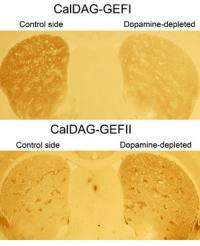
The Graybiel Lab caused Parkinson's disease in rats by depleting dopamine in the right side of the striatum, the brain region that drives the abnormal movements in the disease, leaving the left side as the control. Treating the rats with L-DOPA induced dyskinesia of the limbs controlled by the dopamine-depleted striatum, mimicking the side effect of L-DOPA treatment in humans. Compared to the normal, control side, the treated side shows significantly reduced expression of CalDAG-GEFI but abnormally high levels of CalDAG-GEFII. This imbalance may contribute to the involuntary movements of dyskinesia. Image courtesy / Jill Crittenden, McGovern Institute for Brain Research at MIT

People with Parkinson's disease commonly suffer a slowing or freezing of movement caused by the death of neurons that make dopamine, a key chemical that allows brain cells to send and receive messages essential to voluntary movements. Patients regain the ability to move, seemingly miraculously, by taking L-DOPA or related drugs that mimic the missing dopamine. After a few years on L-DOPA, however, most patients again lose motor control — but in an opposite way. Instead of too little, there is too much movement, like involuntary nodding and rocking — side effects known as L-DOPA-induced dyskinesias.

"L-DOPA-induced dyskinesias are a major problem for patients, and there is a great need to help with these drug side effects," said MIT Institute Professor Ann Graybiel, a prominent Parkinson's researcher at the McGovern Institute for Brain Research at MIT.

Graybiel and her colleagues have identified two molecules whose expression in the brain is altered in the brains of animals with L-DOPA-induced dyskinesias. The results may lead to new approaches to the treatment of dyskinesias in Parkinson's patients, of which there are more than 1 million in the United States alone.

"We're very excited because these genes are concentrated in precisely the places that lose dopamine in Parkinson's disease, so they might be reasonable targets to go after therapeutically," Graybiel said. This research was published Jan. 26 in the advance online issue of Proceedings of the National Academy of Sciences.

The two related genes, named CalDAG-GEFI and CalDAG-GEFII, which are believed to be involved in signaling inside neurons, are expressed in the striatum, a brain structure essential for the control of movement and the main target of the dopamine-containing nerve tract that degenerates in Parkinson's disease.

In a rat model of Parkinson's disease, the two genes showed opposite changes when the animals were treated with L-DOPA. CalDAG-GEFI showed decreased expression while CalDAG-GEFII was increased.

"Moreover, the changes in the rat brain were proportional to the severity of the drug-induced dyskinesias. The more exaggerated the movements, the greater the dysregulation of these genes," said first author Jill Crittenden, a research scientist in the Graybiel Lab.

These CalDAG-GEF genes are thought to work by controlling the activity of other important signaling molecules (Ras, Rap and ERK) that are expressed in many different parts of the body and have many different biological functions. Other labs have shown that inhibiting Ras or ERK in animal models of dyskinesias prevents these involuntary movements.

"But because Ras and ERK do so many things, they are not promising drug targets because blocking them would probably have many unwanted effects," Crittenden said. "Because the CalDAG-GEF molecules control ERK and because they are so enriched in the very part of the brain that controls these involuntary movements, regulating them could have therapeutic value for dyskinesia without causing other problems."

Source: Massachusetts Institute of Technology


print this article email this article download pdf blog this article bookmark this article     Stumble it Digg this share on Facebook retweet share on Reddit add to delicious
Rate this story - not rated yet


January 29, 2009 all stories

Comments: 0

not rated yet
  • Stumble this up

  • Digg this

  • share this

  • hide
  • Related Stories


  • hide
  • Relevant PhysicsForums posts

  • How to prevent another stroke?
    created Nov 11, 2009
  • Swine flu vaccination
    created Nov 10, 2009
  • Improving the brain through chemistry
    created Nov 07, 2009
  • Sleep / REM Sleep and homeostasis
    created Nov 07, 2009
  • More from Physics Forums - Medical Sciences

Other News

A child sleeping (Sleep)

Dreams may have an important physiological function

Medicine & Health / Neuroscience

created Nov 12, 2009 | popularity 3.9 / 5 (26) | comments 11

(PhysOrg.com) -- Dreams have long been assumed to have psychological functions such as consolidating emotional memories and processing experiences or problems, but according to a Harvard psychiatrist and sleep ...


Deepening the search  for clues to rheumatoid arthritis

Deepening the search for clues to rheumatoid arthritis

Medicine & Health / Genetics

created Nov 09, 2009 | popularity 5 / 5 (3) | comments 10

(PhysOrg.com) -- The gnawing pain of rheumatoid arthritis is a signal that the body’s immune system has hit the wrong target: its own cartilage and bone.


FDA questions safety of alcoholic energy drinks

Medicine & Health / Health

created Nov 13, 2009 | popularity 4 / 5 (4) | comments 6

(AP) -- The Food and Drug Administration is challenging makers of alcohol-infused energy drinks to prove their beverages are safe, citing complaints that the products can cause risky behavior and injury.


Review: Reports on Pfizer drug studies misleading

Medicine & Health / Medications

created Nov 11, 2009 | popularity 3.8 / 5 (4) | comments 5

(AP) -- Analysis of a dozen published studies testing possible new uses for a Pfizer Inc. epilepsy drug found that reporting of the results was often fudged, indicating the medicine worked better than internal company documents ...


House passes health care bill on close vote (AP)

Landmark health bill passes House on close vote

Medicine & Health / Health

created Nov 08, 2009 | popularity 3.8 / 5 (10) | comments 5

(AP) -- The Democratic-controlled House narrowly passed far-reaching health care legislation, handing President Barack Obama a hard-won victory on his chief domestic priority though the road ahead in the ...