Analysis shows exposure to ash from TVA spill could have 'severe health implications'
January 29, 2009 Analysis shows exposure to ash from TVA spill could have 'severe health implications'

Enlarge

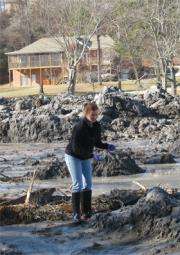
Duke graduate student Laura Ruhl collects samples from a site affected by the TVA coal sludge spill. | Avner Vengosh

(PhysOrg.com) -- A report by Duke University scientists who analyzed water and ash samples from last month’s coal sludge spill in eastern Tennessee concludes that “exposure to radium- and arsenic-containing particulates in the ash could have severe health implications” in the affected areas.

“Our radioactive measurements of solid ash samples from Tennessee suggests the ash has radiation levels above those reported by the Environmental Protection Agency (EPA) for typical coal ash,” said Avner Vengosh, associate professor of earth and ocean sciences at Duke’s Nicholas School of the Environment. “Preventing the formation of airborne particulate matter from the ash that was released to the environment seems essential for reducing possible health impacts.”

More than a billion gallons of sludge coal waste spilled from a holding facility at the Tennessee Valley Authority’s Kingston coal-burning power plant on Dec. 22. The ash-laden waste flooded more than 400 surrounding acres and spilled into a tributary of the Emory River, which converges with the Clinch River and flows into the Tennessee River, a major source of drinking water for many communities in the region. The spill was so large it partly dammed the tributary of the Emory River, turning it into a standing pond.

Vengosh’s team found that the combined content of radium-228 and radium-226 - the two long-lived isotopes of radium - in the solid ash samples they collected from the TVA spill measured about 8 picocuries per gram. That’s higher than the average 5-6 picocuries per gram reported by the EPA in most bottom and fly ash samples. The curie is a standard measure of the intensity of radioactivity.

Radium is a naturally occurring radioactive element that decays from uranium and thorium elements in coal. When the coal is burned, it is concentrated in the ash. The EPA classifies radium as a Group-A carcinogenic material, which means exposure to it could cause cancer.

Water samples collected and analyzed by Vengosh and Duke graduate student Laura Ruhl found high levels of arsenic, measuring 95 parts per billion, in water from the dammed tributary where coal ash has accumulated. Only low concentrations were found in the Emory and Clinch rivers. The EPA has set the arsenic standard for safe public drinking water at 10 parts per billion.

Arsenic is a toxic metal that can occur naturally in the environment or as a by-product of some agricultural and industrial activities. According to the EPA, the effects of long-term chronic exposure to arsenic can include increased risk of certain types of cancer, as well as skin damage and circulatory problems.

“The good news is, we detected only trace amounts of arsenic in waters beyond the dammed tributary,” Vengosh said. “The data suggests that in less than three weeks since the spill, river flow has diluted the arsenic content. The river is clean, but the water from areas like the dammed tributary, where the coal ash has accumulated, still contains high arsenic levels.”

Vengosh is an internationally cited expert on the chemistry of radioactive elements in surface and ground waters. He has conducted extensive research on radon and radium contaminants in the ground waters of western North Carolina and the Middle East.

He and Ruhl collected the water and solid ash samples at sites affected by the TVA spill on Jan. 9. Duke research scientist Gary Dwyer analyzed the water samples for trace metal content using inductively coupled plasma mass spectrometry. Following preliminary analysis, the solid ash samples were incubated and underwent more detailed analysis of their radioactive content using gamma spectrometry.

Vengosh’s team collected the samples from the TVA spill after being contacted by United Mountain Defense, a nonprofit environmental group based in Tennessee. The Duke researchers received no funding from the group or any other external party. All funding was provided by the Nicholas School, Vengosh said, “to maintain total impartiality in our analysis.”

“The TVA spill is one of the largest events of its kind in U.S. history. It raises questions concerning the safety of storing coal ash and the potential effects of coal ash on environmental and human health,” Vengosh said. “We hope our analysis will help provide some answers.”

Provided by Duke University


print this article email this article download pdf blog this article bookmark this article     Stumble it Digg this share on Facebook retweet share on Reddit add to delicious
Rate this story - 3.4 /5 (5 votes)

Rank Filter

Move the slider to adjust rank threshold, so that you can hide some of the comments.


Display comments: newest first

  • GrayMouser - Jan 29, 2009
    • Rank: 1 / 5 (1)
    This begs 2 questions:
    1) What is the health effects of "8 picocuries per gram" on a daily basis in drinking water?
    2) How much of that survives the water treatment and transportation process to come out of the tap?
  • Doug_Huffman - Jan 29, 2009
    • Rank: not rated yet
    For 226 and 228 radium, the MCL is 5 picocuries per liter and for 224 radium it is 15pCi/l. Note that a liter is 1000 grams.

    Traditional municipal water treatment, filtration and chlorination has no effect. An ion exchange resin column or RO might remove Ra.

    Those who refuse to do arithmetic are doomed to nonsense. If it was easy then every one would do it.
  • TJ_alberta - Jan 30, 2009
    • Rank: not rated yet
    they don't mention the form of the radium. for example my Merck Index lists bromides and chlorides of radium as water soluble. Maybe in coal ash it is combined with a silicate??

  • Doug_Huffman - Jan 30, 2009
    • Rank: not rated yet
    As a hypothetical silicate what might the exposure route be that would make the EPA DW MCL ineffective?
  • GrayMouser - Jan 30, 2009
    • Rank: 1 / 5 (1)
    For 226 and 228 radium, the MCL is 5 picocuries per liter and for 224 radium it is 15pCi/l. Note that a liter is 1000 grams.

    Yeah, I looked it up and 5 picocuries was listed as being far below the danger level for continuous exposure over a 70 year span. This level is around the average natural level in the soil although certain geologic formations are listed as being orders of magnitude higher.

    No chemical toxicity levels are given.

    Traditional municipal water treatment, filtration and chlorination has no effect. An ion exchange resin column or RO might remove Ra.

    Ion exchange and reverse osmosis are listed as ways to reduce the amount. Filtration can also help for radium bound to suspended particulates.

January 29, 2009 all stories

Comments: 5

3.4 /5 (5 votes)
  • Stumble this up

  • Digg this

  • share this

  • hide
  • Related Stories


  • hide
  • Relevant PhysicsForums posts

Other News

Baby can wait as expectant dad finishes spacewalk (AP)

Baby can wait as expectant dad finishes spacewalk

Space & Earth / Space Exploration

created 11 hours ago | popularity 3 / 5 (2) | comments 0

(AP) -- A spacewalking astronaut put aside the impending birth of his daughter and blazed through his first-ever venture outside the International Space Station on Saturday.


Unseasonably hot and dry weather combined with strong winds to fan scores of blazes in the country's southeastern states

Australia issues 'catastrophic' alerts as fires rage

Space & Earth / Environment

created 17 hours ago | popularity 4 / 5 (3) | comments 0

Australia has issued "catastrophic" alerts after record-breaking temperatures and wild lightning storms sparked more than 100 fires across the country, officials said Saturday.


Commuters wait on the platform shrouded by fog in London

Climate change not man-made, say majority of Britons: poll

Space & Earth / Environment

created Nov 15, 2009 | popularity 3.3 / 5 (15) | comments 46

Less than half of Britons believes that human activity is to blame for global warming, according to a poll carried out for The Times newspaper and published on Saturday.


Mysteriously warm times in Antarctica

Mysteriously warm times in Antarctica

Space & Earth / Earth Sciences

created Nov 18, 2009 | popularity 4.2 / 5 (21) | comments 28

(PhysOrg.com) -- A new study of Antarctica's past climate reveals that temperatures during the warm periods between ice ages (interglacials) may have been higher than previously thought. The latest analysis ...


UN: Fight climate change with free condoms (AP)

UN: Fight climate change with free condoms

Space & Earth / Environment

created Nov 18, 2009 | popularity 3.1 / 5 (11) | comments 24

(AP) -- The battle against global warming could be helped if the world slowed population growth by making free condoms and family planning advice more widely available, the U.N. Population Fund said Wednesday.