'The robots are coming'
January 29, 2009 Robot Learning

Enlarge

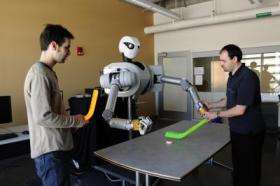
Assistant professor Alexander Stoytchev (right) and graduate student Jivko Sinapov are working to develop software so a robot can learn to use tools. One example of such learning is maneuvering a hockey stick around a puck. Photo by Bob Elbert/Iowa State University

Alexander Stoytchev and his three graduate students recently presented one of their robot's long and shiny arms to a visitor. Here, they said, swing it around.

And so that visitor tentatively gave the robot's left arm a few twists and twirls. The metal arm was heavy, but still moved easily at its shoulder, elbow and wrist joints.

Then the graduate students hit some keyboard commands and the robot replayed those exact arm movements.

It was all incredibly quick, smooth and precise.
Stoytchev, an assistant professor of electrical and computer engineering, says it won't be long before robot technology is something we'll all see and experience.

"We'll have personal robots very soon," Stoytchev said. "We're waiting for the first killer app. Hopefully, we can contribute to that."

Star Wars

There's a little R2-D2-shaped trash can near the door to Stoytchev's lab in the new Electrical and Computer Engineering Building. Turns out the Star Wars movies were an inspiration to a young Stoytchev back home in Bulgaria.

"My interest in robotics stems from the day I saw Star Wars for the first time," the 34-year-old said. "I must have been in second or third grade at that time, but the two robots in the movie (R2-D2 and C-3PO) left a lasting impression on me."

That impression led Stoytchev to his high school's computer club and then to computer science studies as an undergraduate at American University in Bulgaria. He moved to Atlanta's Georgia Institute of Technology for graduate work in computer science. He was at Georgia Tech when he started working with robots.

His research specialty is developmental robotics, a blend of robotics, artificial intelligence, developmental psychology, developmental neuroscience and philosophy.

"It's one of the newest branches of robotics," Stoytchev said. "People have learned that it's unrealistic to program robots from scratch to do every task, so we're looking at human models. Humans are not born knowing everything. It takes a really long time to develop skills."

Stoytchev and his students are trying to figure out how a robot can learn what children learn over the first two years of their lives. (And child development is something Stoytchev is learning firsthand; he and his wife have a 2-month-old son.)

Graduate work

Stoytchev's graduate students are working to develop software that will allow their lab robot to learn and use different sets of skills:

• Shane Griffith, who's from Cedar Rapids and is studying computer engineering and human computer interaction, wants the robot to learn on its own which everyday objects can be used as containers and which cannot.

• Jivko Sinapov, who's from Sofia, Bulgaria, and is studying computer science and human computer interaction, wants the robot to learn how to use objects as tools.

• Matt Miller, who's also from Cedar Rapids and is studying computer science, wants the robot to learn language.

Combine that developing software with existing robotics hardware, and you've got a useful, smart robot.

"The essential goal of developmental robotics is for robots to learn how to learn," Miller said. "We want them to learn how to take a situation, adjust to it and learn from it."

A robot, for example, could learn to use containers by putting a ball in a bucket and seeing what happens when that bucket is pushed across a table. Is the ball pushed along with the bucket? Or is it left behind? The researchers believe that simple interactions like these hold the key to capturing the common-sense knowledge about the real world that comes naturally to people but is so difficult to capture in software code.

A future with robots

Stoytchev was attracted to Iowa State in 2005 by the College of Engineering's reputation and research capabilities. He also liked the interdisciplinary research programs in the department of electrical and computer engineering, the Virtual Reality Applications Center and the graduate program in human computer interaction.

And now he's directing Iowa State's Developmental Robotics Laboratory and making his own research contributions.

It's work that has him looking ahead.

"In the not-too-distant future, we will have personal robots just like we have personal computers today," he said. "The robots of the future will be generalists. They will be employed in a large variety of tasks that require a lot more smarts and autonomy than is currently possible. They will have the ability to learn how to perform new tasks on their own without human intervention."

Yes, he said, "The robots are coming. Are we ready?"

Source: Iowa State University


print this article email this article download pdf blog this article bookmark this article     Stumble it Digg this share on Facebook retweet share on Reddit add to delicious
Rate this story - 4.7 /5 (6 votes)

Rank Filter

Move the slider to adjust rank threshold, so that you can hide some of the comments.


Display comments: newest first

  • BigTone - Jan 29, 2009
    • Rank: 5 / 5 (1)
    Depending on how one defines AI, the existing mechanisms to induce machine learning and robots are often too tightly coupled. It's primarily a software problem not a hardware problem (with the concession that once the software is created - it will drive minimum hardware requirements).

    If you take away the practical limitations of a robot (i.e. MIPS, Power, Memory, Sensor capability, etc) and give whatever AI engine you are using all the advantages possible (distributed computing, human tuning, finite variables, lots of time and memory, etc) - it will still not even begin to rival human problem solving capability...

    Articles like this perpetuate the connection between robots and AI - when the reality is that once the AI engines become worthy - a robot will just be one manifestation of their outputs...

    And of course - we all would love a clever robot that can mimic intelligence well enough to be helpful - I just don't want that confused with what AI research is really all about...
  • SmartK8 - Jan 29, 2009
    • Rank: 5 / 5 (1)
    BigTone: Well it's becoming more evident that the intelligence is not just that of a brain (albeit primary source) but also it's distributed in the bodyparts themselves. There're many examples such as sensory filtering or intermediate body balance being solved by a skeletal and masculatory system. So it may not be (or maybe even can't be) that AI is a processing power while the robotic body is just a rendered state.
  • moj85 - Mar 10, 2009
    • Rank: not rated yet
    @ SmartK8: Can you say that body balance is an important part of intelligence? A simple reactionary mechanism?
  • SmartK8 - Mar 20, 2009
    • Rank: not rated yet
    moj85: Sure. For example the eyes are known to be preprocessing the information and sending only the changes to the brain. I also saw the robots without a brain (environment processing) that were able to solve (overcome) movement through the complex environments just using the body construction. Check this out:

    http://tinyurl.com/68njgm

January 29, 2009 all stories

Comments: 4

4.7 /5 (6 votes)
  • Stumble this up

  • Digg this

  • share this

  • hide
  • Related Stories

  • New computer cluster gets its grunt from games
    created 11 hours ago | popularity not rated yet | comments 0
  • UCSB physicists move one step closer to quantum computing
    created Nov 20, 2009 | popularity not rated yet | comments 0
  • The court will now call its expert witness: the brain
    created Nov 20, 2009 | popularity not rated yet | comments 0
  • Waking up memories while you sleep
    created Nov 19, 2009 | popularity not rated yet | comments 0
  • FutureGrid to provide platform for experimental computation
    created Nov 17, 2009 | popularity not rated yet | comments 0


  • hide
  • Relevant PhysicsForums posts

  • Control System
    created Nov 24, 2009
  • Base Isolation Systems in Skyscrapers?
    created Nov 23, 2009
  • Need to interview a Computer Hardware Engineer for school project
    created Nov 23, 2009
  • transient heat transfer
    created Nov 23, 2009
  • Trying to adapt a fuel gage circuit
    created Nov 22, 2009
  • Pushing the piston.
    created Nov 22, 2009
  • More from Physics Forums - General Engineering

Other News

Nokia 6700 slide

New Nokia 6700 slide and Nokia 7230 unveiled

Electronics / Consumer & Gadgets

created 8 minutes ago | popularity not rated yet | comments 0

Nokia today unveiled two new 3G slider phones, the Nokia 6700 slide and Nokia 7230, made for the design-conscious consumer and optimized for socializing and sharing with those closest to you.


Apple's iPhone

Modified iPhones Are Compromised By New Worm

Electronics / Consumer & Gadgets

created 6 hours ago | popularity 5 / 5 (3) | comments 1

(PhysOrg.com) -- Several research security firms have reported a new worm attack against jail broken iPhones, dubbed "Ikee.B or "Duh", this worm searches for personal and banking information.


Qualcomm's next e-book to use a mirasol display

Qualcomm's next e-book to use a mirasol display

Electronics / Consumer & Gadgets

created Nov 20, 2009 | popularity 4.7 / 5 (11) | comments 2

(PhysOrg.com) -- Qualcomm subsidiary Mirasol is developing a new e-book reader with a color display that uses ambient light. The reader will be capable of displaying video smoothly, but the new features will ...


"Walky" Project (Keio University in Tokyo)

iPhone Software That Controls Robot Movements (w/ Video)

Electronics / Robotics

created Nov 18, 2009 | popularity 5 / 5 (6) | comments 0

(PhysOrg.com) -- At the graduate school of media design at Keio University in Tokyo, a project called "Walky" is under developed. Researchers have developed specifically designed software for the iPhone that ...


New study to evaluate robots as exercise trainers (w/ Video)

Electronics / Robotics

created Nov 19, 2009 | popularity not rated yet | comments 0

Maja Mataric', who directs the University of Southern California Center for Robotics and Embedded Systems, will lead an effort to evaluate robots as exercise coaches for adults of all ages, with a particular focus on the ...