'SnowMan' Software Helps Keep Snow Drifts Off the Road
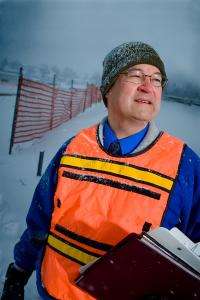
(PhysOrg.com) -- Snow that blows and drifts across roadways has long troubled road maintenance crews and commuters alike, creating treacherous driving conditions and requiring additional maintenance resources to mitigate the problem.
Now, a University at Buffalo engineer has led the development of "SnowMan," a user-friendly, desktop software package that puts cost-effective solutions to the snow drift problem at the fingertips of highway designers and road maintenance personnel.
"SnowMan" helps transportation engineers design roadways that are less likely to be plagued by snow drifts; it also allows maintenance personnel to more precisely situate snow fences in order to reduce drifting on existing roadways.
Stuart Chen, Ph.D., professor of civil, structural and environmental engineering, designed "SnowMan" with former UB graduate student Michael Lamanna. Chen unveiled the software this month at the annual conference of the National Academy of Sciences' Transportation Research Board in Washington, D.C. They developed "SnowMan" with assistance from Darrell Kaminski, regional design engineer for the Western New York region of the New York State Department of Transportation and Ronald Tabler of Tabler and Associates, Niwot, Colorado.
Funded, designed and implemented for the NYSDOT, the computer-aided design software is completely adaptable to wherever blowing and drifting snow is a problem.
"The NYSDOT believes that the SnowMan software will significantly advance the implementation of passive snow-control measures both within New York State and nationwide," said Joseph F. Doherty, senior civil engineer, operations division, NYSDOT, Albany. "It provides an important tool that will facilitate designers' use of decades of research, by Ronald Tabler and others, in the field of blowing snow control.
"We expect improvements in highway safety, lower winter maintenance costs and reduced impacts on the environment as a result."
To mitigate the problems that blowing and drifting snow create, road maintenance crews or contractors will erect snow fences, temporary or permanent barriers made of plastic or wood, along roads where drifting typically occurs.
According to Chen, snow fences serve as a physical means of "interrupting" the blowing and drifting of snow.
"Wind carries particles of snow along just the way that a river will carry silt and mud," he explained. "Snow fences introduce turbulence that causes the wind to deposit some of the snow particles it has been carrying onto the ground behind the snow fence, leaving the roadway clear."
But deciding how to configure and place those snow fences is not an exact science, Chen said.
"Snow fences are typically erected according to general knowledge about an area where blowing and drifting occurs," said NYSDOT's Kaminski, Chen's co-author on the SnowMan research paper and an alumnus of the UB School of Engineering and Applied Sciences.
"Fences are typically a standard height and are placed a certain number of feet from a roadway," he said.
A more precise approach would require maintenance personnel to obtain climate data for an area to determine how much snow and wind that area experiences in a season and then to run a series of calculations to determine the best height and placement for a fence in that location.
The big advantage of SnowMan, Chen explained, is that it provides all of these capabilities to the user automatically, whether the goal is to mitigate a specific blowing and drifting problem or to design a new roadway that minimizes blowing and drifting.
The software is based on a combination of knowledge about the fluid mechanics principles that underlie how snow blows and drifts, with fieldwork done by Tabler, a snow and wind engineering consultant, on the characteristics of blowing and drifting snow.
"SnowMan allows users to analyze different types and heights of virtual snow fences in a variety of distances from a given roadway so that it is possible to come up with the best solution for a specific site and climate," said Chen.
The software includes climatological data about seasonal snowfall and wind velocities for most regions throughout New York State.
"For the first time, it allows us to be precise about where to put snow fences," said Chen.
Chen's work on SnowMan is part of a growing transportation engineering research emphasis at UB, which is based on the university's well-established and internationally renowned strengths in civil and structural engineering, particularly in the physical protection of transportation infrastructure.
UB's transportation research focuses on improving traffic flow and developing intelligent transportation systems, in which information technologies are used to better manage transportation; developing technologies that promote more efficient, safe travel during inclement weather, particularly during upstate New York's harsh winters; and developing collision-avoidance sensors for roads, bridges and vehicles, and more integrated land-use and infrastructure management, funding and planning.
Provided by University at Buffalo


