Wireless at WARP speed
Nothing kills innovation like having to reinvent the wheel. Imagine how dull your diet would be if you had to build a new stove and hammer out a few cooking pots every time you wanted to test a new recipe. Until just a couple of years ago, electronics researchers testing new high-speed wireless technologies faced just this sort of problem; they had to build every test system completely from scratch.
"It was incredibly frustrating," said Ashutosh Sabharwal, director of Rice University's Center for Multimedia Communication (CMC). So, CMC set out to change that in 2006 by creating a turnkey, open-source platform -- the stove, pots and kitchen utensils, if you will -- that would let wireless researchers expand their tech menus.
In just two short years, the platform -- dubbed WARP -- has whetted the appetites of heavyweights like Nokia, MIT, Toyota, NASA and Ericsson, and it's already being used to test everything from low-cost wireless Internet in rural India to futuristic "unwired" spacecraft.
Sabharwal, the lead investigator on the federally funded WARP project, said he and his CMC colleagues were among the lucky few in academia who could afford the high cost of entry into wireless research in 2006.
"Collectively, it was a big waste of time and effort, and there were a lot of people who simply couldn't afford to play," Sabharwal said. "Some of our previous research hinted at the possibilities of an open-access platform, so we had a clear goal when we made our proposal to the National Science Foundation."
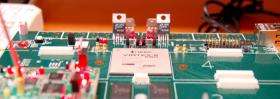
WARP stands for "wireless open-access research platform," and physically, WARP looks like something from the guts of a desktop computer. It's a collection of boards containing a powerful processor and all the transmitters and other gadgets needed for high-end wireless communications. What makes WARP boards so effective is their flexibility. When researchers need to test several kinds of radio transmitters, wireless routers and network access points, all they need to do is write a few programs that allow the WARP board to become each of those devices.
The concept is already starting to pay off. Sabharwal said Motorola is using the system to test an entirely new low-cost architecture for wireless Internet in rural India. It's the sort of low-profit-margin project that probably wouldn't have gotten beyond the drawing board if not for WARP, he said. Another early adopter, NASA, is using WARP to look for ways to save weight, cost and complexity in the wiring systems for future spacecraft.
At Rice, CMC staffer Patrick Murphy -- the former CMC doctoral student who developed the original WARP architecture - is collaborating with graduate students to use WARP in proof-of-concept technologies for "cognitive wireless." The cognitive wireless concept stems from the fact that up to half of the nation's finite wireless spectrum is unused at any given time. Sabharwal said researchers have talked for years about designing smart, "cognitive" networks that can shift frequencies on the fly, opening up vast, unused amounts of spectrum for consumer use.
"WARP provides an entry point for people to test new ideas about cognitive wireless, and our students are answering the fundamental questions: how much spectrum can really be reused without hurting current sporadically used services and more importantly, build practical proof-of-concept prototypes?" Sabharwal said.
Making WARP a reality wasn't easy. Students and staffers from the research groups of Sabharwal and CMC faculty members Ed Knightly, Lin Zhong, Joseph Cavallaro and Behnaam Aazhang designed the WARP hardware and built all the back-end systems, tools and software that allow the various components of WARP to work together.
With so many hands on deck, CMC was able get a version of WARP ready to release to the research community within a year of getting its initial NSF funding. After this early success, Sabharwal spent a few frustrating months trying to find a company to manufacture WARP boards.
"Our philosophy from the beginning had been to drive the cost lower and lower, to sell the boards for as little as possible in order to get them out there," Sabharwal said. "Everyone we contacted seemed to want just the opposite, to mark them up as much as possible and sell to the few people that could afford high prices."
With CMC researchers touting their work at conferences and workshops, colleagues around the world were clamoring for boards. Sabharwal said CMC began producing a few, even as it was seeking a production deal with an established company. The lab wound up selling equipment to about 40 university and corporate research groups before WARP architect Murphy -- now a CMC project manager -- founded Houston-based Mango Communications in mid-2008 to take over production of the boards.
Sabharwal said CMC has NSF funding through 2010 to further develop WARP, and they're putting the final touches on a new set of tools that will allow researchers to control the boards from any location remotely. That will allow them to fulfill one of CMC's longstanding goals of installing the flexible boards into existing test networks like the CMC-built high-speed network that nonprofit Technology For All operates for more than 4,000 users in Houston's East End neighborhood.
Sabharwal said CMC is just beginning to hear back from colleagues about how they are using WARP.
He said several large wireless companies are using WARP to test schemes for wireless phone networks that can transfer data up to 100 times faster than current 3G networks. He said Toyota is using WARP to test car-to-car communications -- systems that automotive engineers hope to use in the future for collision avoidance, traffic management and more. In another case, Sabharwal said he was surprised to learn the some users were partially disassembling the boards to add new functions. It was still cheaper than starting from scratch, so it made sense, but it wasn't something CMC had expected.
"When you put a new technology into people's hands, they'll inevitably find innovative ways to use it," Sabharwal said. "That's one of the best things about WARP. It is going to lead to innovations that we could never have anticipated."
Source: Rice University


