Test in Development of NASA's New Crew Rocket is Successful
January 30, 2009 Test in Development of NASA's New Crew Rocket is Successful

Enlarge

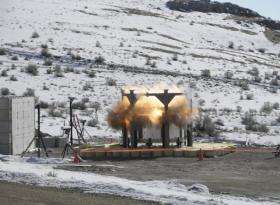
A full-scale separation test of the forward skirt extension for the Ares I-X flight test at its facility in Promontory, Utah on January 29, 2009. (Image: NASA/ATK)

(PhysOrg.com) -- The development of NASA's next-generation crew launch vehicle, the Ares I rocket, took another step forward Thursday as Alliant Techsystems, or ATK, successfully tested a critical piece. ATK conducted a full-scale separation test of the forward skirt extension for the Ares I-X flight test at its facility in Promontory, Utah.

The Ares I-X test launch is scheduled to lift off from NASA's Kennedy Space Center in Florida during 2009. The rocket will climb about 25 miles in altitude during a two-minute powered flight. The launch will culminate with a test of the separation of the first stage from the rocket and deployment of the accompanying parachute system that will return the first stage to Earth for data and hardware recovery.

Yesterday's test simulated the separation event that will take place following the first stage flight of Ares I-X. During the Ares I-X flight, the booster will separate at the frustum, a cone-shaped piece that attaches the first stage to the larger diameter upper stage.

"The Ares I-X team is pleased with the completion of this key test that will provide important data leading up to the launch of the Ares I-X flight," said Steve Davis, deputy mission manager for the Ares I-X test flight at NASA's Marshall Space Flight Center in Huntsville, Ala.

At an altitude of about 15,000 feet, the nose cone will be jettisoned, deploying the pilot parachute. The pilot chute will, in turn, deploy the drogue parachute, which will re-orient the booster vertically and slow it to acceptable conditions for main parachute deployment. At about 4,000 feet, the separation at the base of the forward skirt extension occurs, pulling out the three main chutes packed inside.

Test objectives included demonstrating that the linear shaped charge used to separate the forward skirt extension severed cleanly and measuring the shock created by that charge. NASA will use the data analyze the system and prepare for the Ares I-X flight test and the development of the Ares I crew launch vehicle.

The forward skirt extension is built to withstand the loads of the first stage and support the weight of the upper stage. The component is built as one solid piece of aluminum forged into a 6-foot-long by 12-foot-diameter cylinder with a unique internal support structure that houses three newly-designed main parachutes. Its state-of-the-art design will withstand the force imparted at main chute deployment.

"This was an important milestone for the program, as it validates key parameters to support the upcoming Ares I-X flight test," said Mike Kahn, executive vice president of ATK Space Systems. "The program is one step closer to the flight test of Ares I-X."

Provided by NASA


print this article email this article download pdf blog this article bookmark this article     Stumble it Digg this share on Facebook retweet share on Reddit add to delicious
Rate this story - 3 /5 (2 votes)


January 30, 2009 all stories

Comments: 0

3 /5 (2 votes)
  • Stumble this up

  • Digg this

  • share this

  • hide
  • Related Stories


  • hide
  • Relevant PhysicsForums posts

  • Question about 2-body gravity
    created Nov 24, 2009
  • life on Mars
    created Nov 24, 2009
  • Semi-major axis from cartesian co-ordinates
    created Nov 23, 2009
  • Primary Mirror grinding
    created Nov 23, 2009
  • More from Physics Forums - General Astronomy

Other News

NASA Aircraft Flies Calif. Wildfire Post-Burn Mission

Space & Earth / Environment

created 31 minutes ago | popularity not rated yet | comments 0

(PhysOrg.com) -- NASA's remotely piloted Predator B aircraft, named Ikhana, recently conducted post-burn assessments of two Southern California wildfire sites, the Piute Fire in Kern County and the Station Fire in the Angeles ...


Oceanic crust formation is dynamic after all

Oceanic crust formation is dynamic after all

Space & Earth / Earth Sciences

created 1hour ago | popularity 4 / 5 (1) | comments 0

Imagine the Earth's crust as the planet's skin: Some areas are old and wrinkled while others have a fresher, more youthful sheen, as if they had been regularly lathered with lotion.


Cosmic 'dig' reveals vestiges of the Milky Way's building blocks

Cosmic 'Dig' Reveals Vestiges of the Milky Way's Building Blocks

Space & Earth / Astronomy

created 2 hours ago | popularity 5 / 5 (6) | comments 0

(PhysOrg.com) -- Peering through the thick dust clouds of our galaxy's "bulge" (the myriads of stars surrounding its center), a team of astronomers has unveiled an unusual mix of stars in the stellar grouping ...


NASA's Aqua satellite sees Nida explode into a category 5 Super typhoon

NASA's Aqua satellite sees Nida explode into a category 5 Super typhoon

Space & Earth / Earth Sciences

created 1hour ago | popularity 5 / 5 (1) | comments 0

Typhoon Nida is in a favorable environment that has enabled it to intensify faster and stronger than previously forecast, and has now exploded into a Super typhoon. NASA's Aqua satellite passed over Nida and ...


Mars Reconnaissance Orbite

Mars Reconnaissance Orbite Team Plans Uplink of Protective Files

Space & Earth / Space Exploration

created 7 hours ago | popularity 5 / 5 (1) | comments 0

(PhysOrg.com) -- The team operating NASA's Mars Reconnaissance Orbiter plans to uplink protective files to the spacecraft next week as one step toward resuming the orbiter's research and relay activities.