Scientists discover ground-breaking material: Graphane
January 30, 2009
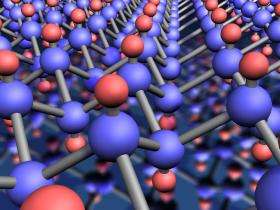
Graphane crystal

Enlarge

Graphane crystal. This novel two-dimensional material is obtained from graphene (a monolayer of carbon atoms) by attaching hydrogen atoms (red) to each carbon atoms (blue) in the crystal.

(PhysOrg.com) -- Researchers at The University of Manchester have produced a ground-breaking new material, graphane, which has been derived from graphene.

Graphene, which was discovered at the University in 2004, is a one-atom-thick crystal with unusual highly conductive properties, which has quickly become one of the hottest topics in physics and materials science. It is also tipped for a number of future applications in electronics and photonics.

But research published today (Friday 30 January, 2009) by Professor Andre Geim and Dr Kostya Novoselov, who led the group that discovered graphene in 2004, suggests its uses could be far greater.
Scientists discover ground-breaking material: Graphane
Enlarge

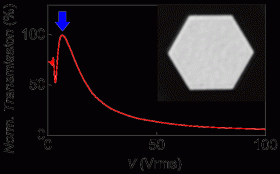
Liquid Crystal Device with electrodes made of graphene with different voltages applied. The overall width of the image is 30 microns. (CLICK FOR ANIMATED VERSION)

That's because the scientists, from the University’s School of Physics and Astronomy, have found that graphene will react with other substances to form new compounds with different properties - opening up further opportunities for development in the field of electronics.

As part of the research, published today in the leading scientific journal Science, Professor Geim and Dr Novoselov have used hydrogen to modify highly conductive graphene into a new two-dimensional crystal - graphane.

The addition of a hydrogen atom on each of the carbon atoms in the graphene achieved the new material without altering or damaging the distinctive one-atom-thick ‘chicken wire’ construction itself.

But instead of being highly conductive, like graphene, the new substance graphane has insulating properties.

The researchers say the findings demonstrate that the material can be modified using chemistry - clearing the way for the discovery of further graphene-based chemical derivatives.

“Graphene is an excellent conductor and is tipped for many electronic applications,” said Dr Novoselov. “However it was tempting to look at ways to gain additional control of its electronic properties through the use of chemistry.

“Our work proves that this is a viable route and hopefully will open the floodgates for other graphene-based chemical derivatives. This should widen the possible applications dramatically.”

The unique electronic properties of graphene have already led researchers to look at ways the material could be used in the development of increasingly small and fast transistors. However, the absence of the energy gap in the electronic spectra forced scientists to use rather complex graphene-based structures like quantum point contacts and quantum dots for this purpose.

The discovery that graphene can be modified into new materials, fine tuning its electronic properties, has opened up the increasingly rich possibilities in the development of future electronic devices from this truly versatile material.

Professor Geim said: “The modern semiconductor industry makes use of the whole period table: from insulators to semiconductors to metals.

“But what if a single material is modified so that it covers the entire spectrum needed for electronic applications?

“Imagine a graphene wafer with all interconnects made from highly conductive, pristine graphene whereas other parts are modified chemically to become semiconductors and work as transistors.”

The Manchester researchers produced high-quality crystals of graphane by exposing pristine graphene to atomic hydrogen. The approach shows a way of making many other ultra-thin crystalline materials based on graphene.

Reference: ‘Control of Graphene’s Properties by Reversible Hydrogenation: Evidence for Graphane’, journal Science.

Provided by University of Manchester

4.6 /5 (54 votes)  

Filter


Move the slider to adjust rank threshold, so that you can hide some of the comments.


Display comments: newest first

OregonWind
Jan 30, 2009

Rank: 4.8 / 5 (5)
This is good news. The best time for the electronics did not happen yet.
ShadowRam
Jan 30, 2009

Rank: 1 / 5 (1)
Whoa whoa whoa...

Isn't this just Benzene?
OregonWind
Jan 30, 2009

Rank: 4 / 5 (1)
Benzene formula C6H6. In this case: '...addition of a hydrogen atom on each of the carbon atoms in the graphene' that would not necessarily reflects the formula for Benzene. What do you think?
El_Nexus
Jan 30, 2009

Rank: 4.6 / 5 (9)
ShadowRam and OregonWind,

It is true that Benzene and Graphane have the same empirical formula, that is, both compounds contain carbon and hydrogen in the same ratios (1:1). But it is very possible for two compounds to have the same empirical formula and yet differ in their structure.

A simple example, since we're talking about carbon rings anyway, is the difference between cyclopropane and cyclohexane. Both contain two hydrogen atoms for every one carbon atoms, but the first has three carbon atoms and the latter six. And they differ greatly in their chemical and physical properties.

In this case, benzene contains a single carbon ring with alternating double bonds. It is a flat molecule with the hydrogens pointing out from the center. Graphane contains countless carbon rings and doesn't contain any double bonds. It is a distinctly three-dimensional molecule with the hydrogens sticking up and down out of the plane of the molecule.
OregonWind
Jan 30, 2009

Rank: 5 / 5 (2)
El_Nexus

Thank you for the explanation.
El_Nexus
Jan 30, 2009

Rank: 3 / 5 (2)
No problemo
RAL
Jan 31, 2009

Rank: not rated yet
Great article, great comments.
donatiello
Jan 31, 2009

Rank: 1 / 5 (1)
Great article. I am curious about large scale applications for this material. Lightweight, strong building material with integrated processor or display technology? Could this be produced to have intermittent zones in which different co - elements bond?
blengi
Jan 31, 2009

Rank: 1 / 5 (1)
kool, a generalisable 2d information scaffold from which to create some cryobiological weirdness...
abadaba
Jan 31, 2009

Rank: 3.7 / 5 (3)
adding to the whole benzene thing. Benzene is an aromatic compound meaning 3 sp2 bonds for each carbon, and resonating double bonds. Graphene, being in a "chicken wire" sheet structure, needs each carbon to be connected to three other carbons, the two adjacent on its ring, plus one one neighboring to complete the mesh. Adding one more hydrogen would be the 4th bond, the max that carbon can support. Therefore it can have no double bonds, no resonance, and no aromaticity, which is what makes benzene benzene.
NeilFarbstein
Feb 01, 2009

Rank: not rated yet
Vulvox has begun researching heat exchange materials that transfer heat between hot and cold environments. They show very high heat transfer characteristics in experiments and can be manufactured from materials that can be scaled up and it is possible we can take advantage of economies of scale. They transfer heat much faster than stainless steel and they are much lighter than metallic materials.They will be applied in breakthrough products such as geothermal pumps, solar thermal energy collectors, and industrial heat exchangers with much higher efficiencies. They will be products that will increase industrial efficiency and that will pay for themselves even in a recessionary era. Vulvox has begun experiments on new ways to synthesize graphene paper, one of the strongest materials known to science. Our new materials are shown at the address below;
HTTP://VULVOX.TRI...d10.html
TrustTheONE
Feb 02, 2009

Rank: not rated yet
Will it be as strong as the carbon nanotube?
dev2000
Feb 02, 2009

Rank: 1 / 5 (1)
Kudos to the genius who named "graphane" so that it would be mistaken, confused, spell-check corrected, misread, mumbled, etc. to "graphene".

What, was "hydrographene" already taken?

People, please. We're in a recession here.
Rank 4.6 /5 (54 votes)
Relevant PhysicsForums posts
  • Corrosion Tests on Magnesium
    created11 hours ago
  • polyethylene copper nanocomposite
    created17 hours ago
  • Output of xrd analysis
    createdFeb 08, 2012
  • Transport phenomena problem based on problems 18.B11 and 19B.6 from Bird, stewart, lw
    createdFeb 06, 2012
  • Help with material selection - Car Piston
    createdFeb 05, 2012
  • Name of the steel alloy?!!?
    createdFeb 02, 2012
  • More from Physics Forums - Materials & Chemical Engineering

More news stories

'Dark plasmons' transmit energy

Microscopic channels of gold nanoparticles have the ability to transmit electromagnetic energy that starts as light and propagates via "dark plasmons," according to researchers at Rice University.

Nanotechnology / Nanophysics

created 7 hours ago | popularity 5 / 5 (4) | comments 0 | with audio podcast

Nanotube therapy takes aim at breast cancer stem cells

Wake Forest Baptist Medical Center researchers have again proven that injecting multiwalled carbon nanotubes (MWCNTs) into tumors and heating them with a quick, 30-second laser treatment can kill them.

Nanotechnology / Bio & Medicine

created 12 hours ago | popularity 5 / 5 (1) | comments 0 | with audio podcast

Inspired by steel, nanomanufacturing gets wear-resistant carbide tip

(PhysOrg.com) -- Scientists at the University of Pennsylvania, the University of Wisconsin-Madison and IBM Research - Zurich have fabricated an ultrasharp silicon carbide tip possessing such high strength ...

Nanotechnology / Nanophysics

created 17 hours ago | popularity 5 / 5 (3) | comments 1 | with audio podcast

New technology platform for molecule-based electronics

Researchers at the Nano-Science Center at the University of Copenhagen have developed a new nano-technology platform for the development of molecule-based electronic components using the wonder material graphene. At the same ...

Nanotechnology / Nanomaterials

created 14 hours ago | popularity 5 / 5 (2) | comments 0

Australians risking skin cancer to avoid nanoparticles

More than three in five Australians are concerned enough about the health implications of nanoparticles in sunscreens to want to know more about their impact. And while the initial scientific information released suggests ...

Nanotechnology / Bio & Medicine

created 16 hours ago | popularity 5 / 5 (1) | comments 0


FDA-approved drug rapidly clears amyloid from the brain, reverses Alzheimer's symptoms in mice

Neuroscientists at Case Western Reserve University School of Medicine have made a dramatic breakthrough in their efforts to find a cure for Alzheimer's disease. The researchers' findings, published in the journal Science, show t ...

Hydrogen from acidic water: Researchers develop potential low cost alternative to platinum for splitting water

A technique for creating a new molecule that structurally and chemically replicates the active part of the widely used industrial catalyst molybdenite has been developed by researchers with the Lawrence Berkeley ...

Ultraviolet protection molecule in plants yields its secrets

Lying around in the sun all day is hazardous not just for humans but also for plants, which have no means of escape. Ultraviolet (UV) radiation from the sun can damage proteins and DNA inside cells, leading ...

Anyone can learn to be more inventive, cognitive researcher says

There will always be a wild and unpredictable quality to creativity and invention, says Anthony McCaffrey, a cognitive psychology researcher at the University of Massachusetts Amherst, because an "Aha moment" is rare and ...

Soraa LED light may dim 50-watt halogen rivals

(PhysOrg.com) -- Soraa, a Fremont, California company founded in 2008, this week launched its first product, a light that uses LEDS (light emitting diodes). The "Soraa LED MR16 lamp" is the "perfect" replacement ...

New method makes culture of complex tissue possible in any lab

Scientists at the University of California, San Diego have developed a new method for making scaffolds for culturing tissue in three-dimensional arrangements that mimic those in the body. This advance, published online in ...