Paleontologist reflects on Darwinian connections
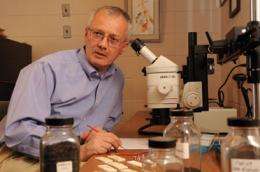
(PhysOrg.com) -- As the former director and chief executive of the Royal Botanic Gardens, Kew, in England, Sir Peter Crane often walked in the footsteps of Charles Darwin.
"Darwin probably visited the house we used to live in many times," said Crane, the John and Marion Sullivan University Professor in Geophysical Sciences at the University of Chicago. "The links between Darwin and Kew are very strong."
Darwin was the author of The Origin of Species, a classic of scientific literature. The scientific world will celebrate the 200th anniversary of Darwin's birth on Thursday, Feb. 12.
Kew's second director, Joseph Dalton Hooker, was a close friend and colleague of Darwin's, as attested by the more than 1,300 archived letters between them. "The relationship between those two men was close, and absolutely crucial for both of them," Crane said.
Hooker and Darwin shared many interests, including the distribution of plants around the world. Darwin initially gained fame for his scientific voyage around the world on the HMS Beagle. Hooker participated in a similar voyage, the Ross Expedition, which led to the discovery of Antarctica's Ross Ice Shelf. "Darwin was one of the advisers for that expedition," Crane said.
Similar plants, separate lands
The Ross Expedition made stops in southern South America, New Zealand and Tasmania, where Hooker became interested in the similarity of plants growing on these separate landmasses.
"When he came back, Darwin offered Hooker the material that he had collected while he was in places like Tierra del Fuego." Likewise, Hooker shared many specimens with Darwin, including many living plants from the Kew collections.
Darwin and Hooker also shared their ideas. For example, they both studied insectivorous plants. Hooker repeated some of Darwin's experiments on these bizarre plants and subsequently delivered an influential paper on the results. Darwin's book on the topic notes that there was no need to review all of the pertinent literature because Hooker had already done so.
Darwin and Hooker also supported one another in many different ways throughout their lives, Crane said. Darwin spent years working on The Origin of Species, but Alfred Russell Wallace unknowingly nearly pre-empted the whole enterprise with his own ideas about evolution. Wallace had independently developed a similar theory. Seeking feedback, he sent Darwin a pre-publication manuscript that described his own version of the theory.
Wallace's action put Darwin in a quandary, and he turned to Hooker for advice. Along with Charles Lyell, a leading geologist of the period, Hooker arranged for the joint reading of Darwin and Wallace's papers before the Linnean Society of London.
Buried at Westminster Abbey
After Darwin's death, Hooker was among those who successfully advocated for his burial at Westminster Abbey, a high honor.
Crane served as Kew's director from 1999 until 2006. Appearing in the 2007 NOVA documentary First Flower, he displayed a Kew flowering plant specimen that Darwin had collected during his voyage on the Beagle. The specimen was one of many from Darwin's botanical collections that are kept at Kew.
Crane was one of few people who focused on fossil flowers when he began his career as a paleontologist in the early 1980s. They were rarely preserved, or so went the conventional wisdom. But he and colleague Else Marie Friis learned to sniff them out.
"We turned up wonderfully rich and beautifully preserved flowers, which have illuminated the early history of flowers and flowering plants in ways that would've been previously unthinkable," Crane said.
In the early 1980s, Friis discovered an assemblage of 80-million-year-old fossil flowers in southern Sweden. Since then, Friis, Crane and others have turned up similar troves of fossil flowers all over the world, including Kazakhstan, Japan, central Europe and even Antarctica.
Fossil flower beds
Crane and Friis also have tracked down deposits of fossil flowers (angiosperms) in eastern North America and central Portugal. The rock samples they collected are about 120 million years old but not much more consolidated than modern-day mud.
"The material is significant in providing rich assemblages of small, three-dimensionally preserved flowers from the earliest phases of angiosperm diversification," said Friis, professor of paleobotany at the Swedish Museum of Natural History. "Currently these two areas are the only places that have yielded this kind of fossil from rocks this old."
The fossils enabled Crane and Friis, along with longtime collaborator Kaj Pedersen at the University of Aarhus in Denmark, to reconstruct the reproductive biology and evolutionary history of the earliest angiosperms.
When flowering plants first appeared approximately 120 million years ago, they were relatively rare and displayed limited diversity. "By the time you get to 80 million years, there's almost nothing but flowering plants, and there's a huge diversity," Crane said. "And that diversity has continued to build ever since."
Provided by University of Chicago


