Single gene lets bacteria jump from host to host
(PhysOrg.com) -- All life -- plants, animals, people -- depends on peaceful coexistence with a swarm of microbial life that performs vital services from helping to convert food to energy to protection from disease.
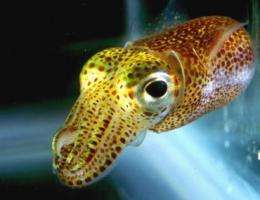
Now, with the help of a squid that uses a luminescent bacterium to create a predator-fooling light organ and a fish that uses a different strain of the same species of bacteria like a flashlight to illuminate the dark nooks of the reefs where it lives, scientists have found that gaining a single gene is enough for the microbe to switch host animals.
The finding, reported this week (Feb. 1) in the journal Nature by a team of scientists from the University of Wisconsin-Madison, is important not only because it peels back some of the mystery of how bacteria evolved to colonize different animals, but also because it reveals a genetic pressure point that could be manipulated to thwart the germs that make us sick.
"It seems that every animal we know about has microbes associated with it," says Mark J. Mandel, the lead author of the study and a postdoctoral fellow in the UW-Madison School of Medicine and Public Health. "We pick up our microbial partners from the environment and they provide us with a raft of services from helping digestion to protection from disease."
In the Pacific, a species of bacteria known as Vibrio fischeri lives in luminescent harmony with two distinct hosts: the diminutive nocturnal bobtail squid and the reef-dwelling pinecone fish. In the squid, which feeds at night near the ocean surface, one strain of the bacterium forms a light organ that mimics moonlight and acts like a cloaking device to shield the squid from hungry predators below. In the pinecone fish, another strain of the bacterium colonizes a light organ within the animal's jaw and helps illuminate the dark reefs in which it forages at night. The fish light organ may also play a role in attracting the zooplankton that make up the pinecone fish's menu.
But how did a single species of bacteria come to terms with such different hosts?
Working in the UW-Madison laboratory of microbiologist Ned Ruby, Mandel and his colleagues scoured the genomes of the two different strains of V. fischeri and found that most of the bacterium's genetic architecture was conserved over the course of millions of years of evolutionary history, but with a key difference: The strain that colonizes the squid has a regulatory gene that controls other genes that lay down a biofilm that allows the microbe to colonize the animal's light organ.
"During squid colonization, this regulatory gene turns on a suite of genes that allow bacteria to colonize the squid through mucus produced by the animal," Mandel explains. "The mucus is the pathway to the light organ, but it also helps keep out the bad guys."
Both strains of bacteria, Mandel explains, have the same genes that produce the biofilms the bacterium needs to get established in its host. But the regulatory gene that sets the other biofilm genes in motion is absent in the strain that lives in the pinecone fish, the animal scientists believe was first colonized by V. fischeri before it moved in to the squid light organ when the squid family came onto the scene in the Pacific Ocean at least 30 million years ago.
"The regulatory gene entered the bacterium's lineage and allowed it to expand its host range into the squid," according to Mandel. "The bottom-line message of the paper is that bacteria can shift host range by modifying their capabilities with small regulatory changes."
The regulatory gene acquired by the bacterium, notes Ruby, is essentially a switch the organism uses to activate a set of genes that had been residing quietly in the V. fischeri genome. Such mechanisms, he says, are very likely at play in many other species of bacteria, including those that infect humans and cause illness.
"This is going to inform a question that has been around a long time in the area of pathogenesis," says Ruby. One line of thought is that "in order to become a pathogen, a whole suite of genes needs to be imported to a bacterium."
The new finding by his group, however, suggests that nature is far more parsimonious: Instead of requiring organisms to acquire many new genes to occupy a new host, the combination of a new regulatory gene and genes that already reside in a bacterium is enough to do the trick.
"Together, they can do something neither of them could do before. They can mix and match and open up new niches," says Ruby.
Knowing that a regulatory gene plays a key role in allowing an organism to fit a new host may prove useful in human medicine as many bacterial pathogens arose first in other animals before infecting humans. A single gene can be a much easier target for a drug or other intervention to prevent or mitigate infection, the Wisconsin scientists say.
Provided by University of Wisconsin-Madison


